
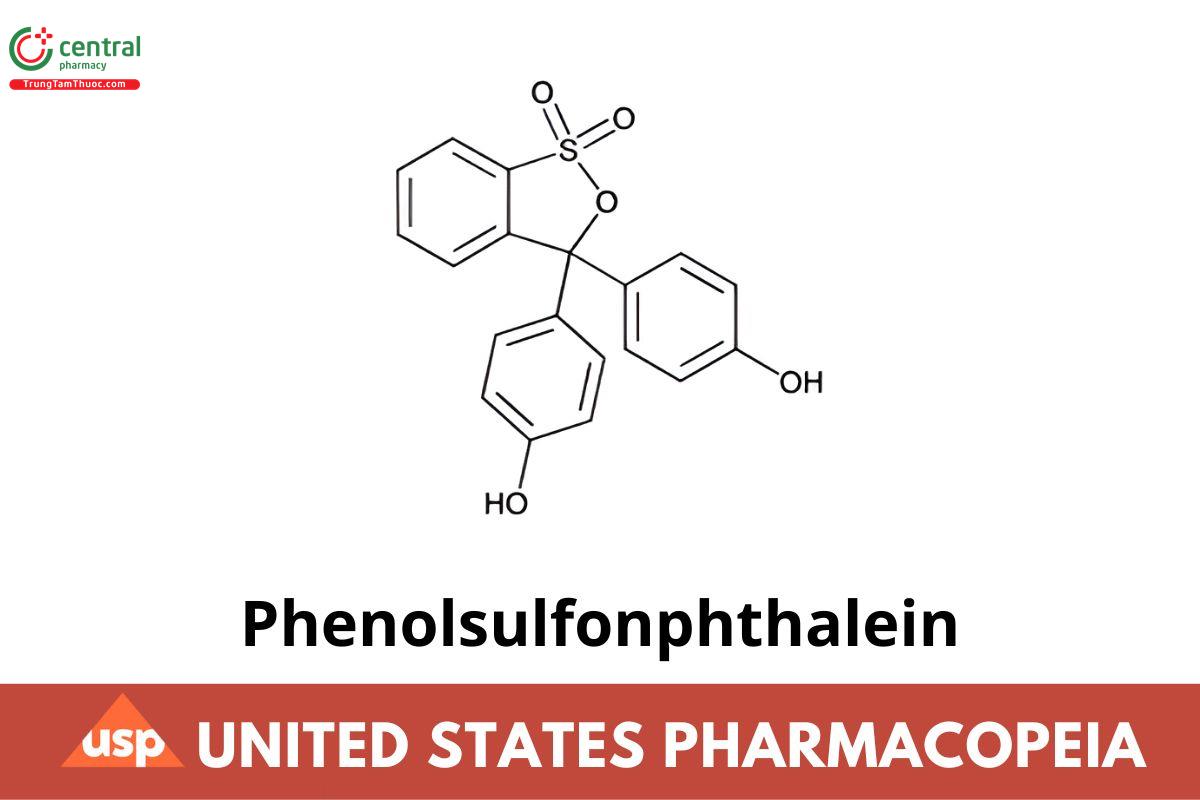
Phenolsulfonphthalein
If you find any inaccurate information, please let us know by providing your feedback here

Tóm tắt nội dung
This article is compiled based on the United States Pharmacopeia (USP) – 2025 Edition
Issued and maintained by the United States Pharmacopeial Convention (USP)
C19H14O5S 354.38
Phenol red;
Phenol, 4,4′-(3H-2,1-benzoxathiol-3-ylidene)bis-,(S,S-dioxide);
3,3-Bis(4-hydroxyphenyl)-3H-2,1-benzoxathiole 1,1-dioxide CAS RN®: 143-74-8.
1 DEFINITION
Phenolsulfonphthalein contains NLT 98.0% and NMT 102.0% of 4,4′-(3H-2,1-benzoxathiol-3-ylidene)bis-,(S,S-dioxide) phenol (C19H14O5S), calculated on the dried basis.
2 IDENTIFICATION
A.
Sample: 5 mg of Phenolsulfonphthalein
Analysis: Transfer the Sample to a 100-mL volumetric flask, dissolve in and dilute with sodium carbonate solution (1 in 100) to volume, and mix. Dilute 5.0 mL of the solution so obtained to 100.0 mL with sodium carbonate solution (1 in 100). Examine between 400 and 630 nm.
Acceptance criteria: The solution exhibits an absorption maximum at 558 nm, and the specific absorbance at the maximum is between 1900 and 2100.
B.
Sample: 10 mg of Phenolsulfonphthalein
Analysis: Dissolve the Sample in 2 mL of 1 N sodium hydroxide, and add 8 mL of water. To 5 mL of the solution so obtained add 1 mL of 0.1 N potassium bromide–bromate and 1 mL of diluted hydrochloric acid, shake, and allow to stand for 15 min. Render the solution alkaline with 1 N sodium hydroxide.
Acceptance criteria: An intense violet-blue color is produced.
3 ASSAY
Procedure
Sample: 0.9 g
Titrimetric system
(See Titrimetry 〈541〉.)
Mode: Residual titration
Titrant: 0.1 N sodium thiosulfate VS
Endpoint detection: Visual
Analysis: Transfer the Sample to a 250-mL volumetric flask, dissolve in 15 mL of 1 N sodium hydroxide, dilute with water to volume, and mix.
Transfer 10.0 mL of the solution so obtained to a glass-stoppered flask. Add 25 mL of glacial acetic acid, 20.0 mL of 0.1 N potassium bromate VS, 5 mL of potassium bromide solution (1 in 10), and 5 mL of hydrochloric acid, and immediately insert the stopper into the flask.
Allow to stand protected from light for 15 min. Quickly add 10 mL of potassium iodide solution (1 in 10), taking care to avoid the escape of bromine vapor. Immediately insert the stopper into the flask, and shake vigorously. Rinse the stopper and the neck of the flask with a small quantity of water. Titrate the liberated iodine with 0.1 N sodium thiosulfate VS, using starch TS as the indicator. Perform a blank determination, and note the difference in volumes required. Each mL of the difference in volumes of 0.1 N sodium thiosulfate is equivalent to 4.43 mg of phenolsulfonphthalein (C19H14O5S).
Acceptance criteria: 98.0%–102.0% on the dried basis
4 IMPURITIES
4.1 Residue on Ignition 〈281〉
Sample: 0.5 g
Acceptance criteria: NMT 0.2%
4.2 Chromatographic Purity
Sample solution A: 20 mg/mL of Phenolsulfonphthalein in 0.1 N sodium hydroxide
Sample solution B: Transfer 0.5 mL of Sample solution A to a 100-mL volumetric flask, dilute with 0.1 N sodium hydroxide to volume, and mix.
Chromatographic system
(See Chromatography 〈621〉, Thin-Layer Chromatography.)
Mode: TLC
Adsorbent: 0.25-mm layer of chromatographic silica gel mixture
Application volume: 10 μL
Developing solvent system: tert-Amyl alcohol, glacial acetic acid, and water (4:1:1)
Analysis
Samples: Sample solution A and Sample solution B
Allow the plate to air-dry until the solvent has evaporated, and expose the plate to ammonia vapor. Examine the plate under short-wavelength UV light.
Acceptance criteria: NMT 0.5%; NMT one spot, apart from the principal spot, appears in the chromatogram from Sample solution A. This spot is not more intense than the spot in the chromatogram from Sample solution B.
4.3 Insoluble Substances
Sample: 1 g of finely powdered Phenolsulfonphthalein
Analysis: To the Sample add a solution of 0.5 g of sodium bicarbonate in 12 mL of water. Allow to stand for 1 h, shaking frequently. Dilute with sufficient water to make 100 mL, and allow to stand for 15 h. Centrifuge at 2000–3000 g for 30 min, and decant the supernatant. Wash the residue first with 25 mL of sodium bicarbonate solution (1 in 100), then with 25 mL of water, and dry at 105°.
Acceptance criteria: The weight of the insoluble residue does not exceed 0.5% of the weight of the Phenolsulfonphthalein taken.
5 SPECIFIC TESTS
Visual Transition Interval
Potassium chloride solution: Dissolve 1.0 g of potassium chloride in 100 mL of water, and adjust with 0.01 N hydrochloric acid or sodium hydroxide to a pH of 6.8.
Sample solution: Dissolve 0.1 g of Phenolsulfonphthalein in 100 mL of alcohol.
Analysis 1: Add 0.15 mL of the Sample solution to the Potassium chloride solution.
Acceptance criteria 1: The color is yellow with NMT a faint trace of green color.
Analysis 2: Titrate the solution from Analysis 1 with 0.01 N sodium hydroxide to a pH of 7.0.
Acceptance criteria 2: The color of the solution becomes orange.
Analysis 3: Continue the titration of the solution from Analysis 2 with 0.01 N sodium hydroxide to a pH of 8.2.
Acceptance criteria 3: The color of the solution becomes red. NMT 0.20 mL of 0.01 N sodium hydroxide is consumed in the entire titration.
Microbial Enumeration Tests 〈61〉andTests for Specified Microorganisms 〈62〉: The total aerobic microbial count does not exceed 103cfu/g, and the total combined molds and yeasts count does not exceed 102 cfu/g.
Loss on Drying 〈731〉
Sample: 1 g of powdered Phenolsulfonphthalein
Analysis: Dry the Sample at 105° to constant weight.
Acceptance criteria: NMT 1.0%
6 ADDITIONAL REQUIREMENTS
Packaging and Storage: Preserve in well-closed containers. No storage requirements specified.

