
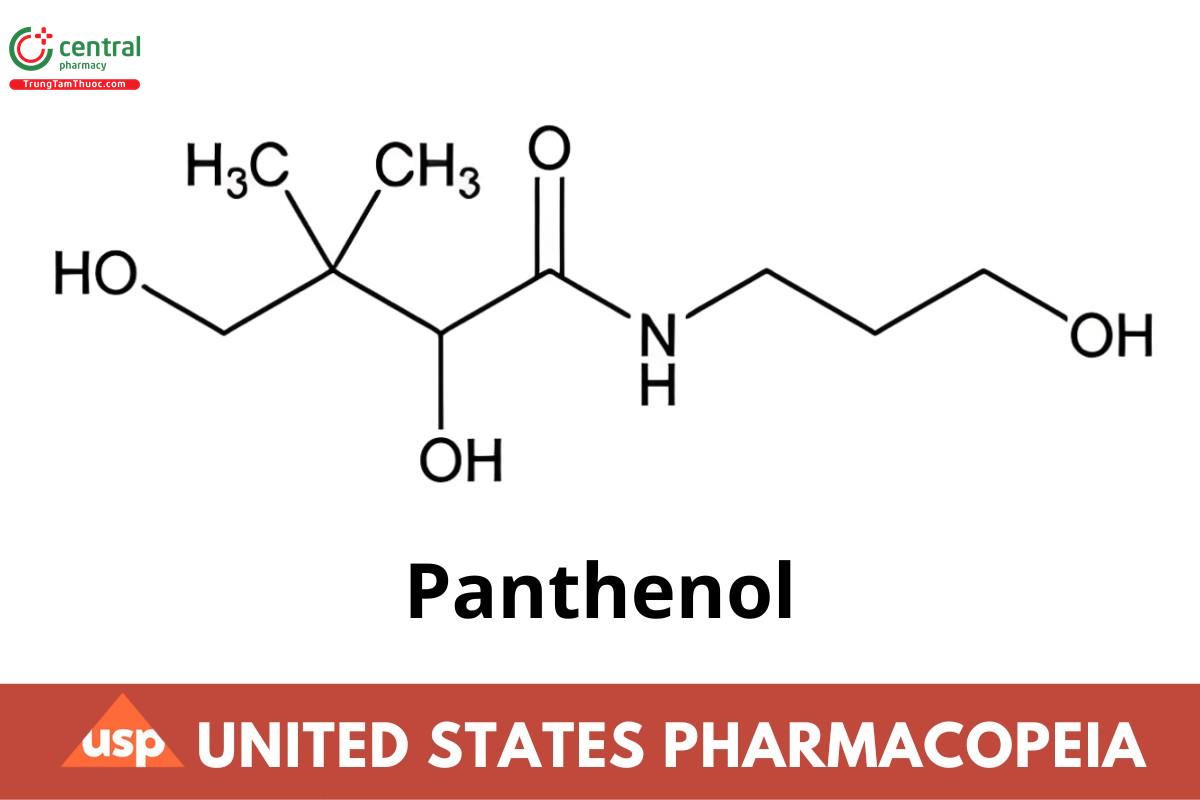
Panthenol
If you find any inaccurate information, please let us know by providing your feedback here

Tóm tắt nội dung
This article is compiled based on the United States Pharmacopeia (USP) – 2025 Edition
Issued and maintained by the United States Pharmacopeial Convention (USP)
C9H19NO4 205.25
Butanamide, 2,4-dihydroxy-N-(3-hydroxypropyl)-3,3-dimethyl-, (±)-;
(±)-2,4-Dihydroxy-N-(3-hydroxypropyl)-3,3-dimethylbutyramide;
(±)-Pantothenyl alcohol CAS RN®: 16485-10-2; UNII: WV9CM0O67Z.
1 DEFINITION
Panthenol is a racemic mixture of the dextrorotatory and levorotatory isomers of panthenol. It contains NLT 99.0% and NMT 102.0% of racemic panthenol (C9H19NO4), calculated on the dried basis.
2 IDENTIFICATION
Change to read:
A. SPECTROSCOPIC IDENTIFICATION TESTS (197), Infrared Spectroscopy: 197M (CN 1-MAY-2020)
B.
Sample solution: 100 mg/mL of Panthenol
Analysis: To 1 mL of the Sample solution add 5 mL of 1 N sodium hydroxide and 1 drop of cupric sulfate TS, and shake vigorously.
Acceptance criteria: A deep blue color develops.
C.
Sample solution: 10 mg/mL of Panthenol
Analysis: To 1 mL of the Sample solution add 1 mL of 1 N hydrochloric acid, and heat on a steam bath for 30 min. Cool, add 100 mg of hydroxylamine hydrochloride, and add 5 mL of 1 N sodium hydroxide. Allow to stand for 5 min, then adjust with 1 N hydrochloric acid to a pH of 2.5-3.0, and add 1 drop of ferric chloride TS.
Acceptance criteria: A purplish red color develops.
3 ASSAY
3.1 PROCEDURE
0.1 M potassium biphthalate: Transfer 20.42 g of potassium biphthalate into a 1000-mL volumetric flask, and add sufficient glacial acetic acid to dissolve. If necessary, warm the mixture on a steam bath to achieve complete solution, observing precautions against absorption of moisture. Cool to room temperature, and dilute with glacial acetic acid to volume.
Sample: 400 mg of Panthenol
Blank: Proceed as directed in the Analysis, omitting the Sample.
Titrimetric system
(See Titrimetry (541).)
Mode: Residual titration
Titrant: 0.1 N perchloric acid VS
Back-titrant: 0.1 M potassium biphthalate
Endpoint detection: Visual
Analysis: Transfer the Sample to a 300-mL flask fitted to a reflux condenser by means of a standard-taper glass joint, add 50.0 mL of Titrant, and reflux for 5 h. Cool, observing precautions to prevent atmospheric moisture from entering the condenser, and rinse the condenser with glacial acetic acid, collecting the rinsings in the flask. To the flask add 5 drops of crystal violet TS, and titrate with the Back-titrant to a blue-green endpoint. Perform the Blank determination.
Calculate the percentage of panthenol (C9H19NO4) in the Sample taken:
Result = {[(VB - VS) x M x F]/W} x 100
VB = Back-titrant volume consumed by the Blank (mL)
VS = Back-titrant volume consumed by the Sample (mL)
M = actual molarity of the Back-titrant (mM/mL)
F = equivalency factor, 205.3 mg/M
W = Sample weight (mg)
Acceptance criteria: 99.0%-102.0% on the dried basis
4 IMPURITIES
4.1 RESIDUE ON IGNITION (281)
NMT 0.1%
4.2 LIMIT OF AMINOPROPANOL
Sample: 10 g of Panthenol
Blank: 25 mL of water
Titrimetric system
(See Titrimetry (541).)
Mode: Direct titration
Titrant: 0.01 N sulfuric acid VS
Endpoint detection: Visual
Analysis: Dissolve the Sample in 25 mL of water, and add bromothymol blue TS. Titrate with the Titrant to a yellow endpoint. Perform the Blank determination.
Calculate the percentage of aminopropanol in the Sample taken:
Result = {[(VS - VB) x N x F]/W} x 100
VS = Titrant volume consumed by the Sample (mL)
VB = Titrant volume consumed by the Blank (mL)
N = actual normality of the Titrant (mEq/mL)
F = equivalency factor, 75.11 mg/mEq
W = Sample weight (mg)
Acceptance criteria: NMT 0.10%
5 SPECIFIC TESTS
5.1 MELTING RANGE, Class (741)
64.5°-68.5°
5.2 OPTICAL ROTATION, Specific Rotation (781S)
Sample solution: 50 mg/mL in water
Acceptance criteria: -0.05° to +0.05°
5.3 LOSS ON DRYING (731)
Dry a sample in a vacuum over phosphorus pentoxide at 56° for 4 h: it loses NMT 0.5% of its weight.
6 ADDITIONAL REQUIREMENTS
6.1 PACKAGING AND STORAGE
Preserve in tight containers.
6.2 USP REFERENCE STANDARDS (11)
USP Racemic Panthenol RS

