
Oxfendazole
If you find any inaccurate information, please let us know by providing your feedback here

Tóm tắt nội dung
This article is compiled based on the United States Pharmacopeia (USP) – 2025 Edition
Issued and maintained by the United States Pharmacopeial Convention (USP)
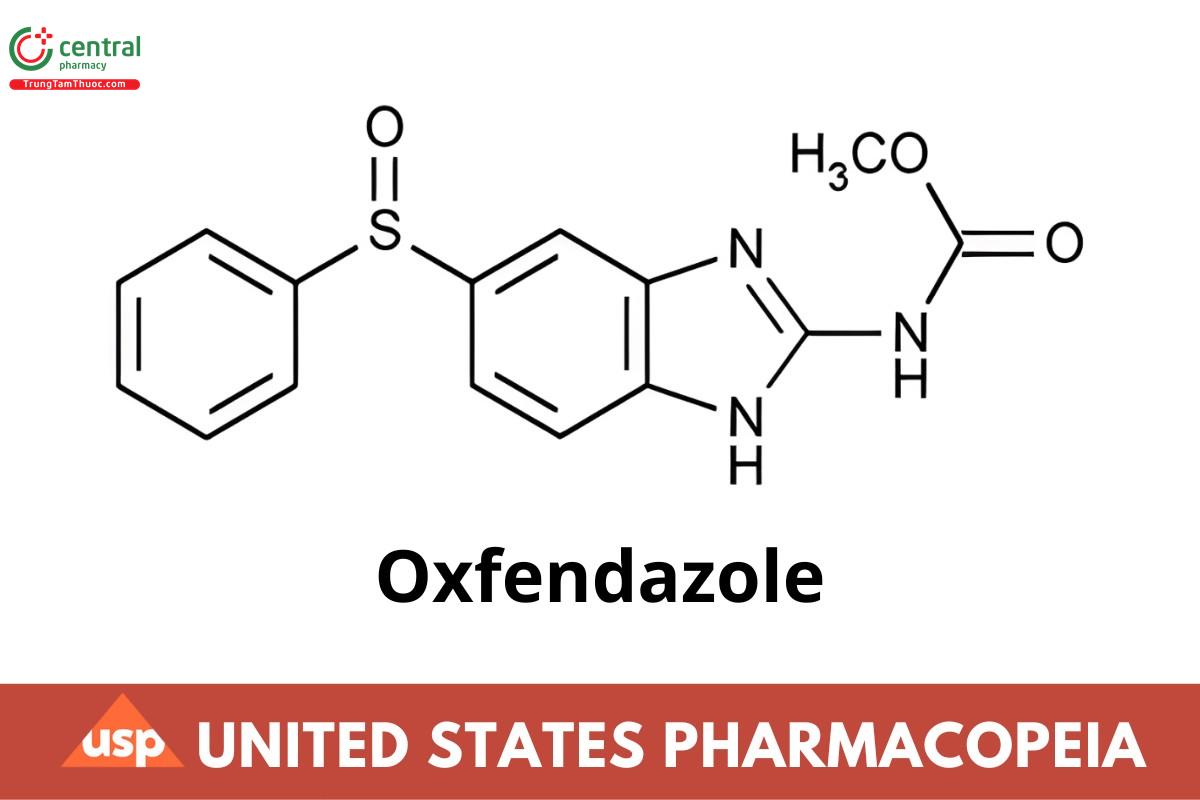
C15H13N3O3S 315.35
Carbamic acid, 5-(phenylsulfinyl)-1H-benzimidazol-2-yl-, methyl ester.
Methyl 5-(phenylsulfinyl)-2-benzimidazolecarbamate CAS RN®: 53716-50-0; UNII: OMP2H17F9E.
>> Oxfendazole contains not less than 98.0 percent and not more than 100.5 percent of C15H13N3O3S, calculated on the dried basis.
1 Packaging and storage
Preserve in well-closed, light-resistant containers.
2 Labeling
Label it to indicate that it is for veterinary use only.
3 USP REFERENCE STANDARDS (11)
USP Fenbendazole RS
USP Oxfendazole RS
4 Identification
Change to read:
A:Spectroscopic Identification Tests (197), Infrared Spectroscopy: 197K (CN 1-May-2020).
B: The appearance of the principal spot in the chromatogram of the Test solution corresponds to that in the chromatogram of Standard solution 1, as obtained in the test for Related compounds.
4.1 LOSS ON DRYING (731)
Dry it in vacuum at a pressure not exceeding 5 mm of mercury at 105° for 2 hours: it loses not more than 1.0% of its weight.
4.2 RESIDUE ON IGNITION (281)
Not more than 0.1%.
5 Related compounds
5.1 Diluent
Prepare a mixture of ethyl acetate and glacial acetic acid (4:1).
5.2 Standard solution 1
Dissolve a quantity of USP Oxfendazole RS in Diluent to obtain a solution having a concentration of 0.1 mg per mL.
5.3 Standard solution 2
Dissolve a quantity of USP Fenbendazole RS in Diluent to obtain a solution having a concentration of 0.05 mg per mL.
5.4 Standard solution 3
Prepare a mixture of Standard solution 1 and Standard solution 2 (1:2).
5.5 Test solution
Dissolve 25 mg of Oxfendazole in Diluent, dilute with Diluent to 5 mL, and mix.
5.6 Procedure
Separately apply 20 µL portions of Standard solution 1, Standard solution 2, Standard solution 3, and the Test solution to a thin-layer chromatographic plate (see Chromatography (621)) coated with a 0.25-mm layer of chromatographic silica gel mixture. Develop the chromatograms in a solvent system consisting of a mixture of ethyl acetate and glacial acetic acid (95:5) until the solvent front has moved about three-fourths of the length of the plate. Remove the plate from the chromatographic chamber, and allow to air-dry. Examine the plate under short-wavelength UV light: the chromatogram obtained from Standard solution 3 shows two clearly separated principal spots. In the chromatogram obtained from the Test solution, no spot corresponding to fenbendazole is more intense than the spot in the chromatogram obtained from Standard solution 2 (1%), and no spot other than the principal spot and no spot corresponding to fenbendazole is more intense than the spot in the chromatogram obtained from Standard solution 1 (2%).
6 Assay
Dissolve about 300 mg of Oxfendazole, accurately weighed, in 3 mL of anhydrous formic acid. Add 40 mL of acetic anhydride, and titrate with 0.1 N perchloric acid VS, determining the endpoint potentiometrically. Each mL of 0.1 N perchloric acid is equivalent to 31.54 mg of C15H13N3O3S.

