
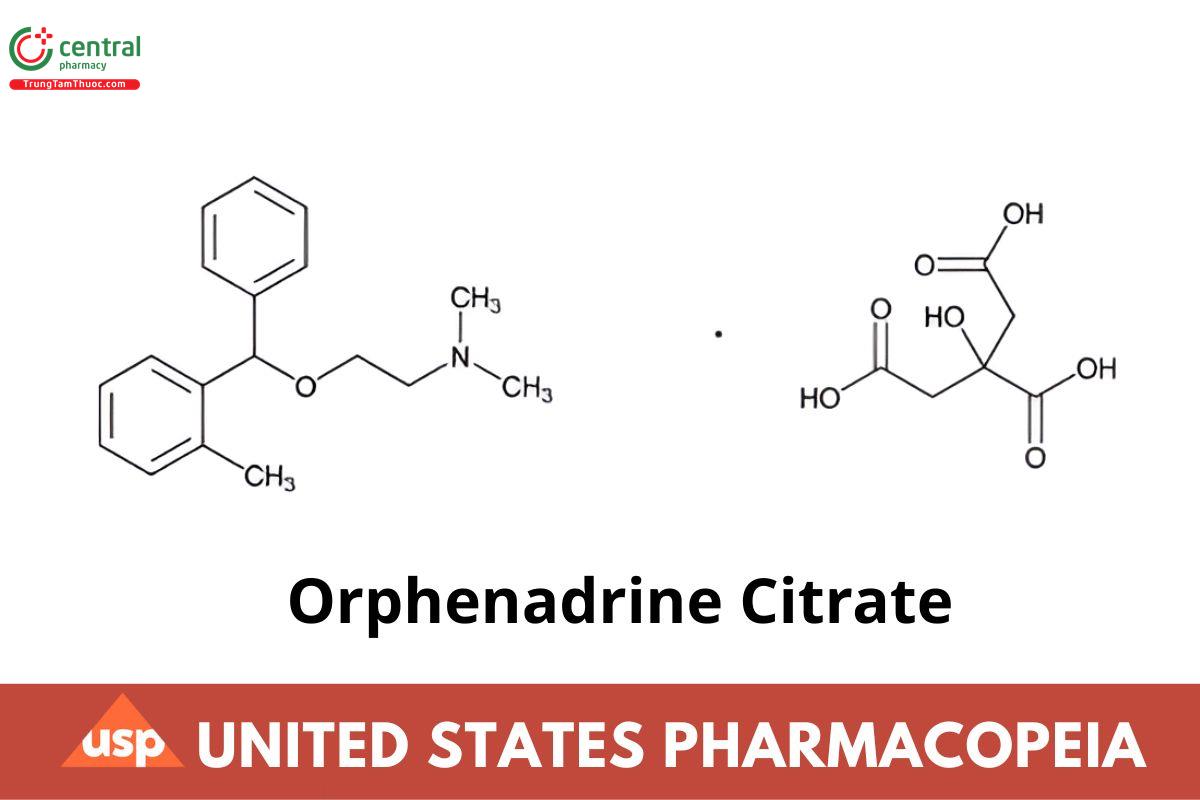
Orphenadrine Citrate
If you find any inaccurate information, please let us know by providing your feedback here

Tóm tắt nội dung
This article is compiled based on the United States Pharmacopeia (USP) – 2025 Edition
Issued and maintained by the United States Pharmacopeial Convention (USP)
C18H23NO · C6H8O7 461.50
Ethanamine, N,N-dimethyl-2-[(2-methylphenyl)phenylmethoxy]-, (±)-, 2-hydroxy-1,2,3-propanetricarboxylate (1:1);
(±)-N,N-Dimethyl-2-[(o-methyl-α-phenylbenzyl)oxy]ethylamine citrate (1:1) CAS RN
®: 4682-36-4; UNII: X0A40N8I4S.
1 DEFINITION
Orphenadrine Citrate contains NLT 98.0% and NMT 101.5% of orphenadrine citrate (C18H23NO · C6H8O7), calculated on the dried basis.
2 IDENTIFICATION
Change to read:
A. Spectroscopic Identification Tests 〈197〉, Infrared Spectroscopy: 197M (CN 1-May-2020)
B. The retention time of the major peak of the Sample solution corresponds to that of the Standard solution, as obtained in the Assay.
C. Identification Tests - General, Citrate〈191〉: Meets the requirements
3 ASSAY
3.1 Procedure
Buffer: 5.8 g/L of monobasic ammonium phosphate in water. Adjust with ammonium hydroxide or phosphoric acid to a pH of 7.9.
Mobile phase: Methanol, acetonitrile, and Buffer (45:15:40)
System suitability solution: 0.01 mg/mL each of USP Orphenadrine Related Compound B RS, USP Orphenadrine Related Compound C RS, and USP Methylbenzhydrol RS and 1.0 mg/mL of USP Orphenadrine Citrate RS in Mobile phase
Standard solution: 1.0 mg/mL of USP Orphenadrine Citrate RS in Mobile phase
Sample solution: 1.0 mg/mL of Orphenadrine Citrate in Mobile phase
3.2 Chromatographic system
(See Chromatography 〈621〉, System Suitability.)
Mode: LC
Detector: UV 220 nm
Column: 4.6-mm × 15-cm; 5-μm packing L1
Column temperature: 40°
Flow rate: 1.5 mL/min
Injection volume: 20 μL
Run time: NLT 2.5 times the retention time of orphenadrine
3.3 System suitability
Samples: System suitability solution and Standard solution
[Note - See Table 1 for the relative retention times.]
3.4 Suitability requirements
Resolution: NLT 3.0 between orphenadrine related compound B and C; NLT 3.0 between orphenadrine related compound C and methylbenzhydrol, System suitability solution
Tailing factor: NMT 2.0, Standard solution
Relative standard deviation: NMT 0.73%, Standard solution
3.5 Analysis
Samples: Standard solution and Sample solution
Calculate the percentage of orphenadrine citrate (C18H23NO · C6H8O7) in the portion of Orphenadrine Citrate taken:
Result = (rU/rS) × (CS/CU) × 100
rU = peak response from the Sample solution
rS = peak response from the Standard solution
CS = concentration of USP Orphenadrine Citrate RS in the Standard solution (mg/mL)
CU = concentration of Orphenadrine Citrate in the Sample solution (mg/mL)
Acceptance criteria: 98.0%–101.5% on the dried basis
4 IMPURITIES
Residue on Ignition 〈281〉: NMT 0.1%
4.1 Organic Impurities, Procedure 1
[Note - If methyl orphenadrine is a known manufacturing impurity, Procedure 1 and the test for Isomer Content are recommended. If diphenhydramine and didesmethyl orphenadrine are known manufacturing process impurities, Procedure 2 is recommended.]
Buffer, Mobile phase, System suitability solution, and Chromatographic system: Proceed as directed in the Assay.
Standard solution: 0.001 mg/mL of USP Orphenadrine Citrate RS in Mobile phase
Sensitivity solution: 0.5 μg/mL of USP Orphenadrine Citrate RS, from the Standard solution, in Mobile phase
Sample solution: 1 mg/mL of Orphenadrine Citrate in Mobile phase
System suitability
Samples: System suitability solution, Standard solution, and Sensitivity solution
[Note - See Table 1 for the relative retention times.]
Suitability requirements
Resolution: NLT 3.0 between orphenadrine related compound B and C; NLT 3.0 between orphenadrine related compound C and 2- methylbenzhydrol, System suitability solution
Tailing factor: NMT 2, Standard solution
Relative standard deviation: NMT 5.0%, Standard solution
Signal-to-noise ratio: NLT 10, Sensitivity solution
Analysis
Samples: Standard solution and Sample solution
Calculate the percentage of each impurity in the portion of Orphenadrine Citrate taken:
Result = (rU/rS) × (CS/CU) × (1/F) × 100
rU = peak area of each impurity from the Sample solution
rS = peak area of Orphenadrine Citrate from the Standard solution
CS = concentration of USP Orphenadrine Citrate RS in the Standard solution (mg/mL)
CU = concentration of the Sample solution (mg/mL)
F = relative response factor (see Table 1)
Acceptance criteria: See Table 1. Disregard any peak less than 0.05%.
Table 1
| Name | Relative Retention Time | Relative Response Factor | Acceptance Criteria, NMT (%) |
|---|---|---|---|
| Citric acidᵃ | 0.14 | – | – |
| Orphenadrine related compound B | 0.25 | 1.3 | 0.1 |
| Orphenadrine related compound C | 0.39 | 1.0 | 0.3 |
| Methylbenzhydrol | 0.51 | 2.4 | 0.1 |
| Diphenhydramine | 0.69 | 1.0 | 0.3 |
| Orphenadrine | 1.0 | – | – |
| Methyl orphenadrineᵇ | 1.54 | 1.9 | 0.1 |
| Any individual unspecified impurity | – | 1.0 | 0.10 |
| Total impuritiesᶜ | – | – | 0.5 |
a Counter ion peak; not to be reported; not to be included in total impurities.
b 2-(Di-o-tolylmethoxy)-N,N-dimethylethan-1-amine.
c Excluding orphenadrine related compound E and orphenadrine related compound F from the Isomer Content test.
4.2 Organic Impurities, Procedure 2
[Note - If didesmethyl orphenadrine is a known manufacturing process impurity, Procedure 2 is recommended. The labeling indicates that the article complies with Organic Impurities, Procedure 2.]
System suitability solution: 0.3 mg/mL each of USP Orphenadrine Citrate RS, USP Diphenhydramine Citrate RS, USP Methylbenzhydrol RS, USP Orphenadrine Related Compound E RS, and USP Orphenadrine Related Compound F RS in toluene prepared as follows. Dissolve 6 mg each of the USP Reference Standards in 10 mL of water. Add 0.2 mL of ammonium hydroxide and shake with 3 mL of toluene. Separate the organic layer. Repeat the extraction of the aqueous layer two more times with 3 mL of toluene. To the combined organic layer add anhydrous sodium sulfate, shake, and filter. Evaporate the filtrate at NMT 50° using a rotary evaporator. Dissolve the residue in 20 mL of toluene.
Sample solution: 25 mg/mL of Orphenadrine Citrate in toluene prepared as follows. Dissolve 500 mg of Orphenadrine Citrate in 50 mL of water. Add 2 mL of ammonium hydroxide and shake with 10 mL of toluene. Separate the organic layer. Repeat the extraction of the aqueous layer two more times with 10 mL of toluene. To the combined organic layers add anhydrous sodium sulfate, shake, and filter.
Evaporate the filtrate at NMT 50° using a rotary evaporator. Dissolve the residue in 20 mL of toluene.
Chromatographic system
(See Chromatography 〈621〉, System Suitability.)
Mode: GC
Detector: Flame ionization
Column: 0.32-mm × 60-m; 1-μm thick coating of phenyl methylpolysiloxane, phase G27
Carrier gas: Helium at 1 mL/min
Temperatures
Injection port: 290°
Detector: 290°
Column: 240°
Injection volume: 2 μL
Injection type: Split ratio, 1:25
Run time: 1.3 times the retention time of orphenadrine
System suitability
Sample: System suitability solution
[Note - Relative retention times for the peaks are given in Table 2.]
Suitability requirements
Resolution: NLT 1.5 between orphenadrine related compound E and orphenadrine; NLT 2.0 between orphenadrine and orphenadrine related compound F
Analysis
Sample: Sample solution
Calculate the sum of the percentage of any individual impurity in the portion of Orphenadrine Citrate taken:
Result = (rU/rT) × 100
rU = peak response of the impurity from the Sample solution
rT = sum of all peak responses from the Sample solution
Acceptance criteria: See Table 2. Disregard any peak less than 0.05%.
Table 2
| Name | Relative Retention Time | Acceptance Criteria, NMT (%, w/w) |
|---|---|---|
| Methylbenzophenoneᵃ | 0.5 | 0.3 |
| Methylbenzhydrol | 0.6 | 0.3 |
| Diphenhydramine | 0.8 | 0.3 |
| Didesmethyl orphenadrineᵇ | 0.9 | 0.3 |
| Orphenadrine related compound E | 0.98 | 0.3 |
| Orphenadrine | 1.0 | – |
| Orphenadrine related compound F | 1.1 | 0.3 |
| Any individual unspecified impurity | – | 0.10 |
| Total impurities | – | 1.0 |
a Phenyl(o-tolyl)methanone.
b 2-[Phenyl(o-tolyl)methoxy]ethanamine.
4.3 Isomer Content
If methyl orphenadrine is a known manufacturing impurity, the test for Isomer Content is to be performed.
System suitability solution: 0.3 mg/mL each of USP Orphenadrine Citrate RS, USP Orphenadrine Related Compound E RS, and USP Orphenadrine Related Compound F RS in toluene prepared as follows. Dissolve 6 mg each of the USP Reference Standards in 10 mL of water. Add 0.2 mL of ammonium hydroxide and shake with 3 mL of toluene. Separate the organic layer. Repeat the extraction of the aqueous layer two more times with 3 mL of toluene. To the combined organic layer add anhydrous sodium sulfate, shake, and filter.
Evaporate the filtrate at NMT 50° using a rotary evaporator. Dissolve the residue in 20 mL of toluene.
Sample solution and Chromatographic system: Proceed as directed in Organic Impurities, Procedure 2.
System suitability
Sample: System suitability solution
[Note - The relative retention times of orphenadrine related compound E, orphenadrine, and orphenadrine related compound F are about 0.98, 1.0, and 1.1, respectively.]
Suitability requirements
Resolution: NLT 1.5 between orphenadrine related compound E and orphenadrine; NLT 2.0 between orphenadrine and orphenadrine related compound F
Analysis
Sample: Sample solution
Calculate the percentage of orphenadrine related compound E and orphenadrine related compound F in the portion of Orphenadrine Citrate taken:
Result = (rU/rT) × 100
rU = peak response of orphenadrine related compound E or orphenadrine related compound F from the Sample solution
rT = sum of all peak responses from the Sample solution
Acceptance criteria: NMT 0.3% each of orphenadrine related compound E and orphenadrine related compound F
5 SPECIFIC TESTS
Loss on Drying 〈731〉
Analysis: Dry at 105° for 3 h.
Acceptance criteria: NMT 0.5%
6 ADDITIONAL REQUIREMENTS
Packaging and Storage: Preserve in tight, light-resistant containers.
Labeling: The label states with which Organic Impurities procedure the article complies if Organic Impurities, Procedure 1, is not used.
USP Reference Standards 〈11〉
USP Diphenhydramine Citrate RS
USP Methylbenzhydrol RS
2-Methylbenzhydrol;
Also known as Phenyl(o-tolyl)methanol.
C14H14O 198.26
USP Orphenadrine Citrate RS
USP Orphenadrine Related Compound B RS
N-Ethyl-N,N-dimethyl-2-[phenyl(o-tolyl)methoxy]ethanaminium chloride.
C20H28ClNO 333.90
USP Orphenadrine Related Compound C RS
N-Methyl-2-[phenyl(o-tolyl)methoxy]ethanamine hydrochloride.
C17H21NO · HCl 291.82
USP Orphenadrine Related Compound E RS
N,N-Dimethyl-2-[phenyl(m-tolyl)methoxy]ethanamine.
C18H23NO 269.38
USP Orphenadrine Related Compound F RS
N,N-Dimethyl-2-[phenyl(p-tolyl)methoxy]ethanamine.
C18H23NO 269.38

