
Octoxynol 9
If you find any inaccurate information, please let us know by providing your feedback here

Tóm tắt nội dung
This article is compiled based on the United States Pharmacopeia (USP) – 2025 Edition
Issued and maintained by the United States Pharmacopeial Convention (USP)
Poly(oxy-1,2-ethanediyl), α-[4-(1,1,3,3-tetramethylbutyl)phenyl]-ω-hydroxy-;
α-[4-(1,1,3,3,-Tetramethylbutyl)phenyl]-ω-hydroxypoly(oxy-1,2-ethanediyl);
Polyethylene glycol mono[p-(1,1,3,3-tetramethylbutyl)phenyl] ether;
Polyethylene glycol mono(4-tert-octylphenyl) ether
CAS RN®: 9002-93-1.
1 DEFINITION
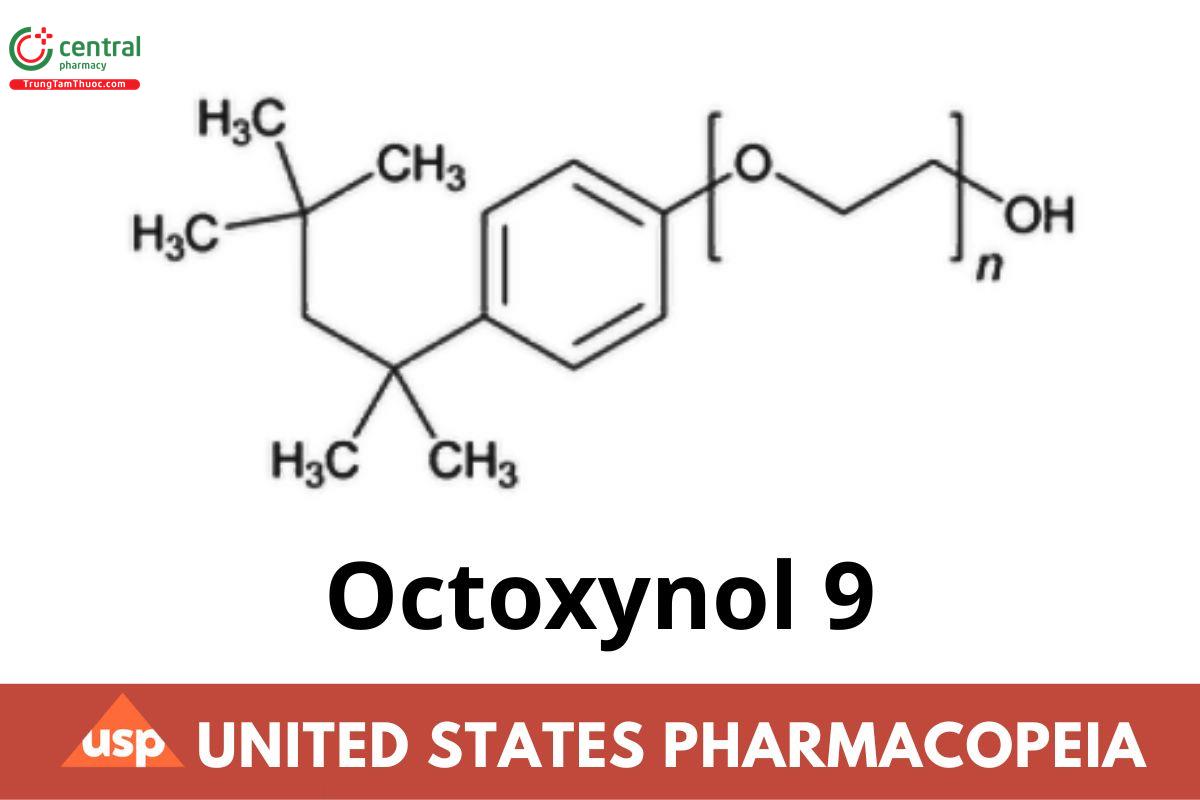
Octoxynol 9 is an anhydrous liquid mixture consisting chiefly of mono[p-(1,1,3,3-tetramethylbutyl)] phenyl ethers of polyethylene glycols, corresponding to:
(CH3)3C(CH2)C(CH3)2C6H4(OCH2CH2)nOH
in which the average value of n is about 9. It contains NLT 90.0% and NMT 110.0% of Octoxynol 9.
2 IDENTIFICATION
Change to read:
A. Spectroscopic Identification Tests 〈197〉, Infrared Spectroscopy: 197F (CN 1-May-2020) On undried specimen
B. The retention time of the major peak of the Sample solution corresponds to that of the Standard solution, as obtained in the Assay.
3 ASSAY
Procedure
Mobile phase: Methanol:water (4:1)
Standard solution: 25 mg/mL of USP Octoxynol 9 RS in Mobile phase
System suitability solution: 25 mg/mL of USP Octoxynol 9 RS and 25 mg/mL of USP Nonoxynol 9 RS in Mobile phase Sample solution: 25 mg/mL of Octoxynol 9 in Mobile phase
3.1 Chromatographic system
(See Chromatography 〈621〉, System Suitability.)
Mode: LC
Detector: UV 280 nm
Column: 4.6-mm × 25-cm, 5-µm packing L1
Column temperature: Ambient
Flow rate: 1.0 mL/min
Injection size: 10 µL
3.2 System suitability
Samples: System suitability solution and Standard solution
[Note—The relative retention times for octoxynol 9 and nonoxynol 9 are 1.0 and 1.4, respectively.]
Suitability requirements
Resolution: NLT 2.0 between octoxynol 9 and nonoxynol 9, System suitability solution
Relative standard deviation: NMT 2.0%, Standard solution
3.3 Analysis
Samples: Standard solution and Sample solution
Record the chromatograms, and measure the responses for octoxynol 9, including any shoulders and bumps.
Calculate the percentage of octoxynol 9 in the portion of test specimen taken:
Result = (rU /rS ) × (CS /CU ) × 100
rU = peak response of octoxynol 9 from the Sample solution
rS = peak response of octoxynol 9 from the Standard solution
CS = concentration of USP Octoxynol 9 RS in the Standard solution (mg/mL)
CU = concentration of Octoxynol 9 in the Sample solution (mg/mL)
Acceptance criteria: 90.0%–110.0%
Content of Free Polyethylene Glycols
Sample: 10 g
Analysis: Transfer the Sample to a 250-mL beaker. Add 100 mL of ethyl acetate, and stir on a magnetic stirrer to make a solution. Transfer, with the aid of 100 mL of 5 N sodium chloride, to a pear-shaped, 500-mL separator fitted with a glass stopper. Insert the stopper, and shake vigorously for 1 min. Remove the stopper carefully to release the pressure. Immerse a thermometer in the mixture, and support the separator so that it is partially immersed in a water bath maintained at 50°. Swirl the separator gently while letting the internal temperature rise to 40°–45°. Immediately remove the separator from the bath, dry the outside surface, and drain the salt (lower) layer into another pear shaped, 500-mL separator. In the same manner, extract the ethyl acetate layer a second time with 100 mL of fresh 5 N sodium chloride, combining the two aqueous extracts. Discard the ethyl acetate layer.
Wash the combined aqueous layers with 100 mL of ethyl acetate, using the same technique, and drain the salt (lower) layer into a clean pear-shaped, 500-mL separator. Discard the ethyl acetate layer.
Extract the aqueous layer with two successive 100-mL portions of chloroform, draining the chloroform (lower) layers through Whatman folded filter paper 2V, and combining them into a 250-mL beaker.
Evaporate on a steam bath or with a rotary evaporator to dryness, and continue heating to remove chloroform. Allow the beaker to cool. Add 25 mL of acetone, and dissolve the residue on a magnetic stirrer. Pass through Whatman folded filter paper 2V into a tared 250-mL beaker, rinsing with two 25-mL portions of acetone. Evaporate on a steam bath or with a rotary evaporator to dryness. Dry in vacuum at 60° for 1 h. Allow the beaker to cool, and weigh.
Acceptance criteria: NMT 1.0% of polyethylene glycol
4 IMPURITIES
Residue on Ignition 〈281〉: NMT 0.4%
4.1 Limit of Free Ethylene Oxide
Stripped octoxynol 9: Maintain Octoxynol 9 at a temperature of 150° with constant stirring in an open vessel until it no longer displays a peak for ethylene oxide when chromatographed as directed below.
Standard stock solution: [Note—Ethylene oxide is toxic and ammable. Prepare these solutions in a well-ventilated hood, using great care.] Chill all apparatus and reagents used in the preparation of standards in a refrigerator or freezer before use. Fill a chilled pressure bottle with liquid ethylene oxide from a lecture bottle, and store in a freezer when not in use. Use a small piece of polyethylene lm to protect the liquid from contact with the rubber gasket. Transfer about 100 mL of chilled isopropyl alcohol to a 500-mL volumetric flask. Using a chilled graduated cylinder, transfer 25 mL of ethylene oxide to the isopropyl alcohol, and swirl gently to mix. Dilute with additional chilled isopropyl alcohol to volume, replace the stopper, and swirl gently to mix. This stock solution contains about 43.6 mg/mL of ethylene oxide.
Standard solutions: Pipet 25 mL of 0.5 N alcoholic hydrochloric acid, prepared by mixing 45 mL of hydrochloric acid with 1 L of alcohol, into a 500-mL conical flask containing 40 g of magnesium chloride hexahydrate. Shake the mixture to effect saturation. Pipet 10 mL of the Standard stock solution into the flask, and add 20 drops of bromocresol green TS. If the solution is not yellow (acid), add an additional volume, accurately measured, of 0.5 N alcoholic hydrochloric acid to give an excess of about 10 mL. Record the total volume of 0.5 N alcoholic hydrochloric acid added. Insert the stopper into the flask, and allow to stand for 30 min. Titrate the excess acid with 0.5 N alcoholic potassium hydroxide VS. Perform a blank titration, using 10.0 mL of isopropyl alcohol instead of Standard stock solution, adding the same total volume of 0.5 N alcoholic hydrochloric acid, and note the difference in volumes required. Each mL of the difference in volumes of 0.5 N alcoholic potassium hydroxide consumed is equivalent to 22.02 mg of ethylene oxide. Calculate the concentration, in mg/mL, of ethylene oxide in the Standard stock solution. Standardize daily. Store in a refrigerator. Prepare a 1000-ppm standard by pipetting into a container the calculated volume (about 2 mL) of cold Standard stock solution that on the basis of the standardization contains 88.6 mg of ethylene oxide, and adding 87.0 g of Stripped octoxynol 9. Prepare 10-, 5-, and 0.5-ppm standards by quantitatively diluting the 1000- ppm standard with additional Stripped octoxynol 9.
Standard solution 0.5 ppm: Transfer 5 ± 0.01 g of the Standard solution containing 0.5 ppm ethylene oxide to suitable serum vials equipped with pressure-tight septum closures designed to relieve any excessive pressure, and seal them.
Standard solution 5 ppm: Transfer 5 ± 0.01 g of the Standard solution containing 5 ppm ethylene oxide to suitable serum vials equipped with pressure-tight septum closures designed to relieve any excessive pressure, and seal them.
Standard solution 10 ppm: Transfer 5 ± 0.01 g of the Standard solution containing 10 ppm ethylene oxide to suitable serum vials equipped with pressure-tight septum closures designed to relieve any excessive pressure, and seal them.
System suitability solution: 10 µg/mL of ethylene oxide and 10 µg/mL of acetaldehyde in Stripped octoxynol 9
Sample solution: Transfer 5 ± 0.01 g of Octoxynol 9 to a serum vial of the same kind as the vials used for Standard solution A.
4.1.1 Chromatographic system
(See Chromatography 〈621〉, System Suitability.)
Mode: GC
Detector: Flame ionization
Column: 2.1-mm × 6.4-m nickel; 60- to 80-mesh support S9 (under typical conditions)
Temperature
Column: 100°
Injector: 160°
Detector: 200°
Carrier gas: Helium
Flow rate: 30 mL/min
4.1.2 System suitability
Samples: System suitability solution, Standard solution 0.5 ppm, Standard solution 5 ppm, and Standard solution 10 ppm
Suitability requirements
Resolution: NLT 1.5 between ethylene oxide and acetaldehyde, System suitability solution
Calibration: None of the points used for constructing the straight line Calibration curve deviates from the line by more than 10%, Standard solution 0.5 ppm, Standard solution 5 ppm, Standard solution 10 ppm.
4.1.3 Analysis
Samples: System suitability solution, Standard solution 0.5 ppm, Standard solution 5 ppm, Standard solution 10 ppm, and Sample solution Calibration: Place the vial containing Standard solution 10 ppm in an oven, and heat at 90° for 30 min. Remove the vial from the oven. Using a gas-tight syringe, immediately inject a 100-µL aliquot of the headspace gas into the gas chromatograph. Obtain the area for the ethylene oxide peak (retention time approximately 8 min). Raise the temperature of the column to 200° after ethylene oxide elutes to volatilize heavy components. Re-equilibrate the column at 100°. Repeat the foregoing steps, using the vials containing Standard solution 0.5 ppm and Standard solution 5 ppm. On linear graph paper, plot area units versus ppm ethylene oxide for the standards, and draw the best straight line through the points.
Place the vial containing the Sample solution in an oven, and heat at 90° for 30 min. Remove the vial from the oven. Immediately inject a 100-µL aliquot of the headspace gas into the gas chromatograph, and obtain the area for the ethylene oxide peak.
Calculate the concentration of ethylene oxide in the sample, in ppm:
Result = rU × S
rU = peak area from the Sample solution
S = slope of the standard curve (ppm/peak area unit)
Acceptance criteria: NMT 5 ppm
4.2 Limit of Dioxane
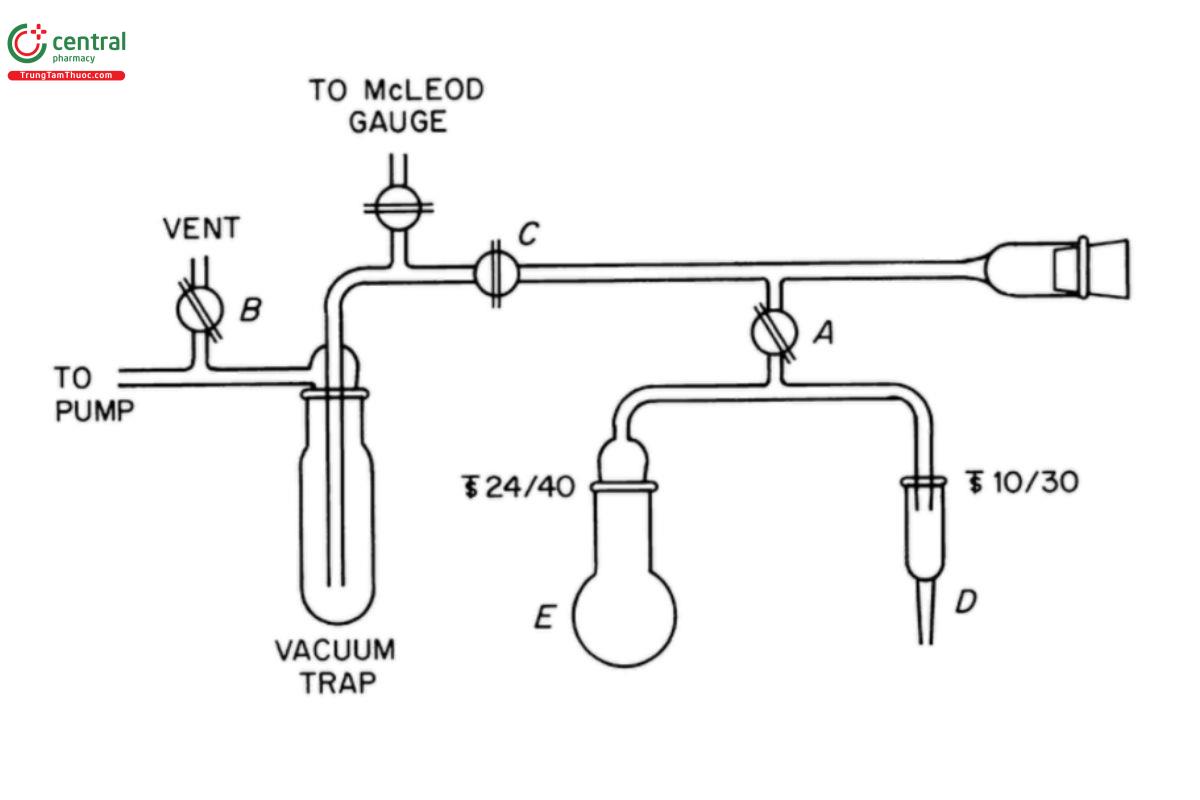
Apparatus: Assemble a closed-system vacuum distillation apparatus, using glass vacuum stopcocks (A, B, and C), as shown in Figure 1. The concentrator tube (D)1 is made of borosilicate or quartz (not int) glass, graduated precisely enough to measure the 0.9 mL or more of distillate collected and marked so that the analyst can dilute accurately to 2.0 mL.
Standard solution: 100 µg/mL of dioxane in water. Use a freshly prepared solution.
Sample solution: Transfer 20.0 g to a 50-mL round-bottom flask (E) having a 24/40 ground-glass neck joint. Add 1.0 mL of water. Place a small polytef-covered stirring bar in the flask, insert the stopper, and stir to mix. Immerse the flask in an ice bath, and chill for 1 min. Wrap heating tape around the tube connecting the concentrator tube (D) and the round-bottom flask, and apply 10 V to the tape. Apply a light coating of high-vacuum silicone grease to the ground-glass joints, and connect the concentrator tube to the 10/30 joint and the round bottom flask to the 24/40 joint. Immerse the vacuum trap in a Dewar flask filled with liquid nitrogen, close stopcocks A and B, open stopcock C, and begin evacuating the system with a vacuum pump. Prepare a slurry bath from powdered dry ice and methanol, and raise the bath to the neck of the round-bottom flask. After freezing the contents of the flask for 10 min, and when the vacuum system is operating at a 0.05-mm pressure or lower, open stopcock A for 20 s, then close it. Remove the slurry bath, and allow the flask to warm in air for 1 min. Immerse the flask in a water bath maintained at a temperature of 20°–25°, and after about 5 min warm the water bath to 35°–40° (sufficient to liquefy most specimens) while stirring slowly but constantly with the magnetic bar. Cool the water in the bath by adding ice, and chill for about 2 min. Replace the water bath with the slurry bath, freeze the contents of the round-bottom flask for 10 min, open stopcock A for 20 s, and then close it. Remove the slurry bath, and repeat the heating steps as before, this time reaching a nal temperature of 45°–50° or a temperature necessary to melt the specimen completely. If there is any condensation in the tube connecting the round bottom flask to the concentrator tube, slowly increase the voltage to the heating tape, and heat until the condensation disappears. Stir with the magnetic stirrer throughout the following steps. Very slowly immerse the concentrator tube in a Dewar flask containing liquid nitrogen.
[Caution—When there is liquid distillate in the concentrator tube, immerse the tube in the liquid nitrogen very slowly, or the tube will break.] Water will begin to distill into the concentrator tube. As ice forms in the concentrator tube, raise the Dewar flask to keep the liquid nitrogen level only slightly below the level of ice in the tube. When water begins to freeze in the neck of the 10/30 joint, or when liquid nitrogen reaches the 2.0-mL graduation mark on the concentrator tube, remove the Dewar flask, and allow the ice to melt without heating. After the ice has melted, check the volume of water that has distilled, and repeat the sequence of chilling and thawing until NLT 0.9 mL of water has been collected. Freeze the tube once again for about 2 min, and release the vacuum first by opening stopcock B, followed by opening stopcock A. Remove the concentrator tube from the apparatus, close it with a greased stopper, and allow the ice to melt without heating. Mix the contents of the concentrator tube by swirling, note the volume of distillate, and dilute with water to 2.0 mL, if necessary.
4.2.1 Chromatographic system
(See Chromatography 〈621〉, System Suitability.)
Mode: GC
Detector: Flame ionization
Column: 2-mm × 1.8-m glass; support S10 (under typical conditions)
Temperature
Column: 140°
Injector: 200°
Detector: 250°
Carrier gas: Nitrogen or helium
Flow rate: 35 mL/min
Install an oxygen scrubber between the carrier gas line and the column. Condition the column for 72 h at 230° with 30–40 mL/min carrier flow. [Note—Support S10 is oxygen-sensitive. Each time a column is installed, flush with carrier gas for 30–60 min before heating.] Injection size: 2–4 µL
4.2.2 Analysis
Samples: Standard solution and Sample solution
Acceptance criteria: The height of the peak from the Sample solution is NMT that from the Standard solution: NMT 10 µg/g (ppm).
5 SPECIFIC TESTS
Fats and Fixed Oils, Acid Value 〈401〉: NMT 0.2
Fats and Fixed Oils, Hydroxyl Value 〈401〉: 85–101
Fats and Fixed Oils, Peroxide Value 〈401〉: NMT 10.0
Water Determination, Method I 〈921〉: NMT 0.5%
6 ADDITIONAL REQUIREMENTS
Packaging and Storage: Preserve in tight containers. Store at room temperature.
USP Reference Standards 〈11〉
USP Nonoxynol 9 RS
USP Octoxynol 9 RS

