
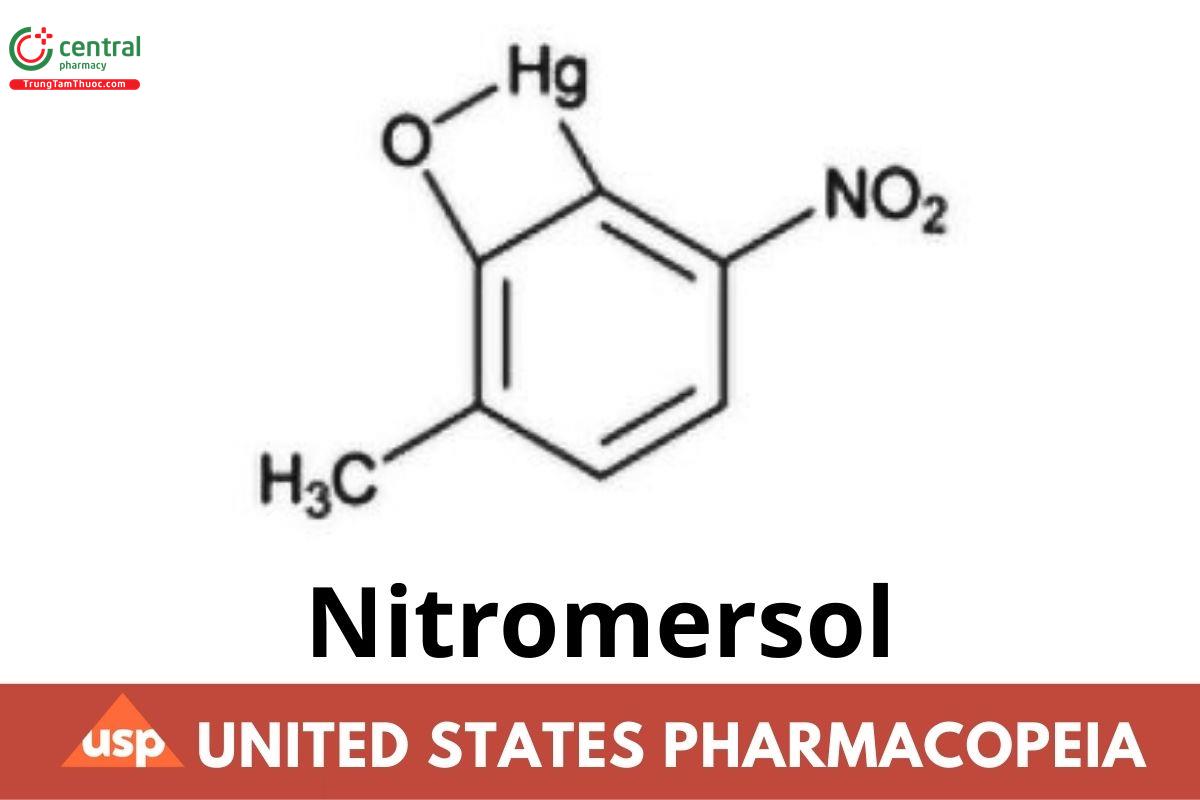
Nitromersol
If you find any inaccurate information, please let us know by providing your feedback here

Tóm tắt nội dung
This article is compiled based on the United States Pharmacopeia (USP) – 2025 Edition
Issued and maintained by the United States Pharmacopeial Convention (USP)
C7H5HgNO3 351.71
7-Oxa-8-mercurabicyclo[4.2.0]octa-1,3,5-triene, 5-methyl-2-nitro-;
5-Methyl-2-nitro-7-oxa-8-mercurabicyclo[4.2.0]octa-1,3,5-triene CAS RN®: 133-58-4; UNII: RU6242GP15.
1 DEFINITION
Nitromersol, dried at 105° for 2 h, contains NLT 98.0% and NMT 100.5% of nitromersol (C7H5HgNO3).
2 IDENTIFICATION
2.1 A.
Sample solution: 1 mg/mL in 1 N sodium hydroxide
Analysis: The Sample solution possesses a reddish orange color. Add 3 N hydrochloric acid.
Acceptance criteria: The reddish orange color disappears, and a yellowish, flocculent precipitate forms.
2.2 B.
Sample solution: Dissolve 250 mg of Nitromersol in 2.5 mL of 1 N sodium hydroxide, and dilute with water to 20 mL.
Analysis 1: Add 3 mL of 3 N hydrochloric acid to the Sample solution.
Acceptance criteria 1: A yellowish precipitate is formed.
Analysis 2: Filter the solution obtained after Analysis 1. The filtrate is nearly colorless or slightly yellow. Retain the filtrate for the test for Mercury Ions. Dissolve the precipitate in 20 mL of water to which 2.5 mL of 1 N sodium hydroxide has been added. Add 0.5 g of sodium hydrosulfite, and heat to boiling.
Acceptance criteria 2: A heavy deposit of metallic mercury is formed.
3 ASSAY
3.1 Procedure
Sample: 200 mg of Nitromersol, previously ground to a fine powder and dried
Titrimetric system
- Mode: Direct titration
- Titrant: 0.1 N ammonium thiocyanate VS
- Endpoint detection: Visual
Analysis: Transfer the Sample to a 500-mL Kjeldahl flask. Add 15 mL of sulfuric acid, and digest cautiously with occasional swirling over a flame until the solution becomes a clear, light yellowish brown. Cool, and add, dropwise, enough 30% Hydrogen peroxide to decolorize the solution. Digest for 2–3 min, adding more hydrogen peroxide if necessary, to produce a colorless solution. Cool, dilute with water to 100 mL, and add potassium permanganate TS until a permanent pink color persists on heating. Then add hydrogen peroxide TS, dropwise, until the color is completely discharged. Cool, and add 5 mL of nitric acid that has been diluted with 10 mL of water. Add 5 mL of ferric ammonium sulfate TS, and titrate with Titrant. Each mL of 0.1 N ammonium thiocyanate is equivalent to 17.59 mg of nitromersol (C7H5HgNO3).
Acceptance criteria: 98.0%–100.5% on the dried basis
4 IMPURITIES
4.1 Residue on Ignition 〈281〉: NMT 0.1%
4.2 Mercury Ions
Sample solution: The filtrate obtained in Identification test B, Analysis 2
Analysis: Add an equal volume of hydrogen sulfide TS to the Sample solution.
Acceptance criteria: No darkening in color is produced, although a small amount of a flocculent, light yellow precipitate may form.
4.3 Alkali-Insoluble Substances
Sample: 1.0 g of Nitromersol
Analysis: Add 7 mL of 1 N sodium hydroxide to the Sample, then dilute with water to 20 mL. The resulting solution, upon standing in a glass-stoppered vessel in the dark for 24 h, shows NMT a slight amount of insoluble material. Collect the insoluble residue, if any, in a tared filter crucible, wash the residue with warm water, and dry at 105° for 1 h.
Acceptance criteria: 0.1%; the weight of the insoluble material is NMT 1 mg.
4.4 Uncombined Nitrocresol
Sample: 500 mg of Nitromersol
Analysis: Shake the Sample with 50 mL of benzene, filter, evaporate the filtrate in a tared dish to dryness, and dry the residue at 80° for 2 h.
Acceptance criteria: 1%; the weight of the residue is NMT 5 mg.
5 SPECIFIC TESTS
5.1 Loss on Drying 〈731〉
Analysis: Dry at 105° for 2 h.
Acceptance criteria: NMT 1.0%
6 ADDITIONAL REQUIREMENTS
Packaging and Storage: Preserve in tight, light-resistant containers.

