
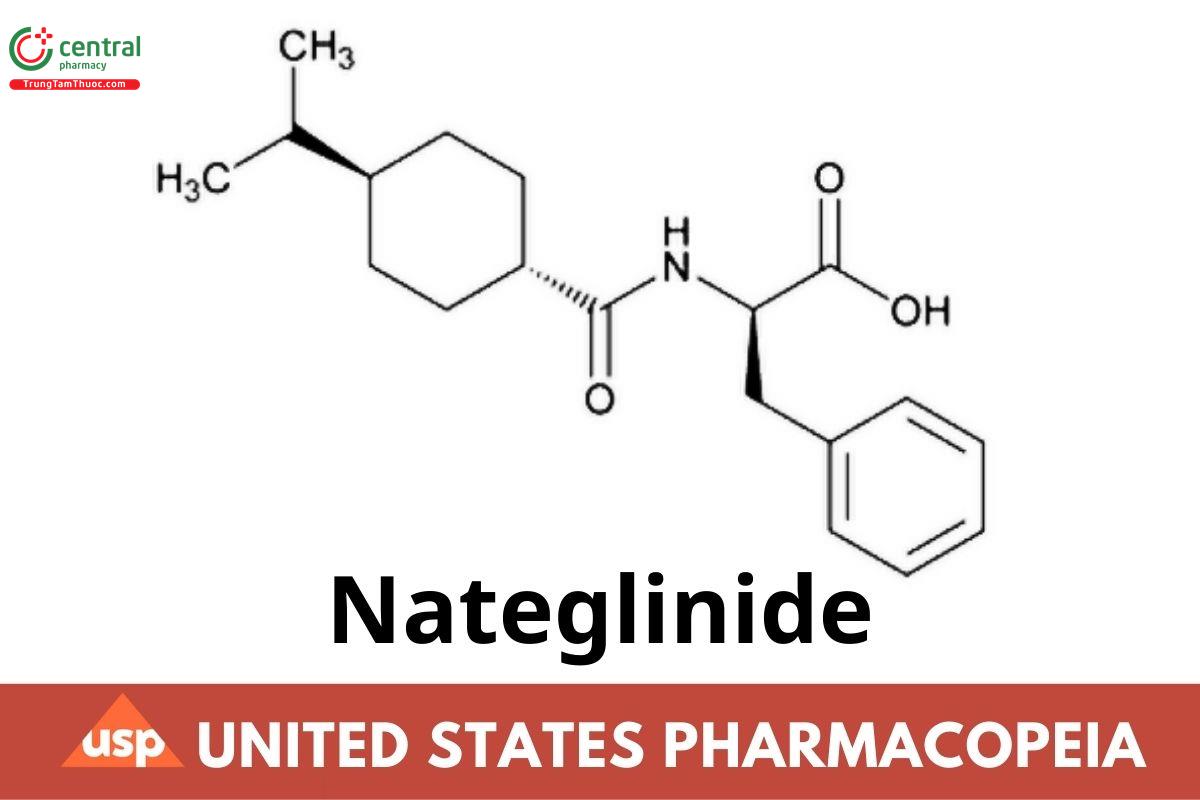
Nateglinide
If you find any inaccurate information, please let us know by providing your feedback here

Tóm tắt nội dung
This article is compiled based on the United States Pharmacopeia (USP) – 2025 Edition
Issued and maintained by the United States Pharmacopeial Convention (USP)
C19H27NO3 317.42
d-Phenylalanine, N-[[trans-4-(1-methylethyl)cyclohexyl] carbonyl]-;
(−)-N-[(trans-4-Isopropylcyclohexyl)carbonyl-d-phenylalanine CAS RN: 105816-04-4; UNII: 41X3PWK4O2.
1 DEFINITION
Nateglinide contains NLT 98.0% and NMT 102.0% of C, H,NO₂, calculated on the dried basis.
2 IDENTIFICATION
A. SPECTROSCOPIC IDENTIFICATION TESTS (197), Infrared Spectroscopy: 197K
B. The retention time of the major peak of the Sample solution corresponds to that of the Standard solution, as obtained in the Assay.
3 ASSAY
PROCEDURE
Buffer: 8.5 g/L of anhydrous dibasic sodium phosphate in water. Adjust with phosphoric acid to a pH of 7.5.
Mobile phase: Methanol and Buffer (1:1)
System suitability stock solution: 0.2 mg/mL each of USP Nateglinide Related Compound C RS and DL-phenylalanine in methanol. [NOTE-Sonicate, if necessary.]
System suitability solution: Transfer USP Nateglinide RS to a suitable volumetric flask, dissolve first in methanol, using 45% of the final volume, add System suitability stock solution equal to 5% of the final volume, and then dilute with Buffer to volume to obtain a solution containing about 1.0 mg/mL of nateglinide and about 0.01 mg/mL each of nateglinide related compound C and DL-phenylalanine.
Standard solution: 1.0 mg/ml of nateglinide prepared as follows: transfer USP Nateglinide RS to a suitable volumetric flask, dissolve first in methanol, using 50% of the final volume, and then dilute with Buffer to volume.
Sample solution: Transfer about 100 mg of Nateglinide to a 100-ml volumetric flask, dissolve in 50 mL of methanol, and dilute with Buffer to volume.
Chromatographic system
(See Chromatography (621), System Suitability.)
Mode: LC
Detector: UV 210 nm
Column: 6-mm x 15-cm; 6-µm packing L71 (see Chromatographic Reagents under Reagents, Indicators, and Solutions)
Column temperature: 30°
Flow rate: 1 mL/min
Injection size: 20 µL
System suitability
Samples: System suitability solution and Standard solution
Suitability requirements
Resolution: NLT 0.9 between nateglinide related compound C and nateglinide, System suitability solution
Relative standard deviation: NMT 1.0%, Standard solution
Analysis
Samples: Standard solution and Sample solution
Calculate the percentage of nateglinide (C19H27NO3) in the portion of Nateglinide taken:
Result = (ru /rs ) × (Cs /Cu ) × 100
ru = peak response from the Sample solution
rs = peak response from the Standard solution
Cs = concentration of USP Nateglinide RS in the Standard solution (mg/mL)
Cu = concentration of Nateglinide in the Sample solution (mg/mL)
Acceptance criteria: 98.0%–102.0% on the dried basis
4 IMPURITIES
RESIDUE ON IGNITION (281): NMT 0.1%
LIMIT OF NATEGLINIDE RELATED COMPOUND A AND OTHER IMPURITIES
Buffer: 7.8 g/L of monobasic sodium phosphate in water. Adjust with phosphoric acid to a pH of 2.5.
Mobile phase: Acetonitrile and Buffer (7:13)
System suitability stock solution: Dissolve USP Nateglinide Related Compound A RS in acetonitrile to obtain a solution containing about 0.6 mg/mL. Further dilute this solution with Mobile phase to obtain a solution containing about 0.12 mg/mL.
System suitability solution: Transfer an amount of USP Nateglinide RS to a suitable volumetric flask, dissolve first in acetonitrile using 10% of the final volume, then add System suitability stock solution equal to 10% of the final volume, and dilute with Mobile phase to volume to obtain a solution containing about 6 mg/mL of nateglinide and about 0.012 mg/ml, of nateglinide related compound A.
Standard solution: Dissolve USP Nateglinide RS in acetonitrile to obtain a solution having a known concentration of about 0.3 mg/mL. Further dilute this solution with Mobile phase to obtain a solution having a known concentration of about 0.06 mg/ml..
Sample solution: Transfer 60 mg of Nateglinide to a 10-mL volumetric flask, dissolve in a minimal amount of acetonitrile, and dilute with Mobile phase to volume.
Chromatographic system
(See Chromatography (621), System Suitability.)
Mode: LC
Detector: UV 210 nm
Column: 3.9-mm x 5-cm; 5-µm packing L7
Column temperature: 40°
Flow rate: 2 mL/min
Injection size: 100 µL
Run time: 5 times the retention time of nateglinide
System suitability
Samples: System suitability solution and Standard solution
Suitability requirements
Resolution: NLT 2.5 between nateglinide related compound A and nateglinide, System suitability solution
Relative standard deviation: NMT 2.0%, Standard solution
Analysis
Samples: Standard solution and Sample solution
Calculate the percentage of each impurity in the portion of Nateglinide taken:
Result = (ru /rs ) × (Cs /Cu ) × (1/F) × 100
ru = peak response of each impurity from the Sample solution
rs = peak response of nateglinide from the Standard solution
Cs = concentration of USP Nateglinide RS in the Standard solution (mg/mL)
Cu = concentration of Nateglinide in the Sample solution (mg/mL)
F = relative response factor (see Table 1)
Acceptance criteria
Individual impurities: See Table 1.
Table 1
| Name | Relative Retention Time | Relative Response Factor | Acceptance Criteria, NMT (%) |
| Nateglinide related compound Aa | 0.5 | 0.015 | 0.2 |
| Ethyl analogb | 0.6 | 1.0 | 0.1 |
| Nateglinide | 1.0 | - | - |
| IPP impurityc | 3.1 | 1.0 | 0.1 |
| Ester impurityd | 4.1 | 0.94 | 0.1 |
| Any other individual impurity | - | 1.0 | 0.1 |
a trans-4-Isopropylcyclohexylcarboxylic acid.
b N-(trans-4-Ethylcyclohexylcarbonyl)-d-phenylalanine.
c N-(trans-4-Isopropylcyclohexylcarbonyl)-d-phenylalanine-d-phenylalanine.
d N-(trans-4-isopropylcyclohexylcarbonyl)-d-phenylalanine-ethyl ester.
4.1 LIMIT OF NATEGLINIDE RELATED COMPOUND B
Mobile phase: 0.77 g/L of ammonium acetate in methanol.
[NOTE-The following solutions are stable for up to 48 h when stored in a refrigerator.]
System suitability solution: 10 mg/mL of USP Nateglinide RS and 0.02 mg/mL of USP Nateglinide Related Compound B RS in methanol
Standard solution: 0.02 mg/mL of USP Nateglinide Related Compound B. RS in methanol. [NOTE-Nateglinide related compound B is N-(trans-4-isopropyl-cyclohexylcarbonyl)-1-phenylalanine.]
Sample solution: 10 mg/mL of Nateglinide in methanol
Chromatographic system
(See Chromatography (621), System Suitability.)
Mode: LC
Detector: UV 220 nm
Column: 4-mm x 25-cm or 4.6-mm x 25-cm; 5-um packing L72 (see Chromatographic Reagents under Reagents, Indicators, and Solutions)
Column temperature: 40°
Flow rate: 0.8 mL/min. [NOTE-The flow rate can be adjusted as needed to achieve a recommended retention time of nateglinide related compound B at about 25 min.]
Injection size: 10 µL
System suitability
[NOTE-The elution order is nateglinide related compound B, followed by the nateglinide peak.]
Samples: System suitability solution and Standard solution
Suitability requirements
Resolution: NLT 0.8 between nateglinide related compound B and nateglinide, System suitability solution
Relative standard deviation: NMT 5%, Standard solution
Analysis
Samples: Standard solution and Sample solution
Calculate the percentage of nateglinide related compound B in the portion of Nateglinide taken:
Result = (ru /rs ) × (Cs /Cu ) × 100
ru = peak response of nateglinide related compound B from the Sample solution
rs = peak response of nateglinide related compound B from the Standard solution
Cs = concentration of USP Nateglinide Related Compound B RS in the Standard solution (mg/mL)
Cu = concentration of Nateglinide in the Sample solution (mg/mL)
Acceptance criteria: NMT 0.2%
4.2 LIMIT OF NATEGLINIDE RELATED COMPOUND C AND PHENYLALANINE
Mobile phase, System suitability solution, Standard solution, Sample solution, and Chromatographic system: Proceed as directed in the
Assay
Diluted standard solution: Dilute the Standard solution with Mobile phase to obtain a solution having a known concentration of about 0.01 mg/mL of nateglinide.
Analysis
Samples: Sample solution and Diluted standard solution
Calculate the percentage of each specied impurity listed in Table 2 in the portion of Nateglinide taken:
Result = (ru /rs ) × (Cs /Cu ) × (1/F) × 100
ru = peak response of each impurity from the Sample solution
rs = peak response of nateglinide from the Diluted standard solution
Cs = concentration of nateglinide in the Diluted standard solution (mg/mL)
Cu = concentration of Nateglinide in the Sample solution (mg/mL)
F = relative response factor of each individual impurity (see Table 2)
Acceptance criteria
Individual impurities: See Table 2.
Table 2
| Name | Relative Retention Time | Relative Response Factor | Acceptance Criteria, NMT (%) |
| Phenylalanine | 0.2 | 1.5 | 0.2 |
| Nateglinide cis-isomera (related compound C) | 0.9 | 0.97 | 0.2 |
| Nateglinide | 1.0 | - | - |
a N-(cis-4-isopropylcyclohexylcarbonyl)-d-phenylalanine.
Total impurities: The sum of all impurities found in the tests for Limit of Nateglinide Related Compound A and Other Impurities, Limit of
Nateglinide Related Compound B, and Limit of Nateglinide Related Compound C and Phenylalanine is NMT 0.5%.
5 SPECIFIC TESTS
Loss on Drying 〈731〉: Dry a sample at 105° for 2 h: it loses NMT 0.5% of its weight.
6 ADDITIONAL REQUIREMENTS
Packaging and Storage: Preserve in tight containers. Store at room temperature.
USP Reference Standards 〈11〉
USP Nateglinide RS
(−)-N-[(trans-4-Isopropylcyclohexyl)carbonyl-d-phenylalanine.
C19H27NO3 317.42
USP Nateglinide Related Compound A RS
trans-4-Isopropylcyclohexylcarboxylic acid.
C10H18NO2 170.2
USP Nateglinide Related Compound B RS
N-(trans-4-Isopropylcyclohexylcarbonyl)-l-phenylalanine.
C19H27NO3 317.4
USP Nateglinide Related Compound C RS
Nateglinide cis-isomer, N-(cis-4-isopropylcyclohexylcarbonyl)-d-phenylalanine.
C19H27NO3 317.4

