
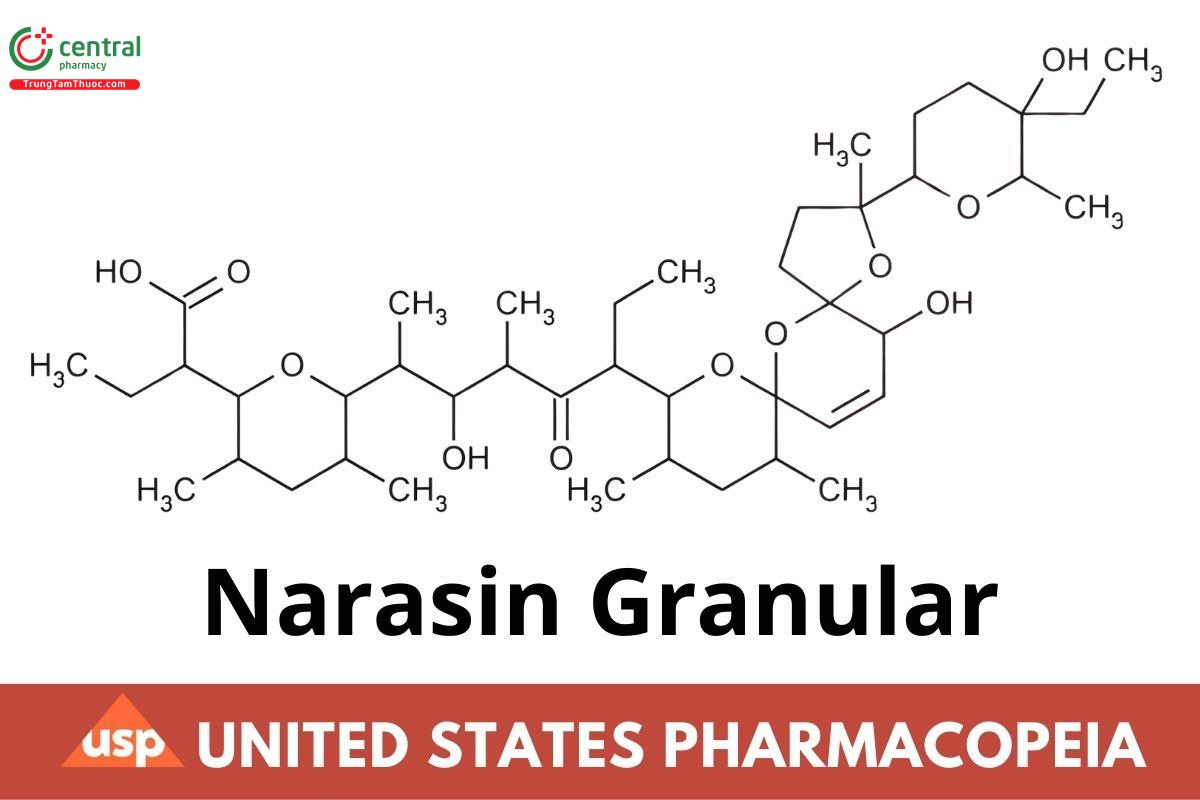
Narasin Granular
If you find any inaccurate information, please let us know by providing your feedback here

Tóm tắt nội dung
This article is compiled based on the United States Pharmacopeia (USP) – 2025 Edition
Issued and maintained by the United States Pharmacopeial Convention (USP)
C43H72O11 (narasin A) 765.03
C43H70O11 (narasin B) 763.01
C44H74O11 (narasin D) 779.05
C44H74O11 (narasin 1) 779.05
Narasin.
2H-Pyran-2-acetic acid, α-ethyl-6-[5-[2-(5-ethyltetrahydro-5-hydroxy-6-methyl-2H-pyran-2-yl)-15-hydroxy-2,10,12-trimethyl-1,6,8-trioxadispiro [4.1.5.3] pentadec-13-en-9-yl]-2-hydroxy-1,3-dimethyl-4-oxoheptyl)tet rahydro-3,5-dimethyl-.
α-Ethyl-6-15-[2-(5-ethyltetrahydro-5-hydroxy-6-methyl-2H-pyran-2-yl)-15-hydroxy-2,10,12-trimethyl-1,6,8-trioxadispiro [4.1.5.3]pentadec-13-en-9-yl]-2-hydroxy-1,3-dimethyl-4-oxoheptyl tetrahydro-3,5-dimethyl-2H-pyran-2-acetic acid CAS RN®: 55134-13-9; UNII: DZY9VU539P.
>> Narasin Granular contains narasin mixed with suitable carriers and inactive ingredients prepared in a granular form that is free-flowing and free of aggregates. It contains not less than 100 mg and not more than 160 mg of narasin per g.
1 Packaging and storage-
Preserve in well-closed containers. Avoid moisture and excessive heat.
2 Labeling-
Label it to indicate that it is for animal use only. Label it also to indicate that it is for manufacturing, processing, or repackaging.
3 USP REFERENCE STANDARDS (11)-
USP Monensin Sodium RS
USP Narasin RS
Identification-The retention time of the major peak for narasin A in the chromatogram of the Assay preparation corresponds to that of the
Standard preparation as obtained in the Assay.
LOSS ON DRYING (731)-Dry it in vacuum at 60° for 3 hours: it loses not more than 10% of its weight.
POWDER FINENESS (811)-Not less than 99% passes a No. 30 sieve, and not more than 15% passes a No. 140 sieve.
Content of narasin A-Using the chromatogram of the Assay preparation obtained as directed in the Assay, calculate the percentage of narasin A by the formula:
100A / [A + (D + I)]
in which A is the narasin A biopotency and D + I is the narasin D + I biopotency. Not less than 85% of narasin A is found.
4 Assay-
Diluent-Prepare a mixture of methanol and water (9:1).
Mobile phase-Prepare a degassed mixture of methanol, water, and glacial acetic acid (94:6:0.1). Make adjustments if necessary (see System
Suitability under Chromatography (621)).
Neutralized methanol-Add 1 g of sodium bicarbonate to 4 L of methanol, mix, and filter.
Derivatizing reagent-Dissolve 30 g of vanillin in a mixture of methanol and sulfuric acid (950:20) in a container protected from light. [CAUTION-To avoid splattering, add the sulfuric acid carefully and slowly with a pipet, do not pour. Allow the mixture of methanol and sulfuric acid to cool before adding the vanillin.] Do not filter.
Resolution solution-Prepare a solution in Neutralized methanol containing about 3 mg of USP Narasin RS and 1 mg of USP Monensin Sodium RS per mL. Transfer 2 mL of this solution to a 200-mL volumetric flask, dilute with Diluent to volume, and mix.
Standard preparations-Dissolve an accurately weighed quantity of USP Narasin RS in Neutralized methanol to obtain a solution having a known concentration of about 1 mg per mL. Transfer 1.0 mL of this stock solution to a 200-ml volumetric flask, and transfer 2.0 mL and 4.0 mL of the stock solution to two separate 100-mL volumetric flasks, dilute each with Diluent to volume, and mix. These solutions contain about 5, 20, and 40 µg of USP Narasin RS per mL. Using the designated percentage of narasin A in the USP Narasin RS, calculate the exact narasin A concentration, in µg per mL, in each of the Standard preparations.
Assay preparation-Transfer about 5 g of Narasin Granular, accurately weighed, to a suitable container, add 200.0 mL of Diluent, and shake by mechanical means for 1 hour. Allow the solids to settle, and quantitatively dilute an accurately measured volume of the supernatant with Diluent to obtain a solution containing about 20 µg of narasin per mL. Pass a portion of this solution through a filter having a 0.5-µm or finer porosity, and use the filtrate as the Assay preparation.
Chromatographic system (see Chromatography (621))-The liquid chromatograph is equipped with a 4.6-mm x 25-cm column that contains packing L1. The column outlet is attached to a tee, the opposing arm is attached to a tube from which is pumped the Derivatizing reagent, and the outlet is connected to a 2-mL postcolumn reaction coil maintained at 98°. The outlet of the reaction coil is connected to a detector set at 520 nm. The Mobile phase and the Derivatizing reagent flow at the rate of about 0.7 mL per minute. Chromatograph the Resolution solution, and record the peak responses as directed for Procedure: the relative retention times are about 0.7 for monensin B, 0.75 for monensin A, 1.0 for narasin A, and 1.1 for narasin D + I; and the resolution, R, between the monensin B peak and the monensin A peak is not less than 1.25, and between the monensin A peak and the narasin A peak not less than 3.5. Chromatograph the Standard preparations, and record the peak. responses as directed for Prcedure: the tailing factor for the narasin A peak is not more than 1.4 when calculated by the formula:
W0.1/2f 0.1
in which W0.1 is the width of the peak at 10% of peak height; and f is the distance from the peak maximum to the leading edge of the peak, the distance being measured at a point on the baseline at which 10% peak height is reached. The relative standard deviation for replicate injections is not more than 10%. [NOTE-After use, flush the system with methanol.]
Procedure-Separately inject equal volumes (about 200 µL) of the Standard preparations and the Assay preparation into the chromatograph, and measure the areas of the peak responses for the narasin A and narasin D + I peaks [NOTE-Narasin D and narasin I will co-elute under this chromatographic system.]
Plot the three narasin peak responses in the chromatograms obtained from the Standard preparations versus the concentration, in µg per mL, of narasin A, and draw the straight line best fitting the three plotted points. From the graph so obtained, and the narasin A peak response in the chromatogram obtained from the Assay preparation, determine the concentration, C, in µg per mL, of narasin A in the Assay preparation. From the same graph and the narasin D + I peak response in the chromatogram obtained from the Assay preparation, determine the concentration, Co in µg per mL, of narasin D + 1 the Assay preparation. Calculate the biopotency, in mg per g, in the portion of Narasin Granular taken by the formula:
(0.001) (CAFA+CD+IFD+I) (VE/M)
in which FA is 1.077 representing the biopotency conversion factor for narasin A; FD+I the biopotency conversion factor for narasin D + I; V is the extraction volume, in mL; E is the dilution factor used in diluting the extract to the final estimated concentration of 20 µg per mL; and M is the weight, in g, of Narasin Granular taken to prepare the Assay preparation. Calculate the bioconversion factor, FD+I for narasin D + I by the formula: D
(1.510D + 0.012) / (D + 1)
in which D and / are the specified percentages of narasin D and narasin I, respectively, in USP Narasin RS: 1.510 is the factor for converting narasin D to narasin D biopotency; and 0.012 is the factor for converting narasin I to narasin I biopotency.

