
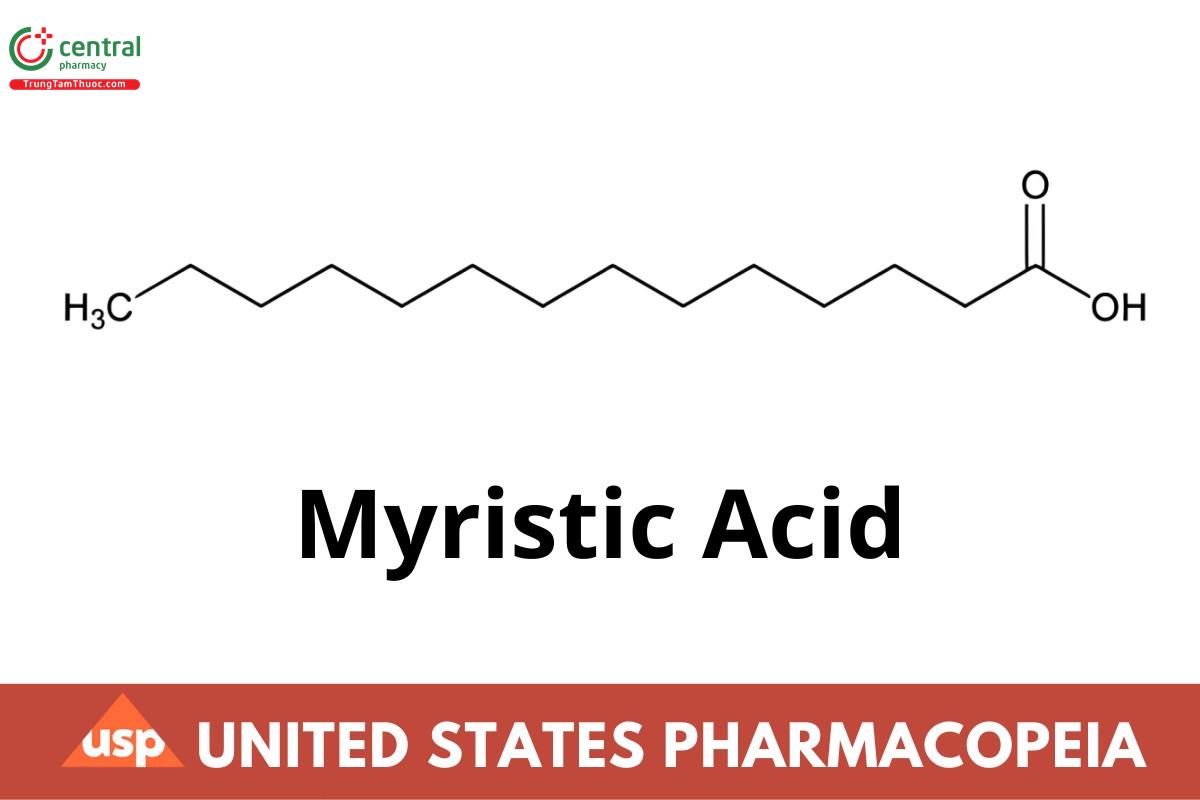
Myristic Acid
If you find any inaccurate information, please let us know by providing your feedback here

Tóm tắt nội dung
This article is compiled based on the United States Pharmacopeia (USP) – 2025 Edition
Issued and maintained by the United States Pharmacopeial Convention (USP)
C14H28O2 228.37
Tetradecanoic acid;
1-Tetradecanoic acid;
1-Tridecanecarboxylic acid CAS RN®: 544-63-8.
1 DEFINITION
Myristic Acid is obtained from coconut oil and other fats. It contains NLT 97.0% of myristic acid (C14H28O2).
2 IDENTIFICATION
Change to read:
A. SPECTROSCOPIC IDENTIFICATION TESTS (197), Infrared Spectroscopy: (1970) (CN 1-MAY-2020) or (197K)
Sample: Undried specimen
Acceptance criteria: Meets the requirements
Change to read:
B. CHROMATOGRAPHIC IDENTITY: (2S (NF36)) The retention time of the major peak of the Sample solution corresponds to that of the Standard solution, as obtained (2S (NF36)) in the Assay.
3 ASSAY
Delete the following:
3.1 FATS AND FIXED OILS, Fatty Acid Composition (401)
System suitability solution: Prepare as directed in the chapter, except that only stearic acid and palmitic acid are used.
Sample solution: Prepare as directed for the Test Solution in the chapter.
Standard solution: Prepare as directed for the Sample solution, using 100 mg of USP Myristic Acid RS instead of the substance to be examined.
Chromatographic system: Prepare as directed in the chapter.
Injection size: 1 µL
System suitability
(See Chromatography 〈621〉, System Suitability.)
Sample: System suitability solution
Suitability requirements
Resolution: NLT 1.5 between methyl stearate and methyl palmitate
Analysis
Samples: Standard solution and Sample solution
Identify the methyl myristate peak from the Sample solution by comparing the retention times of the peaks with those from the Standard solution. Measure the responses for all the peaks from the Sample solution, excluding the solvent peak.
Calculate the percentage of myristic acid (C14H28O2) in the portion of Myristic Acid taken:
Result = (A/B) x 100
A = peak response for methyl myristate from the Sample solution
B = sum of all the peak responses in the Sample solution except the solvent peak
Acceptance criteria: NLT 97.0% (2S (NF36))
Add the following:
3.2 Procedure
Solution A: Add 1 mL of phosphoric acid to 1 L of water to prepare a 0.1% phosphoric acid solution.
Solution B: Acetonitrile
Diluent: Methanol
Mobile phase: See Table 1.
Table 1
| Time (min) | Solution A (%) | Solution B (%) |
| 0.0 | 50 | 50 |
| 20.0 | 1 | 99 |
| 25.0 | 1 | 99 |
| 26.0 | 50 | 50 |
| 30.0 | 50 | 50 |
System suitability solution: 5.0 mg/mL of USP Myristic Acid RS and 0.025 mg/mL of linolenic acid in Diluent
Standard solution: 5.0 mg/mL of USP Myristic Acid RS in Diluent
Sample solution: 5.0 mg/mL of Myristic Acid in Diluent
Chromatographic system
(See Chromatography (621), System Suitability.)
Mode: LC
Detector: UV 210 nm
Column: 4.6-mm × 15-cm; 2.7-µm packing L1
Column temperature: 40°
Flow rate: 1.0 mL/min
Injection volume: 25 µL
Run time: 30 min
System suitability
Samples: System suitability solution and Standard solution
[NOTE-The relative retention times for linolenic acid and myristic acid are 0.97 and 1.00, respectively.)
Suitability requirements
Resolution: NLT 1.5 between linolenic acid and myristic acid, System suitability solution
Tailing factor: 0.8-1.8, Standard solution
Relative standard deviation: NMT 0.5%, Standard solution
Analysis
Samples: Standard solution and Sample solution
Calculate the percentage of myristic acid (C14H28O2) in the portion of Myristic Acid taken:
Result = (rU/rS) x (CS/CU) x 100
rU = peak response from the Sample solution
rS = peak response from the Standard solution
CS = concentration of USP Myristic Acid RS in the Standard solution (mg/mL)
CU = concentration of Myristic Acid in the Sample solution (mg/mL)
Acceptance criteria: NLT 97.0% (2S (NF36))
4 IMPURITIES
4.1 RESIDUE ON IGNITION (281)
NMT 0.1%
Add the following:
4.2 Limit of Lauric Acid and Palmitic Acid
Solution A, Solution B, Diluent, Mobile phase, System suitability solution, and Chromatographic system: Proceed as directed in the Assay.
Standard solution: 0.15 mg/mL of USP Lauric Acid RS and 0.15 mg/mL of USP Palmitic Acid RS in Diluent
Sample solution: 5.0 mg/mL of Myristic Acid in Diluent
System suitability
Samples: System suitability solution and Standard solution
[NOTE-The relative retention times for lauric acid, linolenic acid, myristic acid, and palmitic acid are 0.73, 0.97, 1.00, and 1.26, respectively.]
Suitability requirements
Resolution: NLT 1.5 between linolenic acid and myristic acid, System suitability solution
Relative standard deviation: NMT 5%, Standard solution
Analysis
Samples: Standard solution and Sample solution
Based on the Standard solution, identify the peaks of appropriate fatty acids.
Calculate the percentage of lauric acid (C12H24O2) or palmitic acid (C16H32O2) in the portion of Myristic Acid taken:
Result = (rU/rS) x (CS/CU) x 100
rU = peak response of lauric acid or palmitic acid from the Sample solution
rS = peak response of lauric acid or palmitic acid from the Standard solution
CS = concentration of USP Lauric Acid RS or USP Palmitic Acid RS in the Standard solution (mg/mL)
CU = concentration of Myristic Acid in the Sample solution (mg/mL)
Acceptance criteria: Disregard peaks that are less than 0.05% for any individual impurity and any peaks due to solvent.
Sum of lauric acid and palmitic acid: NMT 3.0% (2S (NF36))
4.3 LIMIT OF LEAD
[NOTE-Select reagents with as low a lead content as practicable, and store all solutions in high-density polyethylene containers. Rinse all plastic and glassware thoroughly with warm 8 N nitric acid followed by deionized water.]
Standard stock solution: Dissolve 160 mg of lead nitrate in 100 mL of water containing 1 mL of nitric acid. Dilute with water to 1000 mL.
Standard solutions: [NOTE-Prepare these solutions on the day of use.] Transfer 10.0 mL of Standard stock solution to a 100-mL volumetric flask, and dilute with water to volume. Each milliliter of this solution contains the equivalent of about 10 µg of lead. Dilute accurately measured volumes of the diluted Standard stock solution with water to obtain solutions with known concentrations of 1, 2, and 5 µg/mL of lead.
Sample solution: Transfer 5 g of Myristic Acid to an evaporating dish. Add 5 mL of a 25% sulfuric acid solution, and distribute the sulfuric acid uniformly through the sample. Within a hood, place the dish on a steam bath to evaporate most of the water. Place the dish on a burner, and slowly pre-ash the sample by expelling most of the sulfuric acid. Place the dish in a muffle furnace that has been set at 525°, and ash the sample until the residue appears free from carbon. Prepare a blank by ashing 5 mL of a 25% sulfuric acid solution. Cool, and cautiously wash down the inside of each evaporation dish with water. Treat both the sample and the blank as follows. Add 5 mL of 1 N hydrochloric acid. Place each dish on a steam bath, and evaporate to dryness. To each dish add 1.0 mL of 3 N hydrochloric acid and about 5 mL of water, and heat briefly on a steam bath to dissolve any residue. Transfer each solution quantitatively to a 10-mL volumetric flask, and dilute with water to volume.
Instrumental conditions
(See Atomic Absorption Spectroscopy (852).)
Mode: Atomic absorption spectrophotometry
Analytical wavelength: 283.3 nm at the lead emission line
Lamp: Lead electrodeless discharge
Flame: Air-acetylene with a suitable burner head
Slit width: 0.7 nm
Blank: Water. [NOTE-Perform a blank determination following the manufacturer's operating instructions.]
Analysis
Samples: Standard solutions, Sample solution, and Blank
Determine the corrected absorbance values by subtracting the absorbance of the Blank from the absorbance of each of the Standard solutions and from the absorbance of the Sample solution. Prepare a standard curve by plotting the corrected absorbance values of the Standard solutions versus their corresponding concentrations, in µg/mL. From the calibration curve, determine the lead concentration in the Sample solution.
Calculate the lead content, in ppm, in the portion of Myristic Acid taken:
Result = (C/WS) x V
C = measured concentration of lead in the Sample solution from the standard curve (µg/mL)
WS = weight of Myristic Acid taken (g)
V = final volume of the Sample solution, 10 mL
Acceptance criteria: NMT 2 ppm
4.4 LIMIT OF MINERAL ACIDS
Sample: 5 g of melted Myristic Acid
Analysis: Shake the Sample with an equal volume of hot water for 2 min, cool, and filter.
Acceptance criteria: The filtrate is not reddened by the addition of 1 drop of methyl orange TS.
5 SPECIFIC TESTS
CONGEALING TEMPERATURE (651): 48°-55.5°
FATS AND FIXED OILS (401), Procedures, Acid Value: 242-249
FATS AND FIXED OILS (401), Procedures, lodine Value: NMT 1.0
FATS AND FIXED OILS (401), Procedures. Peroxide Value: NMT 10.0
FATS AND FIXED OILS (401), Procedures, Unsaponifiable Matter: NMT 1%
WATER DETERMINATION (921), Method /: NMT 0.2%
6 ADDITIONAL REQUIREMENTS
6.1 PACKAGING AND STORAGE
Preserve in well-closed containers. No storage requirements specified.
Change to read:
6.2 USP REFERENCE STANDARDS (11)
USP Lauric Acid RSA (2S (NF36))
USP Myristic Acid RS
USP Palmitic Acid RSA (2S (NF36))

