
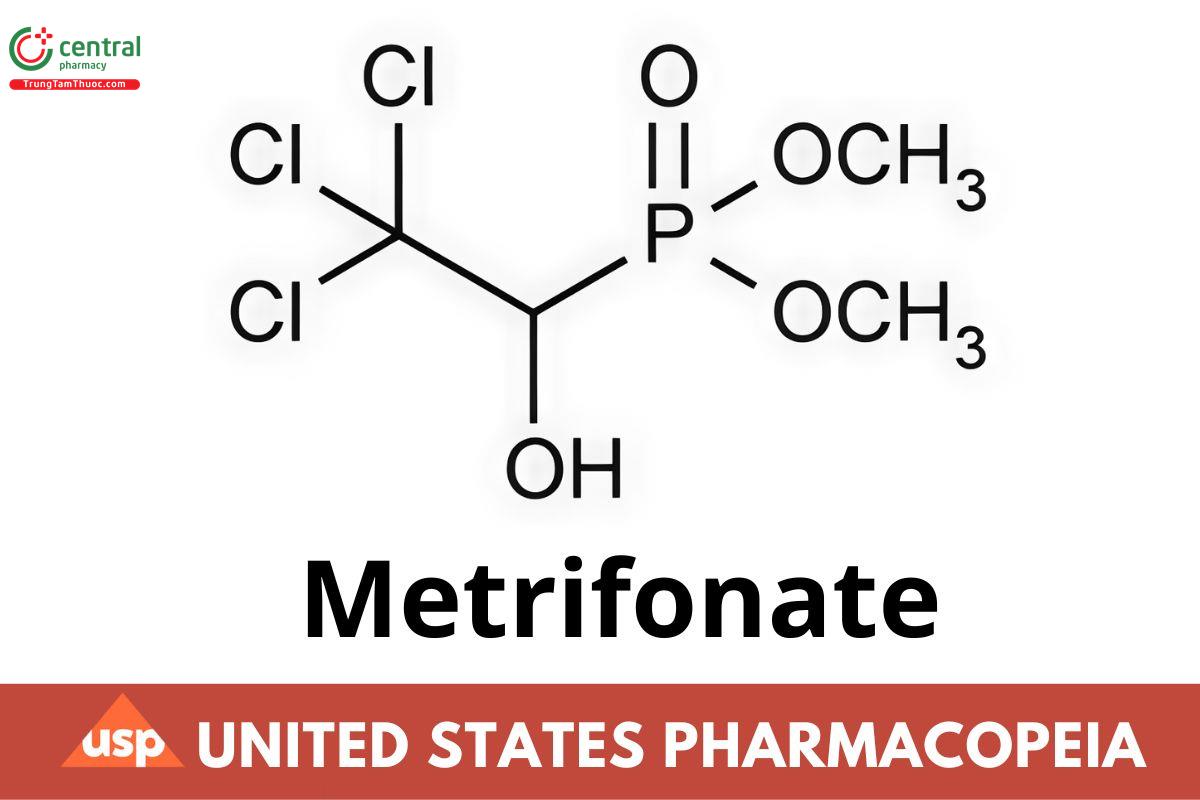
Metrifonate
If you find any inaccurate information, please let us know by providing your feedback here

Tóm tắt nội dung
This article is compiled based on the United States Pharmacopeia (USP) – 2025 Edition
Issued and maintained by the United States Pharmacopeial Convention (USP)
C4H8CI3O4P 257.44
Phosphonic acid, (2,2,2-trichloro-1-hydroxyethyl)-, dimethyl ester.
Dimethyl (2,2,2-trichloro-1-hydroxyethyl)phosphonate CAS RN®: 52-68-6; UNII: DBF2DG4G2K.
>> Metrifonate contains not less than 98.0 percent and not more than 100.5 percent of C4H8CI3O4P calculated on the anhydrous basis.
Packaging and storage-Preserve in well-closed containers at a temperature not exceeding 25°.
Labeling-Label it to indicate that it is for veterinary use only.
1 USP REFERENCE STANDARDS (11)-
USP Metrifonate RS
Trichlorfon.
COMPLETENESS OF SOLUTION (641): meets the requirements, 0.5 g of it being dissolved in methanol.
COLOR OF SOLUTION (631)-The solution obtained in the test for Completeness of solution has no more color than Matching Fluid F.
Change to read:
1.1 Identification-
A: ▲Spectroscopic Identification Tests (197). Infrared Spectroscopy: 197K▲(CN 1-May-2020)
B: Thin-Layer Chromatographic Identification Test (201)-
Test solution: Dissolve 10 mg of Metrifonate in methanol, and dilute with methanol to 10.0 mL..
Developing solvent sytstem: a mixture of toluene, dioxane, and glacial acetic acid (70:25:5)
Procedure-Proceed as directed in the chapter. After allowing the plate to air-dry, spray the plate with a 5% solution of 4-(p-nitrobenzyl)pyridine in acetone, and heat at 120° for 15 minutes. Before the plate cools, spray it with a 10% solution of tetraethylenepentamine in acetone, and immediately examine the plate: the principal spot in the chromatogram obtained from the Test solution corresponds in R, value, size, and blue color to that in the chromatogram obtained from the Standard solution.
C: Dissolve 20 mg of Metrifonate in 1 mL of 2 N sodium hydroxide, add 1 mL of pyridine, shake, and heat on a water bath for 2 minutes: a red color develops in the pyridine layer.
D: To 100 mg of Metrifonate add 0.5 mL of nitric acid, 0.5 mL of a 50% solution of ammonium nitrate, and 0.1 mL of 30 percent Hydrogen peroxide, and heat on a water bath for 10 minutes. Heat to boiling, and add 1 mL of ammonium molybdate TS: a yellow color precipitate is formed.
Acidity-Dissolve 2.5 g of it in carbon dioxide-free water, dilute with carbon dioxide-free water to 50 mL, and add 0.1 mL of methyl red TS. Not more than 1.0 mL of 0.1 N sodium hydroxide is required to change the color of the indicator.
WATER DETERMINATION, Method (921): not more than 0.3%.
Limit of free chloride-Dissolve 5.0 g of Metrifonate in 30 mL of alcohol, and add a mixture of 100 mL of water and 15 mL of nitric acid. Titrate with 0.1 N silver nitrate VS, determining the endpoint potentiometrically using a silver electrode. Not more than 0.7 mL of 0.1 N silver nitrate is consumed (0.05%).
1.2 Chromatographic purity-
Solution A-Dissolve 1.36 g of monobasic potassium phosphate in water, and dilute with water to 1000 mL. Adjust with phosphoric acid to a pH of 3.0.
Solution B-Use acetonitrile.
Mobile phase-Use variable mixtures of Solution A and Solution B as directed for Chromatographic system. Make adjustments if necessary (see System Suitability, under Chromatography (621)).
Diluent-Prepare a mixture of acetonitrile and water (1:1)..
Standard preparation-Prepare a solution of USP Metrifonate RS in Diluent containing 20 mg per mL.
Test solution-Transfer 500 mg of Metrifonate, accurately weighed, to a 25-mL volumetric flask, dissolve in and dilute with Diluent to volume, and mix.
Chromatographic system (see CHROMATOGRAPHY (621))-The liquid chromatograph is equipped with a 210-nm detector and a 4-mm x 25-cm column that contains 5-µm packing L7. The column is maintained at a constant temperature of about 40°. The flow rate is about 1.5 mL per minute. The chromatograph is programmed as follows.
| Time (minutes) | Solution A (%) | Solution B (%) | Elution |
| 0 | 90 | 10 | equilibration (10 minutes) |
| 0-5 | 90 | 10 | isocratic |
| 5 | 90→85 | 10→15 | step gradient |
| 5–25 | 85 | 15 | isocratic |
| 25 | 85→45 | 15→55 | step gradient |
| 25-end- | 45 | 55 | isocratic |
The elution concludes at 3 times the retention time of metrifonate.
Procedure-Separately inject equal volumes (about 50 µL) of the Standard solution and the Test solution into the chromatograph, record the chromatograms, and measure the peak areas. Calculate the percentage of each impurity taken by the formula:
100F(ri/rS)
in which F is a response factor, being 0.38 for the desmethylmetrifonate peak, if present at a retention time of 0.5 relative to that of Metrifonate, 0.03 for the dichlorvos peak, if present, at a retention time of 1.9 relative to that of Metrifonate, and 1.0 for any other impurity, ri is the peak area for the individual impurity obtained from the Test solution; and rS is the peak area for Metrifonate obtained from the Standard solution: not more than 1.0% of desmethylmetrifonate, 0.2% of dichlorvos, and 0.5% of any other impurity are found; and a total of not more than 1.0% of impurities other than desmethylmetrifonate and dichlorvos is found.
Assay-Dissolve about 300 mg of Metrifonate, accurately weighed, in 30 mL of alcohol. Add 10 mL of monoethanolamine, and allow to stand for 1 hour at 21 ± 1°. Cool while adding a mixture of 100 mL of water and 15 mL of nitric acid. While maintaining the temperature at 21 ± 1°, titrate with 0.1 N silver nitrate VS, determining the endpoint potentiometrically using a silver electrode. Each mL of 0.1 N silver nitrate is equivalent to 25.74 mg of C4H8CI3O4P.

