
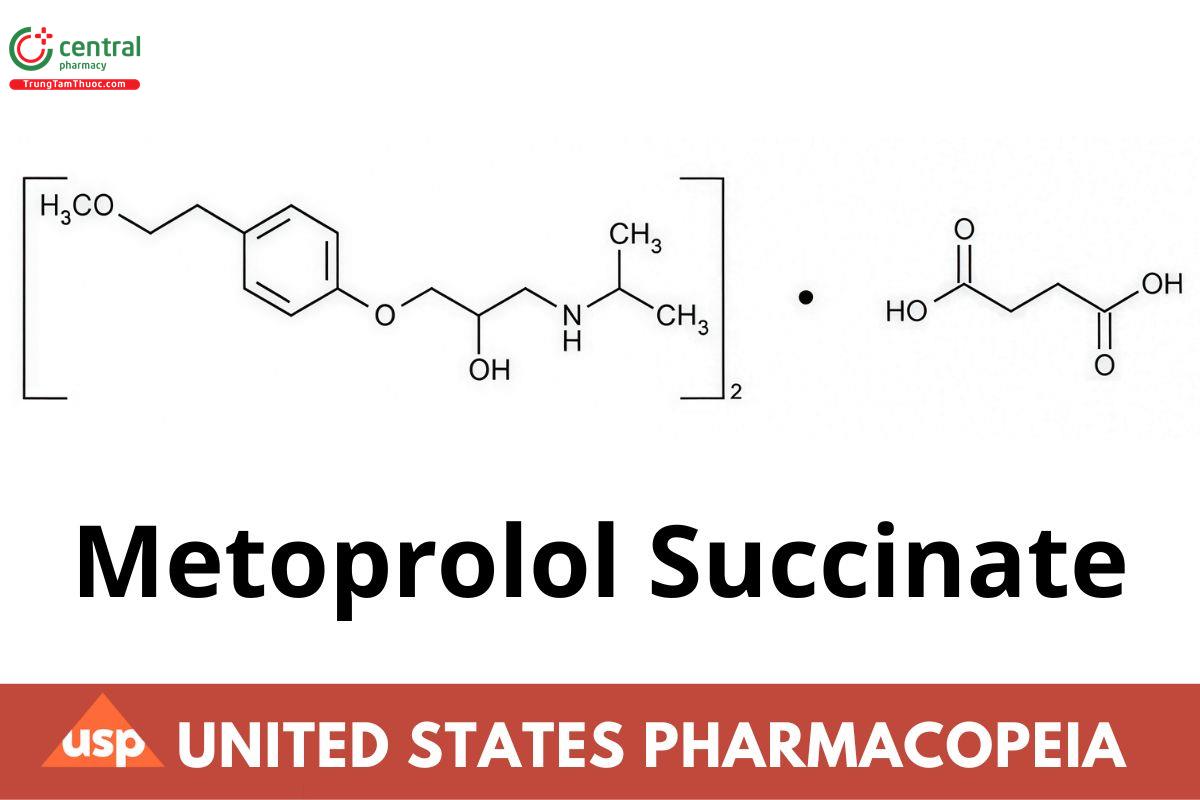
Metoprolol Succinate
If you find any inaccurate information, please let us know by providing your feedback here

Tóm tắt nội dung
This article is compiled based on the United States Pharmacopeia (USP) – 2025 Edition
Issued and maintained by the United States Pharmacopeial Convention (USP)
C15H25NO3)2 · C4H6O4 652.82
2-Propanol, 1-[4-(2-methoxyethyl)phenoxy]-3-[(1-methylethyl)amino]-, (±)-, butanedioate (2:1) (salt).
(+)-1-(Isopropylamino)-3-[p-(2-methoxyethyl)phenoxy]-2-propanol succinate (2:1) (salt) CAS RN: 98418-47-4; UNII: TH25PD4CCB.
>>> Metoprolol Succinate contains not less than 98.0 percent and not more than 102.0 percent of C15H25NO3)2 · C4H6O4 calculated on the dried basis.
1 Packaging and storage-
Preserve in tight containers at controlled room temperature.
Change to read:
2 USP REFERENCE STANDARDS (11)-
USP Metoprolol Related Compound A RS
(±)1-Ethylamino)-3-[4-(2-methoxyethyl)phenoxy]-propan-2-ol.
C14H23NO3 253.34
USP Metoprolol Related Compound B RS
(+)1-Chloro-2-hydroxy-3-[4-(2-methoxyethyl)phenoxy]-propane.
C12H17CIO3 244.71
USP Metoprolol Related Compound C.RS
▲4-[2-Hydroxy-3-(isopropylamino)propoxy]benzaldehyde hydrochloride ▲(ERR 1-Jun-2020)
C13H19NO3▲ · HCI 273.76 ▲(ERR 1-Jun-2020)
USP Metoprolol Related Compound D RS
▲N,N-Bis(2-hydroxy-3-[4-(2-methoxyethyl)phenoxy)propyl isopropylamine hydrochloride; also known as (±) N,N-Bis(2-hydroxy-3-[4-(2-methoxyethyl)phenoxy]propyl] (1-methylethyl)amine hydrochloride. ▲(ERR 1-Jun-2020)
C27H41NO6▲ · HCI 512.08 ▲(ERR 1-Jun-2020)
USP Metoprolol Succinate RS
3 Clarity and color of solution-
A solution of Metoprolol Succinate having a concentration of 20 mg per mL is not less clear than an equal volume of water in a test tube of similar size. The absorbance of the solution determined at 440 nm in a 5-cm cell, using water as the blank, is not more than 0.1.
4 Identification
Spectroscopic Identification Tests (197), Infrared Spectroscopy: 197K.
PH (791): between 7.0 and 7.6, in a solution containing 65 mg per mL.
LOSS ON DRYING (731)-Dry it in vacuum at 60° for 4 hours: it loses not more than 0.2% of its weight.
RESIDUE ON IGNITION (281): not more than 0.1%.
5 Related compounds-
5.1 TEST 1-
Adsorbent: 0.25-mm layer of chromatographic silica gel mixture.
Test solution-Dissolve an accurately weighed quantity of Metoprolol Succinate in methanol to obtain a solution containing 50 mg per mL..
Standard solution-Dilute the Test solution quantitatively, and stepwise if necessary, with methanol to obtain a solution having a concentration of 0.1 mg per mL.
Application volume: 10 µL.
Developing solvent system: a mixture of ethyl acetate and methanol (80:20).
Procedure-Proceed as directed for Thin-Layer Chromatography under Chromatography (621). Place two 50-mL beakers, each containing 30 mL of ammonium hydroxide, on the bottom of a chromatographic chamber that is lined with filter paper and contains the Developing solvent system, and allow to equilibrate for 1 hour. Position the plate in the chromatographic chamber, and develop the chromatogram until the solvent front has moved about two-thirds of the length of the plate. Remove the plate from the chamber, mark the solvent front, and dry the plate for 3 hours in a current of warm air. Place the plate in a chamber containing iodine vapor, and allow to react for at least 15 hours.
Compare the intensities of the brown spots appearing on the chromatogram: any secondary spot obtained from the Test solution is not more intense than the corresponding spot obtained from the Standard solution. Not more than 0.2% is found.
5.2 TEST 2-
Sodium dodecyl sulfate solution, Mobile phase, and Resolution solution- Prepare as directed in the Assay.
Standard solution-Dissolve an accurately weighed quantity of USP Metoprolol Succinate RS in Mobile phase, and dilute quantitatively, and stepwise if necessary, with Mobile phase to obtain a solution having a known concentration of about 1.0 µg per mL.
Test solution-Transfer about 50 mg of Metoprolol Succinate, accurately weighed, to a 50-mL volumetric flask, dissolve in and dilute with Mobile phase to volume, and mix.
Chromatographic system (see CHROMATOGRAPHY (621)) -Prepare as directed in the Assay. Chromatograph the Resolution solution, and record the peak responses as directed for Procedure: the resolution, R, between metoprolol related compound A and metoprolol related compound B is not less than 2.5; and the resolution, R, between metoprolol related compound B and metoprolol related compound C is not less than 1.5. [NOTE-The relative retention times are about 0.6 for metoprolol related compound C, 0.7 for metoprolol related compound B, 0.8 for metoprolol related compound A, 1.0 for metoprolol, and 5.0 and 5.2 for the two diastereomers of metoprolol related compound D.]
Chromatograph the Standard solution, and record the peak responses as directed for Procedure: the relative standard deviation for replicate injections is not more than 5.0%.
Procedure-Inject equal volumes (about 10 µL) of the Standard solution and the Test solution into the chromatograph, record the chromatograms, and measure the peak responses. Calculate the percentage of each impurity in the portion of Metoprolol Succinate taken by the formula:
100(CS/CT)(ri /rS)
in which Co is the concentration, in mg per mL, of USP Metoprolol Succinate RS in the Standard solution; C, is the concentration of metoprolol succinate in the Test solution; r, is the individual peak response of related impurities; and r is the peak response obtained from the Standard solution: not more than 0.1% of any single impurity is found, and not more than 0.5% of total impurities is found. [NOTE-The sum of the peak responses for the two diastereomers of metoprolol related compound D is used in the above calculation to report the amount of metoprolol related compound D.]
6 Assay-
Sodium dodecyl sulfate solution-Add 1.3 g of sodium dodecyl sulfate to 1 L of aqueous phosphoric acid, 0.1% (w/v).
Mobile phase-Prepare a filtered and degassed mixture of Sodium dodecyl sulfate solution and acetonitrile (60:40). Make adjustments if necessary (see System Suitability under Chromatography (621)).
Resolution solution-Prepare a solution in Mobile phase containing about 5 µg each of USP Metoprolol Succinate RS, USP Metoprolol Related Compound A RS, USP Metoprolol Related Compound B RS, USP Metoprolol Related Compound C RS, and USP Metoprolol Related Compound D RS per mL.
Standard preparation-Dissolve an accurately weighed quantity of USP Metoprolol Succinate RS in Mobile phase, and dilute quantitatively, and stepwise if necessary, with Mobile phase to obtain a solution having a known concentration of about 0.08 mg per mL.
Test preparation-Transfer about 80 mg of Metoprolol Succinate, accurately weighed, to a 100-mL volumetric flask, dissolve in and dilute with Mobile phase to volume, and mix. Transfer 5.0 mL of this solution to a 50-mL volumetric flask, dilute with Mobile phase to volume, and mix. Chromatographic system (see CHROMATOGRAPHY (621)) -The liquid chromatograph is equipped with a 223-nm detector and a 4-mm x 12.5-cm column that contains 4-µm packing L7. The column temperature is maintained at 30°. The flow rate is about 0.9 mL per minute.
Chromatograph the Resolution solution, and record the peak responses as directed for Procedure: the resolution, R, between metoprolol related compound A and metoprolol related compound B is not less than 2.5; and the resolution, R, between metoprolol related compound B and metoprolol related compound C is not less than 1.5. [NOTE-The relative retention times are about 0.6 for metoprolol related compound C, 0.7 for metoprolol related compound B, 0.8 for metoprolol related compound A, 1.0 for metoprolol, and 5.0 and 5.2 for the two diastereomers of metoprolol related compound D.] Chromatograph the Standard preparation, and record the peak responses as directed for Procedure: the relative standard deviation for replicate injections is not more than 2.0%.
Procedure-Inject equal volumes (about 10 µL) of the Standard preparation and the Test preparation into the chromatograph, record the chromatograms for at least 1.5 times the retention of the metoprolol peak, and measure the peak responses. Calculate the quantity, in mg, of C15H25NO3)2 · C4H6O4, in the portion of Metoprolol Succinate taken by the formula:
1000C(rU/rS)
in which C is the concentration, in mg per mL, of USP Metoprolol Succinate RS in the Standard preparation; and rU and rS are the peak responses obtained from the Test preparation and the Standard preparation, respectively.

