
Mercury
If you find any inaccurate information, please let us know by providing your feedback here


Tóm tắt nội dung
This article is compiled based on the United States Pharmacopeia (USP) – 2025 Edition
Issued and maintained by the United States Pharmacopeial Convention (USP)
Add the following:
1 INTRODUCTION
This chapter describes five analytical procedures for the evaluation of the levels of mercury (Hg). Use Procedure 1, Procedure 2, Procedure 3, Procedure 4, or Procedure 5 as indicated in the individual monograph. Procedure 4 or Procedure 5 can be used in all circumstances, provided that suitability is demonstrated by meeting the Requirements for Procedure Validation. (Official 1-Jun-2023)
Change to read:
2 PROCEDURES
2.1 Procedure 1: Titration (Official 1-Jun-2023)
[Note—Mercuric dithizonate is light sensitive. Perform this test in subdued light.]
Dithizone stock solution: Dissolve 40 mg of dithizone in 1000 mL of chloroform.
Dithizone titrant: Dilute 30.0 mL of Dithizone stock solution with chloroform to 100.0 mL. This solution contains approximately 12 mg of dithizone per liter.
Mercury stock solution: Transfer 135.4 mg of mercuric chloride to a 100-mL volumetric flask, and dilute with 1 N sulfuric acid to volume. This solution contains the equivalent of 100 mg of mercury in 100 mL.
Mercury solution for standardizing dithizone titrant: Transfer 2.0 mL of Mercury stock solution to a 100-mL volumetric flask, and dilute with 1 N sulfuric acid to volume. Each milliliter of this solution contains the equivalent of 20 µg of mercury.
The following solutions are called for in the limit test for mercury that is specified in the monographs for Ferrous Fumarate, Ferrous Sulfate, and Dried Ferrous Sulfate:
Hydroxylamine hydrochloride solution: Dissolve 20 g of hydroxylamine hydrochloride in sufficient water to make approximately 65 mL. Transfer to a separator, add 5 drops of thymol blue TS, then add ammonium hydroxide until the solution assumes a yellow color. Add 10 mL of sodium diethyldithiocarbamate solution (1 in 25), mix, and allow to stand for 5 min. Extract this solution with successive 10- to 15-mL portions of chloroform until a 5-mL portion of the chloroform extract does not assume a yellow color when shaken with cupric sulfate TS. Add 3 N hydrochloric acid until the solution is pink (if necessary, add 1 or 2 drops more of thymol blue TS), then dilute with water to 100 mL. (Official 1-Jun-2023)
Standard mercury solution: On the day of use, quantitatively dilute 1.0 mL of Mercury stock solution with 1 N sulfuric acid to 1000 mL. Each milliliter of the resulting solution contains the equivalent of 1 µg of mercury.
Dithizone extraction solution: Dissolve 30 mg of dithizone in 1000 mL of chloroform, and add 5 mL of alcohol. Store the solution in a refrigerator. Before use, shake a suitable volume of the Dithizone extraction solution with about half its volume of dilute nitric acid (1 in 100), discarding the nitric acid. (Official 1-Jun-2023)
Diluted dithizone extraction solution: Just prior to use, dilute 5 mL of Dithizone extraction solution with 25 mL of chloroform.
Standardization of dithizone titrant: Transfer 1.0 mL of Mercury solution for standardizing dithizone titrant to a 250-mL separator, and add 100 mL of 1 N sulfuric acid, 90 mL of water, 1 mL of glacial acetic acid, and 10 mL of hydroxylamine hydrochloride solution (1 in 5). Titrate the solution with Dithizone titrant from a 10-mL microburet, shaking the mixture 20 times after each addition and allowing the chloroform layer to separate, then discarding the chloroform layer. Continue until a final addition of Dithizone titrant is green in color after shaking.
Calculate the quantity, in micrograms, of mercury equivalent to each milliliter of Dithizone titrant:
Result = 20/V
V = volume of Dithizone titrant added (mL)
Test preparation: Transfer about 2 g of the substance under test, accurately weighed, to a glass-stoppered, 250-mL conical flask, add 20 mL of a mixture of equal volumes of nitric acid and sulfuric acid, attach a suitable condenser, reflux the mixture for 1 h, cool, cautiously dilute with water, and boil until fumes of nitrous acid are no longer noticeable. Cool the solution, cautiously dilute with water, transfer to a 200-mL volumetric flask, dilute with water to volume, mix, and filter.
Analysis: (Official 1-Jun-2023) Transfer 50.0 mL of Test preparation to a 250-mL separator, and extract with successive small portions of chloroform until the last chloroform extract remains colorless. Discard the chloroform extract, and add to the extracted Test preparation 50 mL of 1 N sulfuric acid, 90 mL of water, 1 mL of glacial acetic acid, and 10 mL of hydroxylamine hydrochloride solution (1 in 5). Proceed as directed in Standardization of dithizone titrant, beginning with “Titrate the solution”. Calculate the amount of mercury.
2.2 Procedure 2 and Procedure 3 (Official 1-Jun-2023)
[Note—Wash all glassware associated with the test with nitric acid, and rinse thoroughly with water before use.]
Mercury detection instrument: Use any suitable atomic absorption spectrophotometer equipped with a fast-response recorder and capable of measuring the radiation absorbed by mercury vapors at the mercury resonance line of 253.6 nm.
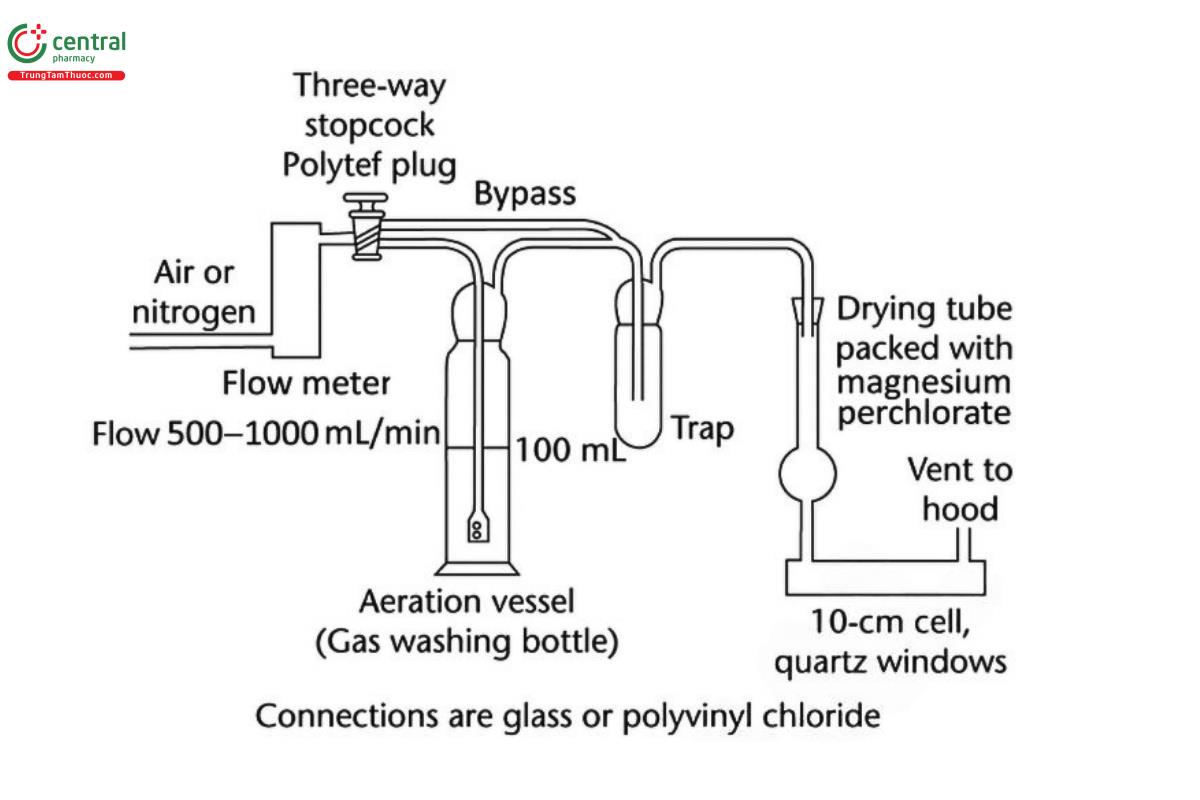
Aeration apparatus: The apparatus (see Figure 1) consists of a flow meter capable of measuring flow rates from 500–1000 mL/min, connected via a three-way stopcock fitted with a polytef plug to an aeration vessel (250-mL gas washing bottle), followed by a trap, a drying tube packed with magnesium perchlorate, a 10-cm × 25-mm flow-through cell with quartz windows, and terminating with a vent to a fume hood.
Potassium permanganate solution: Dissolve 5 g of potassium permanganate in 100 mL of water.
Hydroxylamine hydrochloride solution: Dissolve 10 g of hydroxylamine hydrochloride in 100 mL of water.
Stannous chloride solution: Dissolve 10 g of stannous chloride dihydrate (SnCl₂·2H₂O) in 20 mL of warm hydrochloric acid, and add 80 mL of water. Prepare fresh each week.
Standard mercury solution: Prepare from Mercury stock solution as directed under Procedure 1. (Official 1-Jun-2023) Each milliliter of the Standard mercury solution contains the equivalent of 1 µg of mercury.
Test sample (Official 1-Jun-2023): Unless otherwise directed in the individual monograph, use the quantity, in grams, of the test substance calculated as follows:
Result = 2.0/L
L = limit of mercury (ppm)
2.2.1 Procedure 2: Atomic Absorption Spectroscopy (Official 1-Jun-2023)
Standard preparation: Pipet 2.0 mL of Standard mercury solution into a 100-mL beaker, and add 35 mL of water, 3 mL of sulfuric acid, and 1 mL of potassium permanganate solution. Cover the beaker with a watch glass, boil for a few seconds, and cool.
Test preparation: Transfer the calculated amount of the test substance to a 100-mL beaker, and add 35 mL of water. Stir, and warm to assist solution, if necessary. Add 2 drops of phenolphthalein TS, and, as necessary, slowly neutralize with constant stirring, using 1 N sodium hydroxide or 1 N sulfuric acid. Add 3 mL of sulfuric acid and 1 mL of Potassium permanganate solution. Cover the beaker with a watch glass, boil for a few seconds, and cool.
Analysis: (Official 1-Jun-2023) Assemble the aeration apparatus (see Figure 1), with the aeration vessel and the trap empty, and the stopcock in the bypass position. Connect the apparatus to the absorption cell, and adjust the air or nitrogen flow rate so that, in the following procedure, maximum absorption and reproducibility are obtained without excessive foaming in the test solution. Obtain a smooth baseline reading at 253.6 nm, following the manufacturer's instructions for operating the instrument.
Treat the Standard preparation and the Test preparation similarly, as follows. Destroy the excess permanganate by adding Hydroxylamine hydrochloride solution, dropwise, until the solution is colorless. Immediately wash the solution into the aeration vessel with water, and dilute with water to 100 mL. Add 2 mL of Stannous chloride solution, and immediately reconnect the aeration vessel to the aeration apparatus. Turn the stopcock from the bypass position to the aerating position, and continue the aeration until the absorption peak has been passed and the recorder pen returns to the baseline. Disconnect the aeration vessel from the apparatus, and wash with water after each use. After correcting for any reagent blank, any absorbance produced by the Test preparation does not exceed that produced by the Standard preparation.
2.2.2 Procedure 3: Atomic Absorption Spectroscopy (Official 1-Jun-2023)
[Caution—Some substances may react with explosive violence when digested with hydrogen peroxide. Exercise safety precautions at all times.]
Standard preparation: Pipet 2.0 mL of Standard mercury solution into a 125-mL conical flask, add 3 mL each of nitric acid and sulfuric acid, mix, and add an amount of 30 percent Hydrogen peroxide equal to the total amount used in preparing the Test preparation. Attach a suitable water-cooled condenser with a standard-taper joint to fit the flask, and reflux the mixture in a fume hood for 1 h. Turn off the water circulating through the condenser, and heat until white fumes appear in the flask. Cool, and cautiously add 10 mL of water through the condenser, while swirling the flask. Again heat until white fumes appear, cool, and add an additional 15 mL of water. Remove the condenser, and rinse the sides of the flask to obtain a volume of 35 mL. Add 1 mL of Potassium permanganate solution, boil for a few seconds, and cool.
Test preparation: Transfer the calculated amount of the test substance to a 125-mL conical flask. Add 5 mL each of nitric acid and sulfuric acid and a few glass beads. Attach a suitable water-cooled condenser with a standard-taper joint to fit the flask, and digest in a fume hood, preferably on a hot plate, and at a temperature not exceeding 120°, until charring begins. (If additional sulfuric acid is necessary to wet the specimen completely, add it carefully through the condenser, but do not allow the total volume added to exceed 10 mL.) After the test substance has been decomposed by the acid, cautiously add, dropwise through the condenser, 30 percent hydrogen peroxide, allowing the reaction to subside and again heating between drops (add the first few drops very slowly with sufficient mixing, in order to prevent a rapid reaction; discontinue heating if foaming becomes excessive). When the reaction has abated, heat cautiously, rotating the flask occasionally to prevent the specimen from caking on glass exposed to the heating unit. Maintain oxidizing conditions at all times during the digestion by adding small quantities of the hydrogen peroxide solution whenever the mixture turns brown or darkens. Continue the digestion until the organic matter is destroyed, and then reflux the mixture for 1 h. Turn off the water circulating through the condenser, and heat until fumes of sulfur trioxide are copiously evolved and the solution becomes colorless or retains only a light straw color. Cool, and cautiously add 10 mL of water through the condenser, while swirling the flask. Again heat until white fumes appear. Cool, and cautiously add 15 mL of water. Remove the condenser, and rinse the sides of the flask with a few milliliters of water to obtain a volume of 35 mL. Add 1 mL of Potassium permanganate solution, boil for a few seconds, and cool.
Analysis: (Official 1-Jun-2023) Proceed as directed for Analysis under Procedure 2.
2.3 Procedure 4 and Procedure 5
Both Procedures 4 and Procedure 5 are ICP-based procedures and can be used for the determination of mercury. Procedure 4 can be used for the determination of mercury by inductively coupled plasma atomic (or optical) emission spectroscopy (ICP–AES or ICP–OES). Procedure 5 can be used for the determination of mercury by ICP–MS.
Before initial use, the analyst should verify that the procedure is appropriate for the instrument and sample used (procedural verification) by meeting the Requirements for Procedure Validation.
Where a monograph specifies a limit for mercury concentration, the value listed in the monograph should be used as the J value for the purposes of this test.
System standardization and suitability evaluation using applicable reference materials should be performed on the day of analysis.
Sample preparation: Forms of sample preparation include neat, direct aqueous solution, direct organic solution, and indirect solution. The selection of the appropriate sample preparation depends on the material under test and is the responsibility of the analyst. When a sample preparation is not indicated in the monograph, an analyst may use any appropriately validated preparation procedure. In cases where spiking of a material under test is necessary to provide an acceptable signal intensity, the blank should be spiked with mercury using, where possible, the same spiking solution. [Note—All liquid samples should be weighed.]
Closed vessel digestion: This sample preparation procedure is designed for samples that must be digested in a concentrated acid using a closed vessel digestion apparatus. Closed vessel digestion minimizes the loss of volatile impurities. The choice of a concentrated acid depends on the sample matrix. The use of any of the concentrated acids may be appropriate, but each introduces inherent safety risks. Therefore, appropriate safety precautions should be used at all times. [Note—Weights and volumes provided may be adjusted to meet the requirements of the digestion apparatus used.]
An example procedure that has been shown to have broad applicability is as follows. Dehydrate and predigest 0.5 g of primary sample in 5 mL of freshly prepared concentrated acid. Allow to sit loosely covered for 30 min in a fume hood. Add an additional 10 mL of concentrated acid, and digest, using a closed vessel technique, until digestion or extraction is complete. Repeat, if necessary, by adding an additional 5 mL of concentrated acid. [Note—Follow the manufacturer’s recommended procedures to ensure safe use.]
Reagents: All reagents used for the preparation of sample and standard solutions should be free of elemental impurities, in accordance with Plasma Spectrochemistry 〈730〉.
Procedure 4: ICP–OES
Standardization solution 1: 1.5J of mercury in a matched matrix
Standardization solution 2: 0.5J of mercury in a matched matrix
Sample stock solution: Prepare as directed in Sample preparation. Allow the sample to cool, if necessary. For mercury determination, add an appropriate stabilizer.
Sample solution: Dilute the Sample stock solution with an appropriate solvent to obtain a final concentration of mercury at not more than 1.5J.
Blank: Matched matrix
Elemental spectrometric system
(See 〈730〉.)
Rinse: Use diluent.
Standardization: Standardization solution 1, Standardization solution 2, and Blank
System suitability
Sample: Standardization solution 1
Suitability requirements
Drift: Compare results obtained from Standardization solution 1 before and after the analysis of the Sample solution.
Suitability criteria: Not more than 20% for mercury. [Note—If samples are high in mineral content, rinse the system well before introducing the Sample in order to minimize carryover.]
Analysis: Analyze according to the manufacturer's suggestions for program and wavelength. Calculate and report results on the basis of the original sample size. [Note—Appropriate measures must be taken to correct for matrix-induced interferences (e.g., wavelength overlaps).]
Procedure 5: ICP–MS
Follow Procedure 4 except for Detector and Analysis.
[Note—An instrument with a cooled spray chamber is recommended. (A collision cell or reaction cell may also be beneficial.)]
Detector: Mass spectrometer
Analysis: Analyze according to the manufacturer's suggestions for program and mass-to-charge ratio. Calculate and report results based on the original sample size. [Note—Appropriate measures must be taken to correct for matrix-induced interferences.] (Official 1-Jun-2023)
Add the following:
3 REQUIREMENTS FOR PROCEDURE VALIDATION
The following section defines the validation parameters and the acceptance criteria for performance-based procedures. Meeting these requirements must be demonstrated experimentally using an appropriate system suitability procedure and reference materials. Any alternative procedure (e.g., an atomic-absorption-based procedure) that has been validated and meets the acceptance criteria that follow is considered to be suitable for use.
Meeting these validation acceptance criteria is sufficient to demonstrate that the procedure will produce comparable results to those obtained using the procedure prescribed in the monograph.
3.1 Accuracy
Standard solutions: Prepare solutions containing mercury at concentrations ranging from 50% to 150% of J using appropriate reference materials.
Test samples: Spike the material under test with the appropriate reference materials before any sample preparation steps (digestion or solubilization). Prepare three replicate samples at concentrations ranging from 50% to 150% of J for mercury.
Acceptance criteria
Spike recovery: 70%–150% for the mean of three replicate preparations at each concentration
3.2 Precision
Repeatability
Test samples: Six independent samples of material under test (taken from the same lot) spiked with appropriate reference materials for mercury at the indicated concentration
Acceptance criteria
Relative standard deviation: Not more than 20% (N = 6) for mercury
Intermediate precision (ruggedness)
Analysis: Perform the Repeatability analysis again on a different day, with different instrumentation, with a different analyst, or a combination thereof. Combine the results of this analysis with the Repeatability analysis so the total number of analyses is 12.
Acceptance criteria
Relative standard deviation: Not more than 25% (N = 12) for mercury
3.3 Specificity
The procedure must be able to unequivocally assess (see Validation of Compendial Procedures 〈1225〉) mercury in the presence of components that may be expected to be present, including matrix components.
3.4 Limit of Quantitation, Range, and Linearity
Demonstrated by meeting the Accuracy requirement. (Official 1-Jun-2023)
Add the following:
4 GLOSSARY
Concentrated acid: Concentrated ultra-pure nitric, sulfuric, hydrochloric, or hydrofluoric acid or aqua regia.
Aqua regia: Aqua regia is a mixture of concentrated hydrochloric and nitric acids, typically at ratios of 3:1 or 4:1.
Matched matrix: Solutions having the same solvent composition as the Sample solution. In the case of an aqueous solution, matched matrix would indicate that the same acids, acid concentrations are used in both preparations.
Target limit or target concentration: The acceptance value for the elemental impurity being evaluated, in this case mercury. Where a monograph specifies a threshold limit, this shall become the target limit or target concentration for mercury for the material. Exceeding the target limit indicates that a material under test exceeds the acceptable value. The determination of compliance is addressed in other chapters.
J: The concentration (w/w) of the element of interest, in this case mercury, at the target limit, appropriately diluted to the working range of the instrument.
Appropriate reference materials: Where "appropriate reference materials" are specified in the chapter, certified reference materials (CRMs) from a national metrology institute (NMI), or reference materials that are traceable to the CRM of an NMI should be used. An example of an NMI in the United States is the National Institute of Standards and Technology (NIST). (Official 1-Jun-2023)

