
Menthol
If you find any inaccurate information, please let us know by providing your feedback here
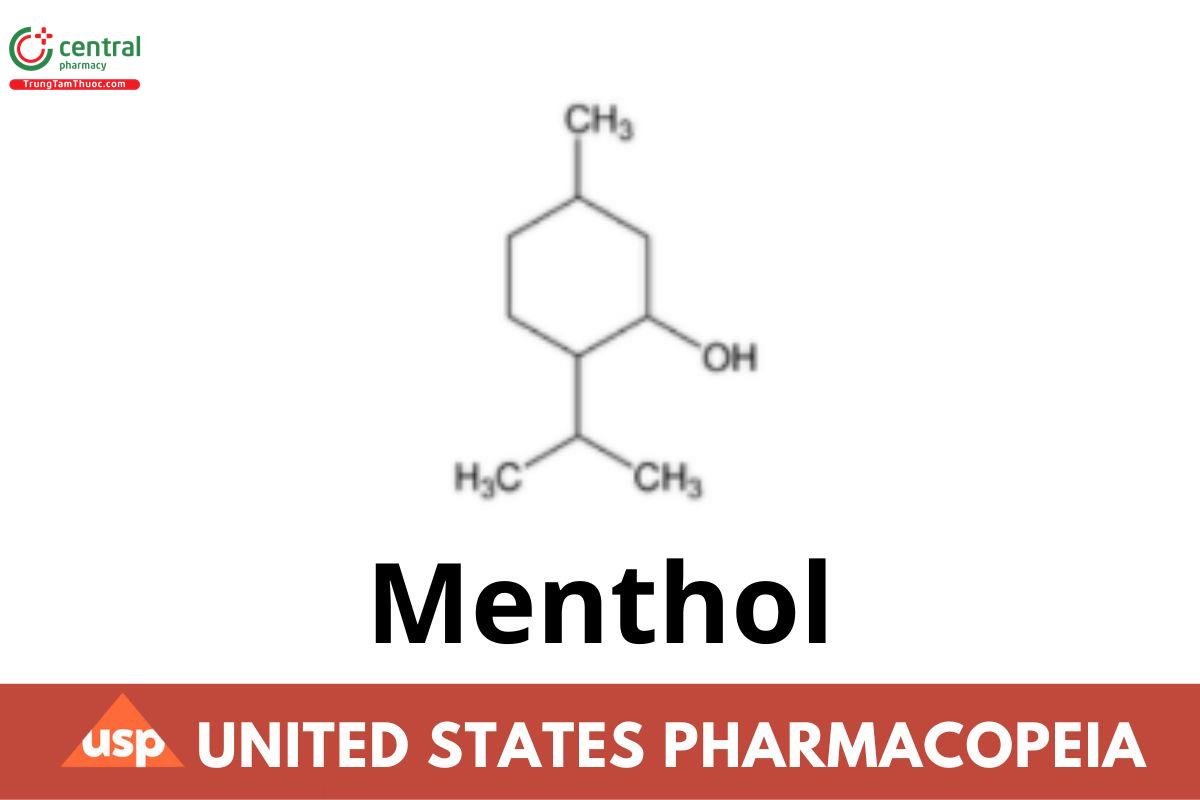

This article is compiled based on the United States Pharmacopeia (USP) – 2025 Edition
Issued and maintained by the United States Pharmacopeial Convention (USP)
DOWNLOAD PDF HERE
1 DEFINITION
Menthol is an alcohol obtained from oils derived from a variety of mints or prepared synthetically. Menthol may be levorotatory (l-menthol) from natural or synthetic sources, or racemic (dl-menthol). It contains NLT 98.0% and NMT 102.0% of menthol (C10H20O).
2 IDENTIFICATION
A. The retention time of the major peak from the Sample solution corresponds to that of the menthol peak from the Standard solution, as obtained in the Assay.
B. It meets the requirements in the test for Optical Rotation.
3 ASSAY
Change to read:
Procedure
Internal standard solution: 10 mg/mL of 1-butanol in hexanes (USP 1-Dec-2022)
Standard solution: 10 mg/mL of USP Menthol RS in the Internal standard solution (USP 1-Dec-2022)
Sample solution: 10 mg/mL of Menthol in the Internal standard solution (USP 1-Dec-2022)
Chromatographic system
(See Chromatography 〈621〉, System Suitability.)
Mode: GC
Detector: Flame ionization
Column: 0.18-mm × 20-m fused silica; coated with a 0.18-μm
lm of stationary phase G16
Temperatures
Injection port: 250°
Detector: 260°
Column: See Table 1.
Table 1
Initial Temperature (°) | Temperature Ramp (°/min) | Final Temperature (°) | Hold Time at Final Temperature (min) |
| 60 | 20 | 110 | 10 |
Carrier gas: Hydrogen
Flow rate: 0.9 mL/min
Injection volume: 0.5 μL
Injection type: Split ratio, 50:1
System suitability
Sample: Standard solution
[Note—The relative retention times for the internal standard and menthol are about 0.27 and 1.00, respectively.] (USP 1-Dec-2022)
Suitability requirements
Relative standard deviation: NMT 2.0% for the ratio of menthol to internal standard peak responses (USP 1-Dec-2022) in replicate injections
Analysis
Samples: Standard solution and Sample solution
Calculate the percentage of menthol (C10H20O) in the portion of Menthol taken:
Result = (rU/rS) × (CS/CU) × 100
rU = peak response ratio (USP 1-Dec-2022) of menthol to the internal standard (USP 1-Dec-2022) from the Sample solution
rS = peak response ratio (USP 1-Dec-2022) of menthol to the internal standard (USP 1-Dec-2022) from the Standard solution
CS = concentration of USP Menthol RS in the Standard solution (mg/mL)
CU = concentration of Menthol in the Sample solution (mg/mL)
Acceptance criteria: 98.0%–102.0%
4 IMPURITIES
Limit of Nonvolatile Residue
Analysis: Evaporate 2 g, accurately weighed, in a tared open porcelain dish on a steam bath, and dry the residue at 105° for 1 h.
Acceptance criteria: NMT 0.05%
Change to read:
Related Compounds
Internal standard solution, (USP 1-Dec-2022) Standard solution, Sample solution, Chromatographic system, and System suitability: Proceed as directed in the Assay.
Analysis
Sample: Sample solution
Calculate the percentage of each individual impurity in the portion of Menthol taken:
Result = (rU/rT) × 100
rU = peak area of each impurity from the Sample solution
rT = sum of the peak areas from the Sample solution
Acceptance criteria
Individual impurities: NMT 0.5% for isomenthol (relative retention time is 1.08) from synthetic racemic menthol and 0.3% for all other
impurities from natural and synthetic menthol
Total impurities: NMT 2.0%
Readily Oxidizable Substances in dl-Menthol
Sample solution: Place 500 mg of dl-menthol in a clean, dry test tube. Add 10 mL of a solution of potassium permanganate, prepared by diluting 3 mL of 0.1 N potassium permanganate with water to 100 mL.
Analysis: Place the test tube in a beaker with water at a temperature between 45° and 50°. Remove the tube from the bath at intervals of 30 s, and mix quickly by shaking.
Acceptance criteria: The purple color of potassium permanganate is still apparent after 5 min.
5 SPECIFIC TESTS
Congealing Range of dl-Menthol
(See Congealing Temperature 〈651〉.)
[Note—Perform this test preferably in a room with a temperature below 30° and a relative humidity below 50%.]
Sample: 10 g of dl-menthol, previously dried in a desiccator over silica gel for 24 h
Analysis: Place the Sample in a dry test tube with an internal diameter of 18–20 mm, and melt the contents at a temperature of about 40°.
Suspend the test tube in water at a temperature of 23°–25°, and stir the contents of the tube continually with a thermometer, keeping the bulb of the thermometer immersed in the liquid.
Acceptance criteria: dl-Menthol congeals at a temperature between 27° and 28°. Shortly after the temperature has stabilized at the congealing point, add a few milligrams of dried dl-menthol to the congealed mass, and continue stirring. After a few min, the temperature of the mass quickly rises to 30.5°–32.0°.
Melting Range of l-Menthol
(See Melting Range or Temperature 〈741〉.)
Acceptance criteria: 41°–44°
Optical Rotation 〈781S〉, Procedures, Specific RotationSample solution: 100 mg/mL in alcohol
Acceptance criteria
l-Menthol: −45° to −51°
dl-Menthol: −2° to +2°
6 ADDITIONAL REQUIREMENTS
Packaging and Storage: Preserve in tight containers, preferably at controlled room temperature.
Labeling: Label it to indicate whether it is levorotatory or racemic.
USP Reference Standards 〈11〉
USP Menthol RS

