
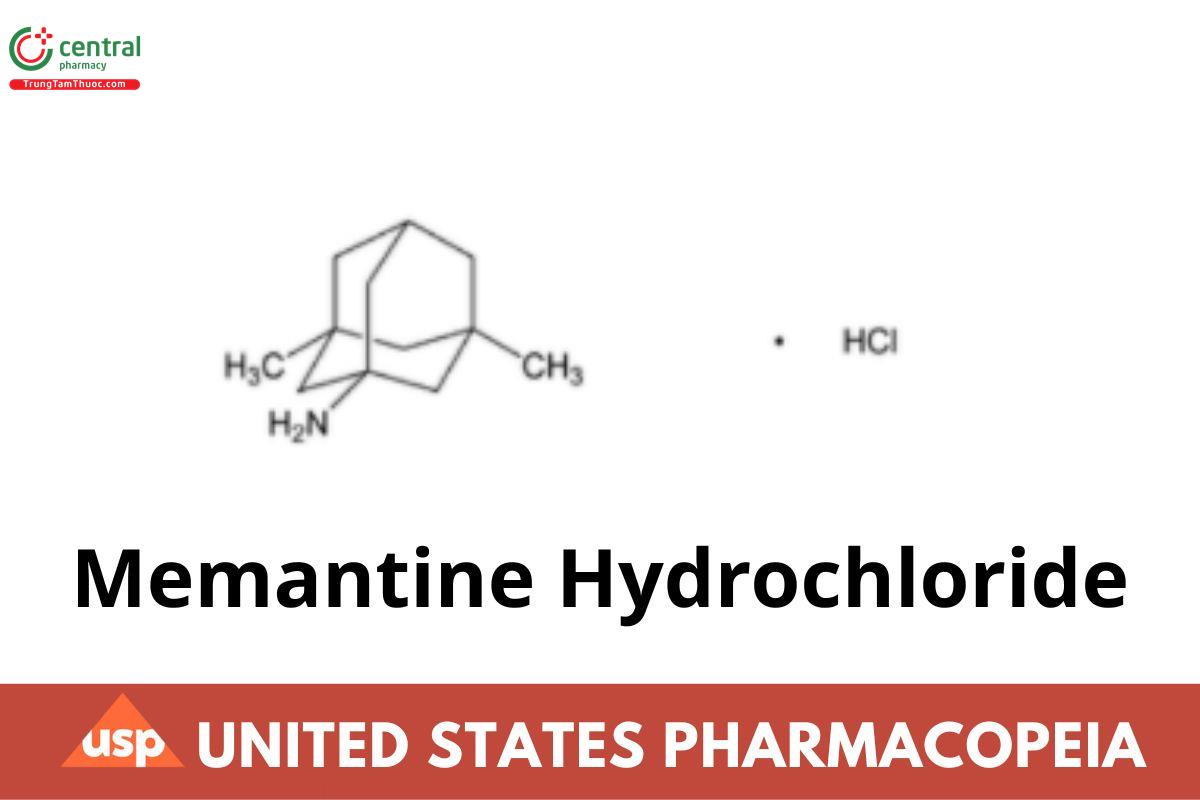
Memantine Hydrochloride
If you find any inaccurate information, please let us know by providing your feedback here

This article is compiled based on the United States Pharmacopeia (USP) – 2025 Edition
Issued and maintained by the United States Pharmacopeial Convention (USP)
DOWNLOAD PDF HERE
1 DEFINITION
Memantine Hydrochloride contains NLT 98.0% and NMT 102.0% of memantine hydrochloride (C12H21N · HCl), calculated on the anhydrous basis.
2 IDENTIFICATION
Change to read:
A. Spectroscopic Identification Tests 〈197〉, Infrared Spectroscopy: 197K (CN 1-May-2020)
B. The retention time of the major peak of the Sample solution corresponds to that of the Standard solution, as obtained in the Assay.
C. Identification Tests—General, Chloride 〈191〉: Meets the requirements
3 ASSAY
Procedure
Internal standard solution: 4.0 mg/mL of adamantane in n-hexane
Standard solution: 4.0 mg/mL of USP Memantine Hydrochloride RS in Internal standard solution prepared as follows. Transfer 100 mg of USP
Memantine Hydrochloride RS to a 50-mL centrifuge tube. Add 15 mL of 1 N sodium hydroxide, and mix. Add 25 mL of Internal standard solution, and shake for 15 min. Allow the layers to separate, and filter a portion of the top hexane layer through anhydrous sodium sulfate.
Use the clear filtrate.
Sample solution: 4.0 mg/mL of Memantine Hydrochloride in Internal standard solution prepared as follows. Transfer 100 mg of Memantine Hydrochloride to a 50-mL centrifuge tube. Add 15 mL of 1 N sodium hydroxide, and mix. Add 25 mL of Internal standard solution, and shake for 15 min. Allow the layers to separate, and filter a portion of the top hexane layer through anhydrous sodium sulfate. Use the clear filtrate.
Chromatographic system
(See Chromatography 〈621〉, System Suitability.)
Mode: GC
Detector: Flame ionization
Column: 50-m × 0.32-mm; 0.52-μm packing G27
Temperatures
Injection port: 220°
Detector: 300°
Column: See Table 1.
Table 1
Initial Temperature (°) | Temperature Ramp (°/min) | Final Temperature (°) | Hold Time at Final Temperature (min) |
| 50 | 5 | 145 | 0 |
| 145 | 10 | 250 | 20 |
Carrier gas: Helium
Flow rate: 4.0 ± 0.4 mL/min
Injection volume: 1 μL
Injection type: Split ratio, 1:50
System suitability
Sample: Standard solution
Suitability requirements
Tailing factor: NMT 2.0 each for memantine and adamantane
Relative standard deviation: NMT 2.0% for the ratio of the peak areas of adamantane and memantine
Analysis
Samples: Standard solution and Sample solution
Calculate the percentage of memantine hydrochloride (C12H21N · HCl) in the portion of Memantine Hydrochloride taken:
Result = (RU/RS) × (CS/CU) × 100
RU = peak response ratio of memantine to the internal standard from the Sample solution
RS = peak response ratio of memantine to the internal standard from the Standard solution
CS = concentration of USP Memantine Hydrochloride RS in the Standard solution (mg/mL)
CU = concentration of Memantine Hydrochloride in the Sample solution (mg/mL)
Acceptance criteria: 98.0%–102.0% on the anhydrous basis
4 IMPURITIES
Residue on Ignition 〈281〉: NMT 0.1%
Organic Impurities
Standard stock solution A: 2.5 mg/mL each of USP Memantine Related Compound A RS, USP Memantine Related Compound B RS, USP Memantine Related Compound C RS, USP Memantine Related Compound D RS, and USP Memantine Related Compound E RS in n-hexane
Standard stock solution B: 2.5 mg/mL of USP Memantine Hydrochloride RS prepared as follows. To the flask containing a weighed amount of USP Memantine Hydrochloride RS, add 5.0 N sodium hydroxide to fill 20% of the final volume and n-hexane to fill 20% of the final volume.
Shake for 10 min, and transfer the contents to a separator. Allow the layers to separate, filter a portion of the top hexane layer, dry the organic layer by swirling with anhydrous sodium sulfate, and allow to stand for a few min to ensure all the remaining water has been removed. Use the clear filtrate.
System suitability solution: 25 μg/mL each of USP Memantine Related Compound A RS, USP Memantine Related Compound B RS, USP Memantine Related Compound C RS, USP Memantine Related Compound D RS, and USP Memantine Related Compound E RS, from Standard stock solution A in Standard stock solution B. The concentration of USP Memantine Hydrochloride RS is 2.5 mg/mL.
Standard solution: 25 μg/mL each of USP Memantine Related Compound A RS, USP Memantine Related Compound B RS, USP Memantine Related Compound C RS, USP Memantine Related Compound D RS, USP Memantine Related Compound E RS, and USP Memantine Hydrochloride RS, from Standard stock solution A and Standard stock solution B, respectively, in n-hexane
Sample solution: 25 mg/mL of Memantine Hydrochloride prepared as follows. Transfer the weighed amount of Memantine Hydrochloride to a suitable volumetric flask. Add 5.0 N sodium hydroxide to fill 30% of the final volume and n-hexane to fill 40% of the final volume. Shake for 10 min, and transfer the contents to a separator. Allow the layers to separate, filter a portion of the top hexane layer, dry the organic layer by swirling with anhydrous sodium sulfate, and allow to stand for a few min to ensure all the remaining water has been removed. Use the clear filtrate.
Chromatographic system: Proceed as directed in the Assay.
System suitability
Samples: System suitability solution and Standard solution
[Note—See Table 2 for the relative retention times.]
Suitability requirements
Resolution: NLT 6.0 between memantine and memantine related compound B; NLT 2.0 between memantine related compound B and memantine related compound C, System suitability solution
Tailing factor: NMT 2.0 for memantine, Standard solution
Relative standard deviation: NMT 10.0% for memantine, Standard solution
Analysis
Samples: Standard solution and Sample solution
[Note—Ignore the peaks at the relative retention times 0.11, 0.12, 0.13, 0.18, and 0.26 with respect to the memantine peak, as they correspond to residual solvents.]
Calculate the percentage of each of memantine related compounds A, B, C, D, and E in the portion of Memantine Hydrochloride taken:
Result = (rU/rS) × (CS/CU) × 100
rU = peak response of memantine related compounds A, B, C, D, or E from the Sample solution
rS = peak response of the corresponding USP Memantine Related Compound RS from the Standard solution
CS = concentration of the corresponding USP Memantine Related Compound RS in the Standard solution (mg/mL)
CU = concentration of Memantine Hydrochloride in the Sample solution (mg/mL)
Calculate the percentage of any other impurity in the portion of Memantine Hydrochloride taken:
Result = (rU/rS) × (CS/CU) × 100
rU = peak response of any other impurity from the Sample solution
rS = peak response of memantine hydrochloride from the Standard solution
CS = concentration of USP Memantine Hydrochloride RS in the Standard solution (mg/mL)
CU = concentration of Memantine Hydrochloride in the Sample solution (mg/mL)
Acceptance criteria: See Table 2.
Table 2
| Name | Relative Retention Time | Acceptance Criteria, NMT (%) |
Memantine related compound A | 0.77 | 0.15 |
| Memantine | 1.0 | - |
Memantine related compound B | 1.03 | 0.15 |
Memantine related compound C | 1.07 | 0.15 |
Memantine related compound D | 1.19 | 0.15 |
Memantine related compound E | 1.44 | 0.15 |
Any individual unspecified impurity | - | 0.10 |
| Total impurities | - | 0.50 |
5 SPECIFIC TESTS
Water Determination, Method I 〈921〉: NMT 1.0%
6 ADDITIONAL REQUIREMENTS
Packaging and Storage: Preserve in well-closed containers. Store at controlled room temperature.
USP Reference Standards 〈11〉
USP Memantine Hydrochloride RS
USP Memantine Related Compound A RS
1,3-Dimethyladamantane.
C12H20 164.29
USP Memantine Related Compound B RS
3,5-Dimethyladamantane-1-ol.
C12H20O 180.29
USP Memantine Related Compound C RS
1-Chloro-3,5-dimethyladamantane.
C12H19Cl 198.73
USP Memantine Related Compound D RS
1-Bromo-3,5-dimethyladamantane.
C12H19Br 243.18
USP Memantine Related Compound E RS
N-3,5-Dimethyladamantan-1-yl formamide.
C13H21NO 207.31

