
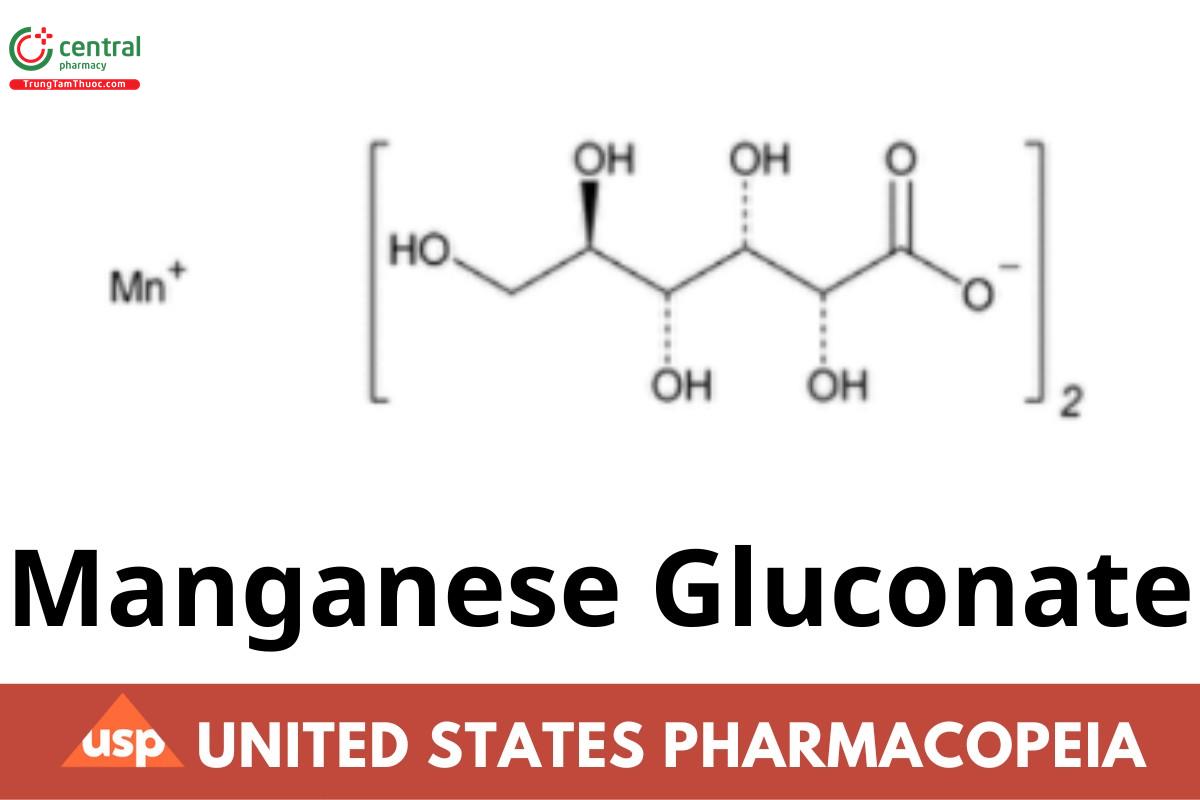
Manganese Gluconate
If you find any inaccurate information, please let us know by providing your feedback here

Tóm tắt nội dung
This article is compiled based on the United States Pharmacopeia (USP) – 2025 Edition
Issued and maintained by the United States Pharmacopeial Convention (USP)
1 DEFINITION
Manganese Gluconate is dried or contains two molecules of water of hydration. It contains NLT 98.0% and NMT 102.0% of manganese gluconate (C12H22MnO14), calculated on the anhydrous basis.
2 IDENTIFICATION
A. IDENTIFICATION TESTS—GENERAL, Manganese 〈191〉: A 50-mg/mL solution meets the requirements.
B. THIN-LAYER CHROMATOGRAPHY
Standard solution: 10 mg/mL of USP Potassium Gluconate RS
Sample solution: 10 mg/mL of Manganese Gluconate, heating in a water bath at 60°, if necessary, to dissolve
Chromatographic system
(See Chromatography 〈621〉, Thin-Layer Chromatography.)
Mode: TLC
Adsorbent: 0.25-mm layer of chromatographic silica gel
Application volume: 5 µL
Developing solvent system: Alcohol, ethyl acetate, ammonium hydroxide, and water (50:10:10:30)
Spray reagent: Dissolve 2.5 g of ammonium molybdate in 50 mL of 2 N sulfuric acid in a 100-mL volumetric flask. Add 1.0 g of ceric sulfate, swirl to dissolve, and dilute with 2 N sulfuric acid to volume.
Analysis
Samples: Standard solution and Sample solution
Develop the chromatogram until the solvent front has moved about three-fourths of the length of the plate. Remove the plate from the chamber, and dry at 110° for 20 min. Allow to cool, and spray with Spray reagent. Heat the plate at 110° for about 10 min.
Acceptance criteria: The principal spot of the Sample solution corresponds in color, size, and R value to that of the Standard solution.
3 ASSAY
3.1 PROCEDURE
Sample: 700 mg of Manganese Gluconate Blank: 50 mL of water
Titrimetric system (See Titrimetry 〈541〉.)
Mode: Direct titration
Titrant: 0.05 M edetate disodium VS Endpoint detection: Visual
Analysis: Dissolve the Sample in 50 mL of water. Add 1 g of ascorbic acid and 10 mL of ammonia–ammonium chloride buffer TS and 0.1 mL of eriochrome black TS. Titrate with the Titrant until the solution is deep blue in color. Perform the blank determination.
Calculate the percentage of manganese gluconate (C12H22MnO14) in the Sample taken:
Result = {[(VS − VB) × M × F]/W} × 100
VS = Titrant volume consumed by the Sample (mL)
VB = Titrant volume consumed by the Blank (mL)
M = actual molarity of the Titrant (mmol/mL)
F = equivalency factor, 445.2 mg/mmol
W = Sample weight (mg)
Acceptance criteria: 98.0%–102.0% on the anhydrous basis
4 IMPURITIES
4.1 CHLORIDE AND SULFATE, Chloride 〈221〉
Standard: 0.70 mL of 0.020 N hydrochloric acid Sample: 1.0 g of Manganese Gluconate Acceptance criteria: NMT 0.05%
4.2 CHLORIDE AND SULFATE, Sulfate 〈221〉
Standard: 4.0 mL of 0.020 N sulfuric acid Sample: 2.0 g of Manganese Gluconate Acceptance criteria: NMT 0.2%
4.3 LEAD
[NOTE—For the preparation of all aqueous solutions and for the rinsing of glassware before use, use water that has been passed through a strong-acid, strong-base, mixed-bed ion-exchange resin. Select all reagents to have as low a content of lead as practicable, and store all reagent solutions in containers of borosilicate glass. Cleanse glassware before use by soaking in warm 8 N nitric acid for 30 min and by rinsing with deionized water.]
Ascorbic acid–sodium iodide solution: 100 mg/mL of ascorbic acid and 192.5 mg/mL of sodium iodide Trioctylphosphine oxide solution: 50 mg/mL of trioctylphosphine oxide in 4-methyl-2-pentanone.
[CAUTION—This solution causes irritation. Avoid contact with eyes, skin, and clothing. Take special precautions in disposing of unused portions of solutions to which this reagent is added.]
Standard solution: Transfer 5.0 mL of lead nitrate stock solution TS, to a 100-mL volumetric flask. Dilute with water to volume. Transfer 2.0 mL of the resulting solution to a 50-mL volumetric flask. Add 10 mL of 9 N hydrochloric acid and 10 mL of water. Add 20 mL of Ascorbic acid–sodium iodide solution and 5.0 mL of Trioctylphosphine oxide solution. Shake for 30 s, and allow to separate. Add water to bring the organic solvent layer into the neck of the flask, shake again, and allow to separate. The organic layer is the Standard solution, and it contains 2.0 µg/mL of lead.
Sample solution: To a 50-mL volumetric flask add 1.0 g of Manganese Gluconate, 10 mL of 9 N hydrochloric acid, 10 mL of water, 20 mL of Ascorbic acid–sodium iodide solution, and 5.0 mL of Trioctylphosphine oxide solution. Shake for 30 s, and allow to separate. Add water to bring the organic solvent layer into the neck of the flask, shake again, and allow to separate. The organic layer is the Sample solution.
Blank: To a 50-mL volumetric flask add 10 mL of 9 N hydrochloric acid, 10 mL of water, 20 mL of Ascorbic acid–sodium iodide solution, and 5.0 mL of Trioctylphosphine oxide solution. Shake for 30 s, and allow to separate. Add water to bring the organic solvent layer into the neck of the flask, shake again, and allow to separate. The organic layer is the Blank, and it contains 0 µg/mL of lead.
4.3.1 Instrumental conditions
(See Atomic Absorption Spectroscopy 〈852〉.)
Mode: Atomic absorption spectrophotometry
Analytical wavelength: 283.3 nm
Lamp: Lead hollow-cathode
Flame: Air–acetylene System suitability
Samples: Standard solution and Blank
Suitability requirements: The absorbance of the Standard solution and the absorbance of the Blank are significantly different.
4.3.2 Analysis
Samples: Standard solution, Sample solution, and Blank
Concomitantly determine the absorbances of the Blank, Standard solution, and the Sample solution. Use the Blank to set the instrument to zero.
Acceptance criteria: The absorbance of the Sample solution does not exceed that of the Standard solution (NMT 10 ppm).
4.4 REDUCING SUBSTANCES
Sample: 1.0 g of Manganese Gluconate
Blank: Proceed as directed in the Analysis, omitting the Sample.
Titrimetric system (See Titrimetry 〈541〉.)
Mode: Residual titration Titrant: 0.1 N iodine VS
Back-titrant: 0.1 N sodium thiosulfate VS Endpoint detection: Visual
Analysis: Transfer the Sample to a 250-mL conical flask, dissolve in 10 mL of water, and add 25 mL of alkaline cupric citrate TS. Cover the flask, boil gently for 5 min, accurately timed, and cool rapidly to room temperature. Add 25 mL of 0.6 N acetic acid, 10.0 mL of Titrant, and 10 mL of 3 N hydrochloric acid, and titrate with Back-titrant, adding 3 mL of starch TS as the endpoint is approached. Perform the blank determination.
Calculate the percentage of reducing substances (as dextrose) in the Sample taken:
Result = {[(VB − VS) × N × F]/W} × 100
VB = Back-titrant volume consumed by the Blank (mL)
VS = Back-titrant volume consumed by the Sample (mL)
N = Back-titrant normality (mEq/mL)
F = equivalency factor, 27 mg/mEq
W = Sample weight (mg)
Acceptance criteria: NMT 1.0%
5 SPECIFIC TESTS
WATER DETERMINATION, Method I 〈921〉
Analysis: Proceed as directed in the chapter. Maintain the mixture containing the Test preparation at 50°, and stir for 30 min before titrating with the Reagent.
Acceptance criteria
Where labeled as the dried form: 3.0%–9.0% Where labeled as the dihydrate: 6.0%–9.0%
6 ADDITIONAL REQUIREMENTS
PACKAGING AND STORAGE: Preserve in well-closed containers.
LABELING: The label indicates whether it is the dried or the dihydrate form.
USP REFERENCE STANDARDS 〈11〉
USP Potassium Gluconate RS

