
Maltose
If you find any inaccurate information, please let us know by providing your feedback here
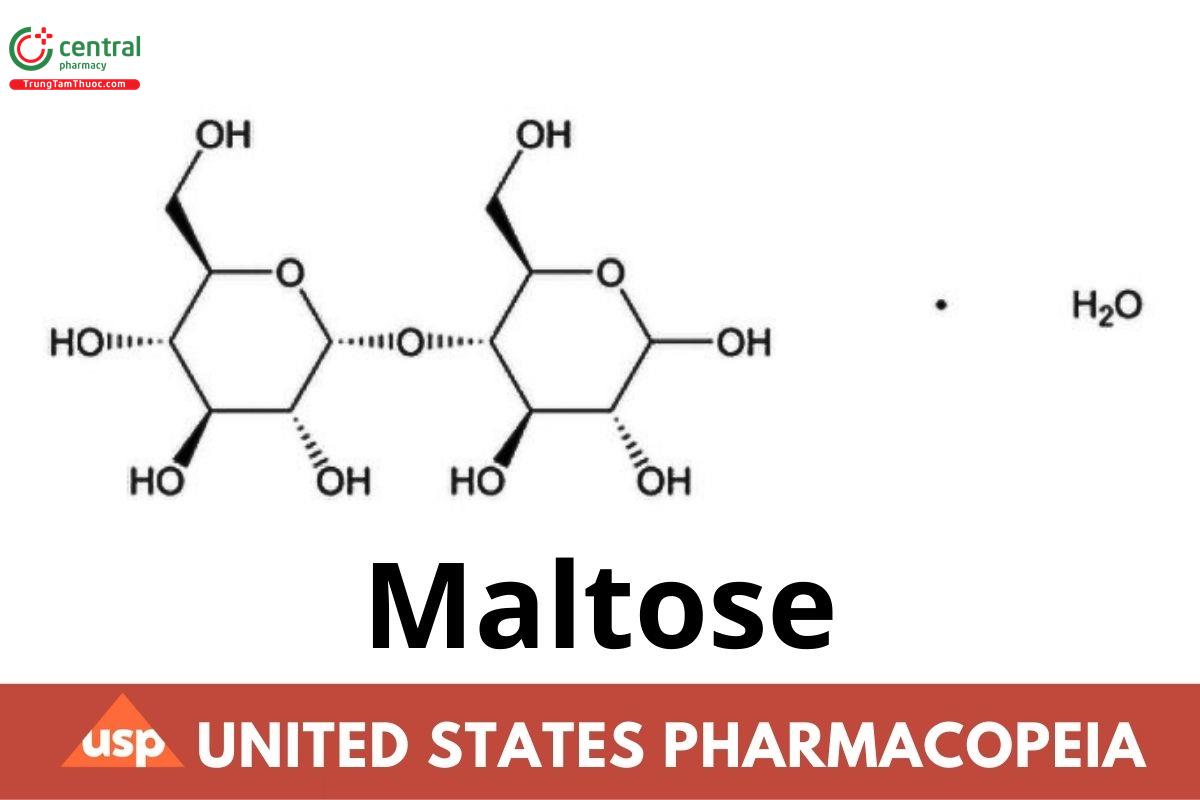

This article is compiled based on the United States Pharmacopeia (USP) – 2025 Edition
Issued and maintained by the United States Pharmacopeial Convention (USP)
C12H22O11 · H2O 360.31
C12H22O11 342.30
4-O-α-d-Glucopyranosyl-β-d-glucose monohydrate CAS RN®: 6363-53-7
4-O-α-d-Glucopyranosyl-β-d-glucose CAS RN®: 69-79-4
1 DEFINITION
Maltose is a sugar. It contains one molecule of water of hydration or is anhydrous. It contains NLT 92.0% of maltose, calculated on the anhydrous basis. The amounts of other sugars, if detected, are not included in the requirements or the calculated amount in General Notices, 5.60.10 Other Impurities in USP and NF Articles.
2 IDENTIFICATION
2.1 A. Perform this test for Anhydrous Maltose only.
Sample solution: 50 mg/mL
Analysis: Add 2–3 drops of the Sample solution to 5 mL of hot alkaline cupric tartrate TS.
Acceptance criteria: A red precipitate is formed.
2.2 B. The retention time of the major peak of the Sample solution corresponds to that of the Standard solution, as obtained in the Assay.
2.3 C. Spectroscopic Identification Tests 〈197〉, Infrared Spectroscopy: 197K
Perform the test for Maltose Monohydrate only. Use the undried sample and USP Maltose Monohydrate RS.
3 ASSAY
Change to read:
3.1 Procedure
Mobile phase: Water
System suitability solution: 10 mg/g each of maltotriose, maltose, and glucose
Standard solution: Dissolve USP Maltose Monohydrate RS in water to obtain a solution having a concentration of about 10 mg/g of maltose.
Sample solution: Dissolve 0.10 g of Maltose in water, and dilute with water to 10 g. Record the final solution weight, and mix thoroughly.
Chromatographic system
- (See Chromatography 〈621〉, System Suitability.)
- Mode: LC
- Detector: Refractive index
- Column: 7.8-mm × 30-cm; packing L58
- Temperatures
- Column: 80 ± 2°
- Detector: 40°
- Flow rate: 0.35 mL/min; adjust so that the resolution between maltotriose and maltose is NLT 1.6.
- Injection volume: 20 µL
System suitability
- Samples: System suitability solution and Standard solution
- [Note-The relative retention times for maltotriose, maltose, and Glucose are about 0.9, 1.0, and 1.2, respectively.]
- Suitability requirements
- Resolution: NLT 1.6 between maltotriose and maltose, System suitability solution
- Relative standard deviation: NMT 2.0%, Standard solution
Analysis
Samples: Standard solution and Sample solution
Calculate the percentage of maltose (C12H22O11) in the portion of Maltose taken:
Result = [(ru/rs) × (Cs/Cu)] / [(100 − W) / 100] × 100
ru = peak response from the Sample solution
rs = peak response from the Standard solution
Cs = concentration of USP Maltose Monohydrate RS in the Standard solution (mg/g)
Cu = concentration of Maltose in the Sample solution (mg/g)
W = percentage of water from the test for Water Determination
Acceptance criteria: NLT 92.0% on the anhydrous basis
4 IMPURITIES
4.1 Residue on Ignition 〈281〉
Sample: 2 g
Acceptance criteria: NMT 0.05%
5 SPECIFIC TESTS
5.1 Dextrin, Starch, and Sulfite
Sample solution: 1.0 g of Maltose in 10 mL of water
Analysis: Add 1 drop of iodine TS to the Sample solution.
Acceptance criteria: A yellow color develops. Then add 1 drop of starch TS; a blue color develops.
5.2 pH 〈791〉
Sample solution: 100 mg/mL in carbon dioxide-free water
Acceptance criteria
- Anhydrous form: 3.7–4.7
- Monohydrate form: 4.0–5.5
5.3 Water Determination 〈921〉, Method I
Anhydrous: NMT 1.5%
Monohydrate: 4.5%–6.5%
6 ADDITIONAL REQUIREMENTS
Packaging and Storage: Preserve in well-closed containers. No storage requirements specified.
USP Reference Standards 〈11〉
USP Maltose Monohydrate RS

