
Mafenide Acetate
If you find any inaccurate information, please let us know by providing your feedback here
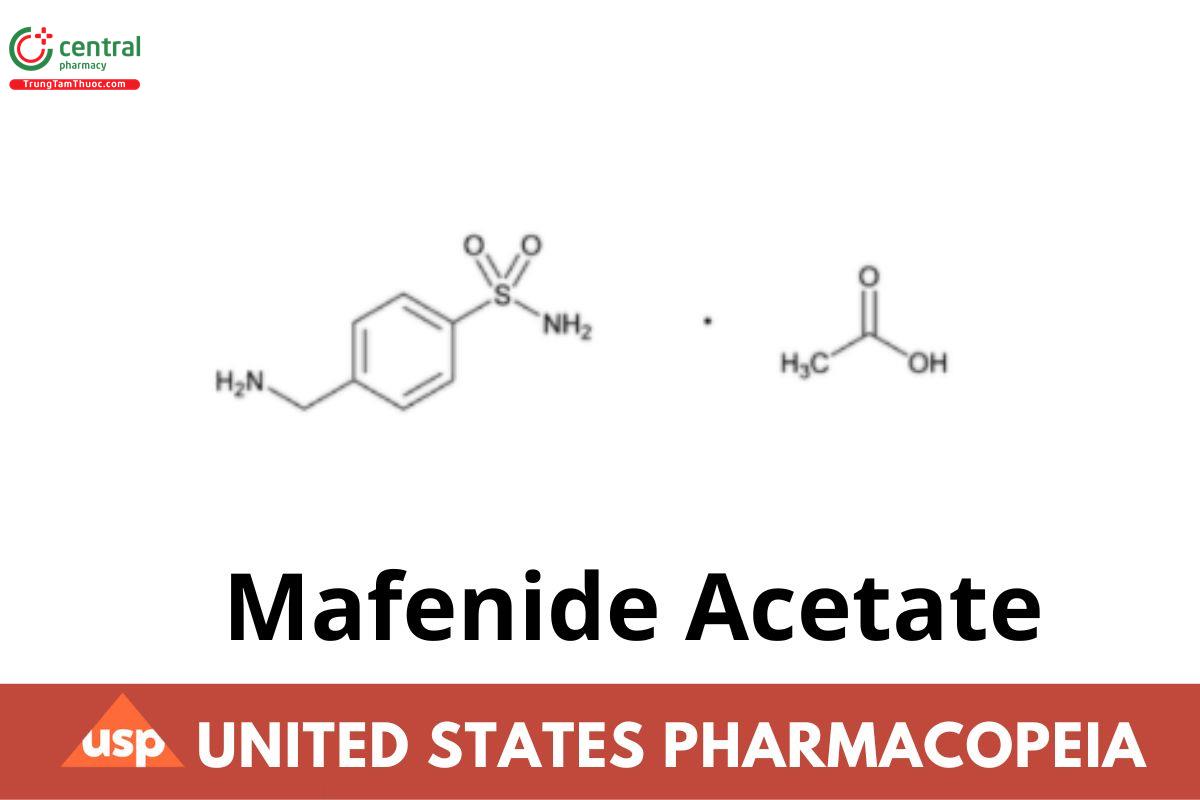

This article is compiled based on the United States Pharmacopeia (USP) – 2025 Edition
Issued and maintained by the United States Pharmacopeial Convention (USP)
DOWNLOAD PDF HERE
1 DEFINITION
Mafenide Acetate contains NLT 98.0% and NMT 102.0% of mafenide acetate (C7H10N2O2S · C2H4O2), calculated on the anhydrous basis.
2 IDENTIFICATION
A. Spectroscopic Identification Tests 〈197〉, Infrared Spectroscopy: 197K
B. The R value of the principal spot of the Identification solution corresponds to that of Standard solution A, as obtained in the test for Organic Impurities.
3 ASSAY
Change to read:
Procedure
Standard solution: 200 μg/mL of USP Mafenide Acetate RS in 0.01 N hydrochloric acid
Sample stock solution: 2 mg/mL of Mafenide Acetate
Sample solution: 200 μg/mL of Mafenide Acetate prepared as follows. Pipet 10 mL of the Sample stock solution into a 100-mL volumetric flask containing 1 mL of 1 N hydrochloric acid, and dilute with water to volume.
Instrumental conditions
(See Ultraviolet-Visible Spectroscopy 〈857〉.) (USP 1-Dec-2021)
Mode: UV
Analytical wavelength: 267 nm
Cell: 1 cm
Blank: 0.01 N hydrochloric acid
Analysis
Samples: Standard solution and Sample solution (USP 1-Dec-2021)
Calculate the percentage of mafenide acetate (C7H10N2O2S · C2H4O2) in the portion of Mafenide Acetate taken:
Result = (AU/AS) × (CS/CU) × 100
AU = absorbance of the Sample solution
AS = absorbance of the Standard solution
CS = concentration of USP Mafenide Acetate RS in the Standard solution (μg/mL)
CU = concentration of Mafenide Acetate in the Sample solution (μg/mL)
Acceptance criteria: 98.0%–102.0% on the anhydrous basis
4 IMPURITIES
Residue on Ignition 〈281〉: NMT 0.2%
Delete the following:
Selenium 〈291〉
Sample: 200 mg
Acceptance criteria: NMT 30 ppm (USP 1-Dec-2021)
Change to read:
Organic Impurities
Standard solution A: 500 μg/mL of USP Mafenide Acetate RS in methanol
Standard solution D: 500 μg/mL of USP Mafenide Related Compound A RS in methanol
(USP 1-Dec-2021)
Standard solutions: Quantitatively dilute portions of Standard solution A with methanol to obtain Standard solution B and Standard solution C.
Similarly, quantitatively dilute portions of Standard solution D with methanol to obtain Standard solution E and Standard solution F. The compositions are shown in Table 1.
Table 1
| Standard Solution | Dilution | Concentration (μg/mL) | Percentage (%, for comparison with test specimen) |
| A | (undiluted) | 500 | 1.0 |
| B | 5 in 10 | 250 | 0.5 |
| C | 1 in 5 | 100 | 0.2 |
| D | (undiluted) | 500 | 1.0 |
| E | 5 in 10 | 250 | 0.5 |
| F | 1 in 5 | 100 | 0.2 |
Sample solution: 50 mg/mL of Mafenide Acetate in methanol
Identification solution: 500 μg/mL from the Sample solution in methanol
Ninhydrin solution: 300 mg of ninhydrin in 100 mL of butyl alcohol. Add 3 mL of glacial acetic acid.
Chromatographic system
(See Chromatography 〈621〉, General Procedures, Thin-Layer Chromatography.)
Mode: TLC
Adsorbent: 0.25-mm layer of chromatographic silica gel mixture
Application volume: 5 μL
Developing solvent system: Ethyl acetate, methanol, and isopropylamine (77:20:3)
Spray reagent: Ninhydrin solution
Analysis
Samples: Standard solutions, Sample solution, and Identification solution
Apply the Samples separately to the chromatographic plate. Position the plate in a chromatographic chamber, and develop the chromatograms in the Developing solvent system until the solvent front has moved about three-fourths of the length of the plate.
Remove the plate from the developing chamber, mark the solvent front, and allow the solvent to evaporate in warm, circulating air.
Examine the plate under short-wavelength UV light, and compare the intensities of any secondary spots observed in the chromatogram of the Sample solution at the R value corresponding to those of the principal spots in the chromatograms of Standard solutions D, E, and F. Spray the plate with Spray reagent, heat the plate at 105° for 5 min, and examine the plate. Compare the intensities of any secondary spots observed in the chromatogram of the Sample solution to those of the principal spots in the chromatograms of
Standard solutions A, B, and C.
Acceptance criteria: No secondary spot, observed by both visualizations, from the chromatogram of the Sample solution is larger or more intense than the principal spots obtained from Standard solution B (0.5%) and Standard solution E (0.5%). The sum of the intensities of all secondary spots obtained from the Sample solution corresponds to NMT 1.0%.
5 SPECIFIC TESTS
Melting Range or Temperature 〈741〉: Between 162° and 171°, but the range between the beginning and end of melting does not exceed 4°.
pH 〈791〉
Sample solution: 100 mg/mL
Acceptance criteria: 6.4–6.8
Water Determination 〈921〉, Method I: NMT 1.0%
6 ADDITIONAL REQUIREMENTS
Packaging and Storage: Preserve in tight, light-resistant containers.
USP Reference Standards 〈11〉
USP Mafenide Acetate RS
USP Mafenide Related Compound A RS
4-Formylbenzenesulfonamide.
C7H7NO3S 185.20

