
Leuprolide Acetate
If you find any inaccurate information, please let us know by providing your feedback here

Tóm tắt nội dung
This article is compiled based on the United States Pharmacopeia (USP) – 2025 Edition
Issued and maintained by the United States Pharmacopeial Convention (USP)
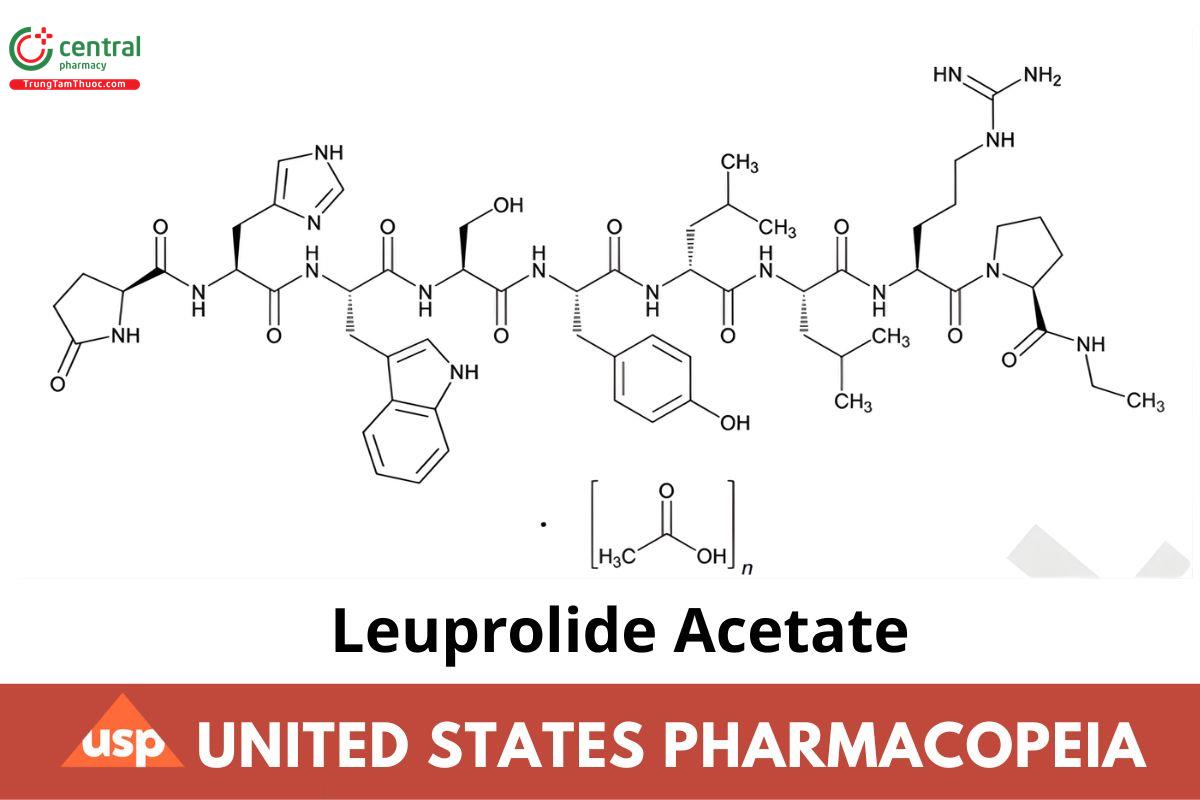
C59H84N16O12 · (C2H4O2)n ,n= 1–2 1209.41 (as free base)
Luteinizing hormone-releasing factor, 6-d-leucine-9-(N-ethyl-l-prolinamide)-10-desglycinamide acetate (salt);
5-Oxo-l-prolyl-l-histidyl-l-tryptophyl-l-seryl-l-tyrosyl-d-leucyl-l-leucyl-l-arginyl-N-ethyl-l-prolinamide acetate (salt);
Free base CAS RN®: 53714-56-0; UNII: EFY6W0M8TG.
Acetate salt CAS RN®: 74381-53-6; UNII: 37JNS02E7V.
1 DEFINITION
Leuprolide Acetate is a synthetic nonapeptide agonist analog of luteinizing hormone-releasing factor. It contains NLT 97.0% and NMT 103.0% of leuprolide (C59H84N16O12 ), calculated on the anhydrous, acetic acid-free basis.
[Note—Due to the hygroscopic nature of this material, analyses are performed immediately after opening the container in a glove box under dry nitrogen purge.]
[Caution—Leuprolide Acetate is a potent hormonal manipulator. Avoid skin contact and inhalation of dusts and mists.]
2 IDENTIFICATION
A. HPLC
Solution A, Solution B, Mobile phase, Standard solution, Degradation standard solution, Sample solution, Chromatographic system, and
System suitability: Proceed as directed in the Assay.
Identity sample solution: Mix equal volumes of the Standard solution and the Sample solution.
Analysis
Samples: Standard solution, Sample solution, and Identity sample solution
Examine the chromatograms of the Standard solution, the Sample solution, and the Identity sample solution.
Acceptance criteria: The retention time of the major peak of the Sample solution corresponds to that of the Standard solution, and the major peak of the Identity sample solution elutes as a single peak.
B. Amino acid Analysis
[Note—The following method is given for informational purposes; any validated amino acid analysis method can be used.]
Standard solutions: Prepare a solution having known equimolar amounts of L-alanine, L-arginine, l-aspartic acid, l-glutamic acid, glycine, l- histidine, l-isoleucine, l-leucine, l-lysine, l-methionine, l-phenylalanine, l-proline, l-serine, l-threonine, l-tyrosine, and l-valine with half the equimolar amount of L-Cystine. Prepare a separate, equimolar solution of l-tryptophan.
Sample solution: Transfer about 6.4 mg of Leuprolide Acetate to a suitable vacuum hydrolysis tube. Add 2.0 mL of 6 N hydrochloric acid to the tube, evacuate, and seal. Heat at 120° for 16 h. Allow to cool. Remove the solvent under vacuum. Dissolve in, and dilute to a suitable volume in, a buffer solution suitable for amino acid analysis.
Analysis: Standardize the instrument with the Standard solutions. Inject suitable volumes of the Standard solutions and the Sample solution into the amino acid analyzer. Record and measure the responses for each amino acid peak. Express the content of each amino acid in nmol.
Calculate the mean nmol of each of the amino acids taken:
Result = (nmol found in the Analysis for Glu, Pro, Tyr, His, Arg, Leu)/7
Divide the nmol of each amino acid by the Result to determine the amino acid ratios that must meet the Acceptance criteria.
Acceptance criteria
Glutamic acid, proline, tyrosine, histidine, and arginine: 0.85–1.1
Leucine: 1.8–2.2
Serine and tryptophan: Present
3 ASSAY
Procedure
Solution A: 15.2 mg/mL of triethylamine in water. Adjust with phosphoric acid to a pH of 3.0.
Solution B: Acetonitrile and n-propyl alcohol (3:2)
Mobile phase: Solution A and Solution B (17:3)
Standard stock solution: 1 mg/mL of USP Leuprolide Acetate RS in Mobile phase
Standard solution: 50 μg/mL of USP Leuprolide Acetate RS in Mobile phase prepared from the Standard stock solution
Degradation standard solution: Dilute the Standard stock solution with water to 0.1 mg/mL. Transfer 5 mL of the solution into a scintillation vial. Add 100 μL of 1 N sodium hydroxide solution, cap tightly, and shake vigorously. Place in an oven at 100° for 60 min. Remove, allow to cool, add 50 μL of 1 M phosphoric acid, recap, and shake vigorously to mix.
Sample solution: 50 μg/mL of Leuprolide Acetate in Mobile phase
Chromatographic system
(See Chromatography 〈621〉, System Suitability.)
Mode: LC
Detector: UV 220 nm
Column: 4.6-mm × 10-cm; 3-μm packing L1
Flow rate: 1–1.5 mL/min
Injection volume: 20 μL
System suitability
Samples: Mobile phase, Standard solution, and Degradation standard solution
[Note—Chromatograph the Mobile phase and verify that no extraneous peaks are present.]
[Note—The relative retention times for the degradation product and leuprolide are about 0.90 and 1.0, respectively.]
Suitability requirements
Resolution: NLT 1.5 between leuprolide and the degradation product, Degradation standard solution
Tailing factor: 0.8–1.5, Standard solution
Retention time: 41–49 min for leuprolide, Degradation standard solution
Relative standard deviation: NMT 1.5% for leuprolide acetate, Standard solution
Analysis
Samples: Standard solution and Sample solution
Calculate the percentage of leuprolide (C59H84N16O12) in the portion of Leuprolide Acetate taken:
Result = (rU/rS)x(CS/CU) × 100
rU = peak area from the Sample solution
rS = peak area from the Standard solution
CS = concentration of USP Leuprolide Acetate RS in the Standard solution (μg/mL)
CU = concentration of Leuprolide Acetate in the Sample solution (μg/mL) on the anhydrous and acetic acid-free basis
Acceptance criteria: 97.0%–103.0% on the anhydrous and acetic acid-free basis
4 OTHER COMPONENTS
Acetic Acid in Peptides 〈503〉: 4.7%–9.0%
5 PRODUCT-RELATED SUBSTANCES AND IMPURITIES
Leuprolide-Related Impurities
Solution A, Solution B, Mobile phase, Standard stock solution, Degradation standard solution, and Chromatographic system: Proceed as directed in the Assay.
Standard solution: 0.01 mg/mL of USP Leuprolide Acetate RS in Mobile phase prepared by diluting the Standard stock solution
Sample solution: 1 mg/mL of Leuprolide Acetate in Mobile phase
System suitability
Samples: Mobile phase, Degradation standard solution, and Standard solution
[Note—Chromatograph the Mobile phase and verify that no extraneous peaks are present.]
[Note—The relative retention times for the degradation product and leuprolide are about 0.90 and 1.0, respectively.]
Suitability requirements
Resolution, Tailing factor, and Retention time: Proceed as directed in the Assay.
Relative standard deviation: NMT 1.5% for leuprolide acetate, Standard solution
Analysis
Samples: Standard solution and Sample solution
[Note—Record the chromatograms for 90 min.]
Calculate the percentage of each impurity in the portion of Leuprolide Acetate taken:
Result = (rU/rS)x(CS/CU) × 100
rU = peak response of each impurity from the Sample solution
rS = peak response of leuprolide from the Standard solution
CS = concentration of USP Leuprolide Acetate RS in the Standard solution (mg/mL)
CU = concentration of Leuprolide Acetate in the Sample solution (mg/mL)
Acceptance criteria: See Table 1.
Table 1
| Name | Relative Retention Time | Acceptance Criteria, NMT (%) |
|---|---|---|
| D-Ser-leuprolidea | 0.8 | 0.5 |
| D-His-leuprolideb | 0.9 | 0.5 |
| Leuprolide | 1.0 | – |
| L-Leu6-leuprolidec | 1.2 | 0.5 |
| (O-Acetyl-L-ser)-leuprolided | 1.5 | 1.0 |
| Any other individual impurity | – | 0.5 |
| Total impurities | – | 2.5 |
a 5-Oxo-l-prolyl-l-histidyl-l-tryptophyl-d-seryl-l-tyrosyl-d-leucyl-l-leucyl-l-arginyl-N-ethyl-l-prolinamide.
b 5-Oxo-l-prolyl-d-histidyl-l-tryptophyl-l-seryl-l-tyrosyl-d-leucyl-l-leucyl-l-arginyl-N-ethyl-l-prolinamide.
c 5-Oxo-l-prolyl-l-histidyl-l-tryptophyl-l-seryl-l-tyrosyl-l-leucyl-l-leucyl-l-arginyl-N-ethyl-l-prolinamide.
d 5-Oxo-l-prolyl-l-histidyl-l-tryptophyl-l-(O-acetyl)-seryl-l-tyrosyl-d-leucyl-l-leucyl-l-arginyl-N-ethyl-l-prolinamide.
6 PROCESS-RELATED IMPURITIES
Trifluoroacetic Acid (TFA) in Peptides 〈503.1〉: NMT 0.25%. [Note—Perform this test if trifluoroacetic acid is used in the manufacturing process.]
7 SPECIFIC TESTS
Water Determination 〈921〉, Method I, Method Ic: NMT 8.0%
Bacterial Endotoxins Test 〈85〉: It contains NMT 166.7 USP Endotoxin Units/mg of leuprolide acetate.
Microbial Enumeration Tests 〈61〉 and Tests for Specified Microorganisms 〈62〉: The total aerobic microbial count does not exceed 102 cfu/g. The total yeast and mold count does not exceed 102 cfu/g.
8 ADDITIONAL REQUIREMENTS
Packaging and Storage: Preserve in tight containers. Store at a temperature not higher than 30°.
USP Reference Standards 〈11〉
USP Leuprolide Acetate RS

