
Lauroyl Polyoxylglycerides
If you find any inaccurate information, please let us know by providing your feedback here

Tóm tắt nội dung
- DEFINITION
- IDENTIFICATION
- IMPURITIES
- SPECIFIC TESTS
- Fats and Fixed Oils 〈401〉, Procedures, Acid Value
- Fats and Fixed Oils 〈401〉, Procedures, Fatty Acid Composition
- Fats and Fixed Oils 〈401〉, Procedures, Hydroxyl Value
- Fats and Fixed Oils 〈401〉, Procedures, Peroxide Value
- Fats and Fixed Oils 〈401〉, Procedures, Saponification Value
- Water Determination 〈921〉, Method I
- ADDITIONAL REQUIREMENTS
This article is compiled based on the United States Pharmacopeia (USP) – 2025 Edition
Issued and maintained by the United States Pharmacopeial Convention (USP)
Lauroyl Polyoxylglycerides 300 CAS RN®: 12737-91-6.
Lauroyl Polyoxylglycerides 600 CAS RN®: 137802-73-4.
Lauroyl Polyoxylglycerides 1500
CAS RN®: 121548-04-7.
1 DEFINITION
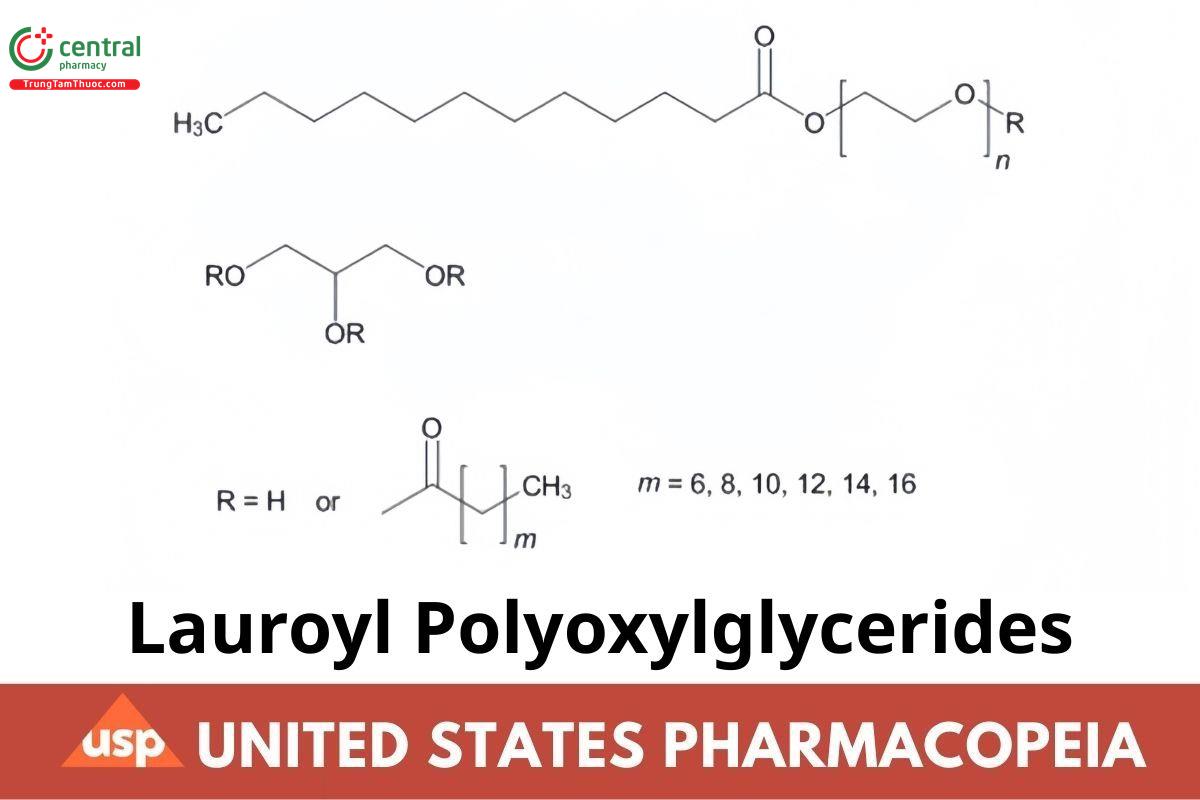
Lauroyl Polyoxylglycerides is a mixture of monoesters, diesters, and triesters of Glycerol and monoesters and diesters of polyethylene glycols. The polyethylene glycols used have a mean molecular weight between 300 and 1500. The article is produced by partial alcoholysis of saturated oils, mainly containing triglycerides of lauric acid with polyethylene glycols, by esterication of glycerol and polyethylene glycols with fatty acids, or as a mixture of glycerol esters and ethylene oxide condensate with the fatty acids of the hydrogenated oils. It may contain free polyethylene glycols.
2 IDENTIFICATION
A. Spectroscopic Identification Tests 〈197〉, Infrared Spectroscopy: 197A. This test only applies to Lauroyl Polyoxylglycerides 300 and Lauroyl Polyoxylglycerides 1500. Use USP Lauroyl Polyoxylglycerides 300 RS for the Lauroyl Polyoxylglycerides 300 sample. Use USP Lauroyl Polyoxylglycerides 1500 RS for the Lauroyl Polyoxylglycerides 1500 sample. For Lauroyl Polyoxylglycerides 300, 197F can also be used with the following standard/sample preparation details: the standard or sample is melted at 70° rst and is suspended neat between suitable plates. For Lauroyl Polyoxylglycerides 1500, 197K can also be used.
Change to read:
B. Thin-Layer Chromatographic Identification Test 〈201〉: For Lauroyl Polyoxylglycerides 300 and Lauroyl Polyoxylglycerides 1500 only
Standard solution: 50 mg/mL of USP Lauroyl Polyoxylglycerides 300 RS (for Lauroyl Polyoxylglycerides 300 sample) or ▲USP Lauroyl Polyoxylglycerides 1500 RS▲ (RB 1-May-2021) (for Lauroyl Polyoxylglycerides 1500 sample) in methylene chloride
Sample solution: 50 mg/mL of Lauroyl Polyoxylglycerides in methylene chloride
Application volume: 10 µL
Developing solvent system: Ether and hexanes (70:30)
Spray reagent: 0.1 mg/mL of rhodamine B in alcohol
Analysis
Samples: Standard solution and Sample solution
Proceed as directed in the chapter, then spray the plate with Spray reagent, and locate the spots on the plate by examination under UV light at a wavelength of 365 nm.
Acceptance criteria: The RF values of the principal spots of the Sample solution correspond to those of the Standard solution. F
C. It meets the requirements in Specic Tests (see Table 1) for Fats and Fixed Oils 〈401〉, Procedures, Fatty Acid Composition.
D. It meets the requirements in Specic Tests for Fats and Fixed Oils 〈401〉, Procedures, Saponication Value for Lauroyl Polyoxylglycerides 600 only.
3 IMPURITIES
3.1 Articles of Botanical Origin 〈561〉, Methods of Analysis, Total Ash
NMT 0.1%
3.2 Alkaline Impurities
Sample: 5.0 g
Analysis: Heat the Sample slightly until the test substance melts, add 10 mL of alcohol and 0.05 mL of bromophenol blue TS, and mix well. While the solution is still warm, titrate with 0.01 N hydrochloric acid VS to change the color to yellow.
Acceptance criteria: NMT 1.0 mL of 0.01 N hydrochloric acid is required.
3.3 Limit of Free Ethylene Oxide and Dioxane
Analysis: Proceed as directed in Ethylene Oxide and Dioxane 〈228〉, Method I.
Acceptance criteria
Ethylene oxide: NMT 1 µg/g
Dioxane: NMT 10 µg/g
3.4 Limit of Free Glycerol
Sample: 1.2 g
Periodic acetic acid solution: Dissolve 0.446 g of sodium periodate in 2.5 mL of a 25% (v/v) solution of sulfuric acid, diluting to 100.0 mL with glacial acetic acid.
Potassium iodide solution: 75 mg/mL of potassium iodide
Blank: 25 mL of methylene chloride
Titrimetric system
(See Titrimetry 〈541〉.)
Mode: Residual titration
Titrant: 0.1 M sodium thiosulfate VS
Endpoint detection: Visual
Analysis: Dissolve the Sample in 25 mL of methylene chloride, heating if necessary. Cool, and add 100 mL of water and 25.0 mL of Periodic acetic acid solution. Shake, and allow to stand for 30 min. Add 40 mL of Potassium iodide solution, and allow to stand for 1 min. Add 1 mL of starch TS, and titrate the liberated iodine with 0.1 M sodium thiosulfate VS. Perform a blank determination, and make any necessary correction.
Calculate the percentage of glycerol in the sample taken:
Result = {[(VB − VS) × N × F]/W} × 100
VB = Titrant volume consumed by the Blank (mL)
VS = Titrant volume consumed by the Sample (mL)
N = actual normality of the Titrant (mEq/mL)
F = equivalency factor, 23.0 mg/mEq
W = Sample weight (mg)
Acceptance criteria: NMT 5.0%
4 SPECIFIC TESTS
4.1 Fats and Fixed Oils 〈401〉, Procedures, Acid Value
Sample: 2.0 g
Acceptance criteria: NMT 2.0
4.2 Fats and Fixed Oils 〈401〉, Procedures, Fatty Acid Composition
Lauroyl Polyoxylglycerides exhibits the composition prole of fatty acids shown in Table 1.
Table 1
| Carbon-Chain Length | Number of Double Bonds | Percentage (%) |
| 8 | 0 | ≤15.0 |
| 10 | 0 | ≤12.0 |
| 12 | 0 | 30.0–50.0 |
| 14 | 0 | 5.0–25.0 |
| 16 | 0 | 4.0–25.0 |
| 18 | 0 | 5.0–35.0 |
4.3 Fats and Fixed Oils 〈401〉, Procedures, Hydroxyl Value
Sample: 1.0 g
Acceptance criteria: Within the range specied in Table 2 for the labeled type
Table 2
| Type of Polyethylene Glycols | Hydroxyl Value |
| 300 | 65–85 |
| 600 | 50–70 |
| 1500 | 36–56 |
4.4 Fats and Fixed Oils 〈401〉, Procedures, Peroxide Value
Sample: 2.0 g
Acceptance criteria: NMT 6.0
4.5 Fats and Fixed Oils 〈401〉, Procedures, Saponification Value
Sample: 2.0 g
Acceptance criteria: Within the range specied in Table 3 for the labeled type
Table 3
| Type of Polyethylene Glycols | Saponification Value |
| 300 | 190–204 |
| 600 | 150–170 |
| 1500 | 79–93 |
4.6 Water Determination 〈921〉, Method I
Sample: 1.0 g
Analysis: Instead of using methanol as the solvent, one of two solvent systems can be used: a mixture of methylene chloride and anhydrous methanol (70:30 v/v), or anhydrous pyridine.
Acceptance criteria: NMT 1.0%
5 ADDITIONAL REQUIREMENTS
Packaging and Storage: Preserve in tight containers, protected from light and moisture. Store at controlled room temperature.
Labeling: Label it to indicate the type and the average nominal molecular weight of polyethylene glycols used as part of the ocial title.
USP Reference Standards 〈11〉
USP Lauroyl Polyoxylglycerides 300 RS
USP Lauroyl Polyoxylglycerides 1500 RS

