
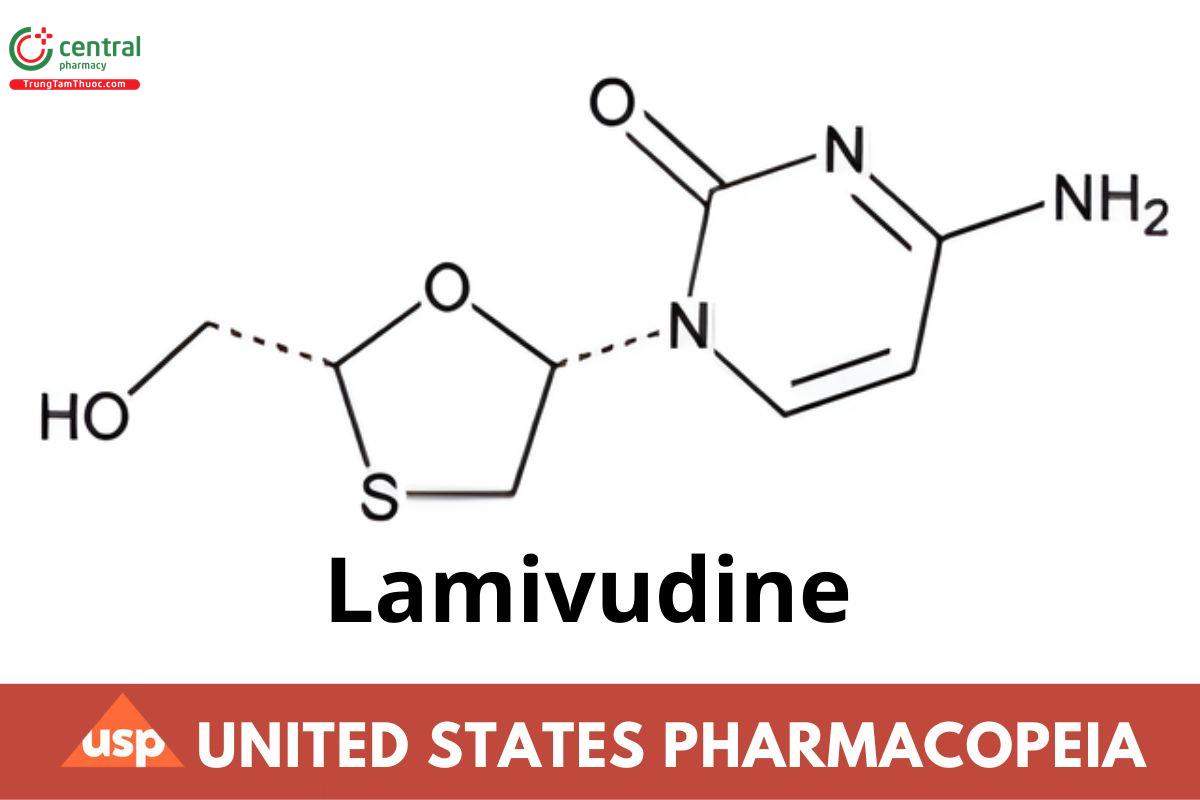
Lamivudine
If you find any inaccurate information, please let us know by providing your feedback here

Tóm tắt nội dung
This article is compiled based on the United States Pharmacopeia (USP) – 2025 Edition
Issued and maintained by the United States Pharmacopeial Convention (USP)
C8H11N3O3S 229.26
C8H11N3O3S · 0.2 CH3OH 235.66
C8H11N3O3S · 0.2 H2O 232.86
2(1H)-Pyrimidinone, 4-amino-1-[2-(hydroxymethyl)-1,3-oxathiolan-5-yl]-, (2R-cis)-;
(–)-1-[(2R,5S)-2-(Hydroxymethyl)-1,3-oxathiolan-5-yl]cytosine CAS RN®: 134678-17-4; UNII: 2T8Q726O95.
1 DEFINITION
Lamivudine contains NLT 98.0% and NMT 102.0% of lamivudine (C8H11N3O3S ), calculated on the anhydrous and solvent-free basis. If labeled as a methanol solvate, it contains NLT 98.0% and NMT 102.0% of lamivudine (C8H11N3O3S ), calculated on the anhydrous, methanol-free, and solvent-free basis.
2 IDENTIFICATION
Change to read:
A. Spectroscopic Identification Tests 〈197〉, Infrared Spectroscopy: 197M (CN 1-May-2020)
B. The retention time of the major peak of the Sample solution corresponds to that of the System suitability solution, as obtained in the test for Limit of Lamivudine Enantiomer.
3 ASSAY
Procedure
Buffer: Transfer about 1.9 g of ammonium acetate to a 1000-mL volumetric flask, dissolve in about 900 mL of water, adjust with acetic acid to a pH of 3.8 ± 0.2, and dilute with water to volume.
Mobile phase: Methanol and Buffer (5:95)
System suitability solution: 0.25 mg/mL of USP Lamivudine Resolution Mixture B RS in Mobile phase
Standard solution: 0.25 mg/mL of USP Lamivudine RS in Mobile phase
Sample solution: 0.25 mg/mL of Lamivudine in Mobile phase
Chromatographic system
(See Chromatography 〈621〉, System Suitability.)
Mode: LC
Detector: UV 277 nm
Column: 4.6-mm × 25-cm; packing L1
Column temperature: 35°
Flow rate: 1 mL/min
Injection volume: 10 μL
System suitability
Samples: System suitability solution and Standard solution
[Note—The relative retention times for lamivudine diastereomer and lamivudine are 0.9 and 1.0, respectively.]
Suitability requirements
Resolution: NLT 1.5 between lamivudine and lamivudine diastereomer, System suitability solution
Relative standard deviation: NMT 2.0% for lamivudine, Standard solution
Analysis
Samples: Standard solution and Sample solution
Calculate the percentage of lamivudine (C8H11N3O3S ) in the portion of Lamivudine taken:
Result = (rU/rS)x(CS/CU) × 100
rU = peak response from the Sample solution
rS = peak response from the Standard solution
CS = concentration of USP Lamivudine RS in the Standard solution (mg/mL)
CU = concentration of Lamivudine in the Sample solution (mg/mL)
Acceptance criteria: 98.0%–102.0% on the anhydrous and solvent-free basis
If labeled as a methanol solvate: 98.0%–102.0% on the anhydrous, methanol-free, and solvent-free basis
OTHER COMPONENTS
Content of Methanol (if labeled as lamivudine methanol solvate)
Diluent: N,N-Dimethylformamide and t-butanol (500:1)
Standard solution: 0.625 mg/mL of methanol in diluent. Transfer 2.0 mL of this solution into a headspace vial, and immediately seal the vial.
Sample solution: Transfer 50 mg of Lamivudine to a headspace vial, add 2.0 mL of Diluent, and immediately seal the vial.
Chromatographic system
(See Chromatography 〈621〉, System Suitability.)
Mode: GC headspace
Detector: Flame ionization
Column: 0.53-mm × 75-m, coated with a 3-μm lm of phase G43
Temperatures
Injector: 180°
Detector: 250°
Column: See Table 1.
Table 1
Initial Temperature (°) | Temperature Ramp (°/min) | Final Temperature (°) | Hold Time at Final Temperature (min) |
| 40 | - | 40 | 13 |
| 40 | 40 | 240 | 12 |
Injection volume: 1.0 mL
Injection type: Split ratio, 15:1
Carrier gas: Helium
Flow rate: 6 mL/min
Headspace samplers
Oven: 95°
Loop: 175°
Transfer line: 175°
Equilibrium time: 10 min
System suitability
Sample: Standard solution
[Note—The relative retention times for methanol and t-butanol are 1.0 and 1.9, respectively.]
Suitability requirements
Tailing factor: NMT 2.0 for methanol
Column efficiency: NLT 25,000 for methanol
Relative standard deviation: NMT 5.0% for methanol
Analysis
Samples: Standard solution and Sample solution
Calculate the percentage of methanol in the portion of lamivudine methanol solvate taken:
Result = (RU/RS)x(CS/CU) × 100
RU = peak response ratio of methanol to t-butanol from the Sample solution
RS = peak response ratio of methanol to t-butanol from the Standard solution
CS = concentration of methanol in the Standard solution (mg/mL)
CU = concentration of Lamivudine (as methanol solvate) in the Sample solution (mg/mL)
Acceptance criteria: 2.0%–3.0%
4 IMPURITIES
4.1 Limit of Lamivudine Enantiomer
Buffer: 7.7 g/L of ammonium acetate in water
Mobile phase: Methanol and Buffer (5:95)
System suitability solution: 0.25 mg/mL of USP Lamivudine Resolution Mixture A RS in water
Sample solution: 0.25 mg/mL of Lamivudine in water
Chromatographic system
(See Chromatography 〈621〉, System Suitability.)
Mode: LC
Detector: UV 270 nm
Column: 4.6-mm × 25-cm; packing L45
Column temperature: 15°–30° (constant temperature)
Flow rate: 1 mL/min
Injection volume: 10 μL
System suitability
Sample: System suitability solution
[Note—The relative retention times for lamivudine and the lamivudine enantiomer are 1.0 and 1.2, respectively.]
Suitability requirements
Resolution: NLT 1.5 between lamivudine and the lamivudine enantiomer
Analysis
Sample: Sample solution
Calculate the percentage of the lamivudine enantiomer in the portion of Lamivudine taken:
Result = [rU/(rU + rS)] × 100
rU = peak response of the lamivudine enantiomer
rS = peak response of lamivudine
Acceptance criteria: NMT 0.3%
Other Related Compounds Buffer, Mobile phase, System suitability solution, Standard solution, Chromatographic system, and System suitability: Proceed as directed in the Assay.
Salicylic acid standard solution: 0.625 μg/mL of USP Salicylic Acid RS in Mobile phase
Sample solution: 0.25 mg/mL of Lamivudine in Mobile phase
Analysis
Samples: Salicylic acid standard solution and Sample solution
Calculate the percentage of salicylic acid in the portion of Lamivudine taken:
Result = (rU/rS)x(CS/CU) × 100
rU = peak response of salicylic acid from the Sample solution
rS = peak response of USP Salicylic Acid RS from the Salicylic acid standard solution
CS = concentration of salicylic acid in the Salicylic acid standard solution (mg/mL)
CU = concentration of Lamivudine in the Sample solution (mg/mL)
Calculate the percentage of other individual impurities in the portion of Lamivudine taken:
Result = (rU/rT) × 100
rU = peak response of each impurity other than salicylic acid from the Sample solution
rT = sum of the responses of all the peaks
Acceptance criteria: See Table 2.
Table 2
| Name | Relative Retention Time | Acceptance Criteria, NMT (%) |
|---|---|---|
| Lamivudine-carboxylic acida | 0.4 | 0.3 |
| Lamivudine-trans (lamivudine diastereomer)b | 0.9 | 0.2 |
| Lamivudine | 1.0 | – |
| Salicylic acid | 2.7 | 0.1 |
| Any other individual impurity | – | 0.1 |
| Total impurities | – | 0.6 |
a (2RS,5SR)-5-(Cytosine-1-yl)-1,3-oxathiolane-2-carboxylic acid.
b 1–[(2RS,5RS)-2-(Hydroxymethyl)-1,3-oxathiolan-5-yl]cytosine.
4.2 Residual Solvents
Internal standard solution: Dilute 1 mL of 2-pentanone with Dimethyl sulfoxide and water (1:1) to 100.0 mL.
Standard solution: Transfer 10 mL of the Internal standard solution to a 100-mL volumetric flask. Add 100 μL each of the following: dehydrated alcohol, isopropyl acetate, methanol, and triethylamine. Dilute with dimethyl sulfoxide and water (1:1) to volume.
Sample solution: Transfer 5 g of Lamivudine to a 100-mL volumetric flask, add 10 mL of the Internal standard solution, and dilute with dimethyl sulfoxide and water (1:1) to volume.
Chromatographic system
(See Chromatography 〈621〉, System Suitability.)
Mode: GC
Detector: Flame ionization
Column: 0.53-mm × 50-m, coated with a 5-μm lm of phase G1
Temperatures
Injector: 150°
Detector: 250°
Column: See Table 3.
Table 3
Initial Temperature (°) | Temperature Ramp (°/min) | Final Temperature (°) | Hold Time at Final Temperature (min) |
| 70 | - | 70 | 3 |
| 70 | 30 | 200 | 6.5 |
Injection volume: 0.5 μL
Injection type: Split flow rate, 320 mL/min
Carrier gas: Hydrogen (at pressure 5 psig)
Analysis
Samples: Standard solution and Sample solution
Calculate the percentage of each residual solvent in the portion of Lamivudine taken:
Result = (RU/RS)x(CS/CU) × 100
RU = peak response ratio of the respective analyte to the internal standard from the Sample solution
RS = peak response ratio of the respective analyte to the internal standard from the Standard solution
CS = concentration of the respective analyte in the Standard solution (mg/mL)
CU = concentration of the Sample solution (mg/mL)
Acceptance criteria: See Table 4.
Table 4
| Name | Acceptance Criteria, NMT (%) |
| Alcohol | 0.2 |
| Isopropyl acetate | 0.2 |
| Methanol | 0.1 |
| Triethylamine | 0.1 |
| Total residual solvents | 0.3 |
5 SPECIFIC TESTS
Water Determination, Method Ic〈921〉: NMT 2.0%
Light Absorption
(See Ultraviolet-Visible Spectroscopy 〈857〉.)
Mode: Vis
Sample solution: 50 mg/mL in water
Analytical wavelength: 440 nm
Cell: 4 cm
Acceptance criteria: Absorptivity NMT 0.0015
6 ADDITIONAL REQUIREMENTS
Packaging and Storage: Preserve in well-closed, light-resistant containers. Store at room temperature.
Labeling: Where it is a methanol solvate form, the label so indicates.
USP Reference Standards 〈11〉
USP Lamivudine RS
USP Lamivudine Resolution Mixture A RS
USP Lamivudine Resolution Mixture B RS
USP Salicylic Acid RS

