
Ketamine Hydrochloride
If you find any inaccurate information, please let us know by providing your feedback here
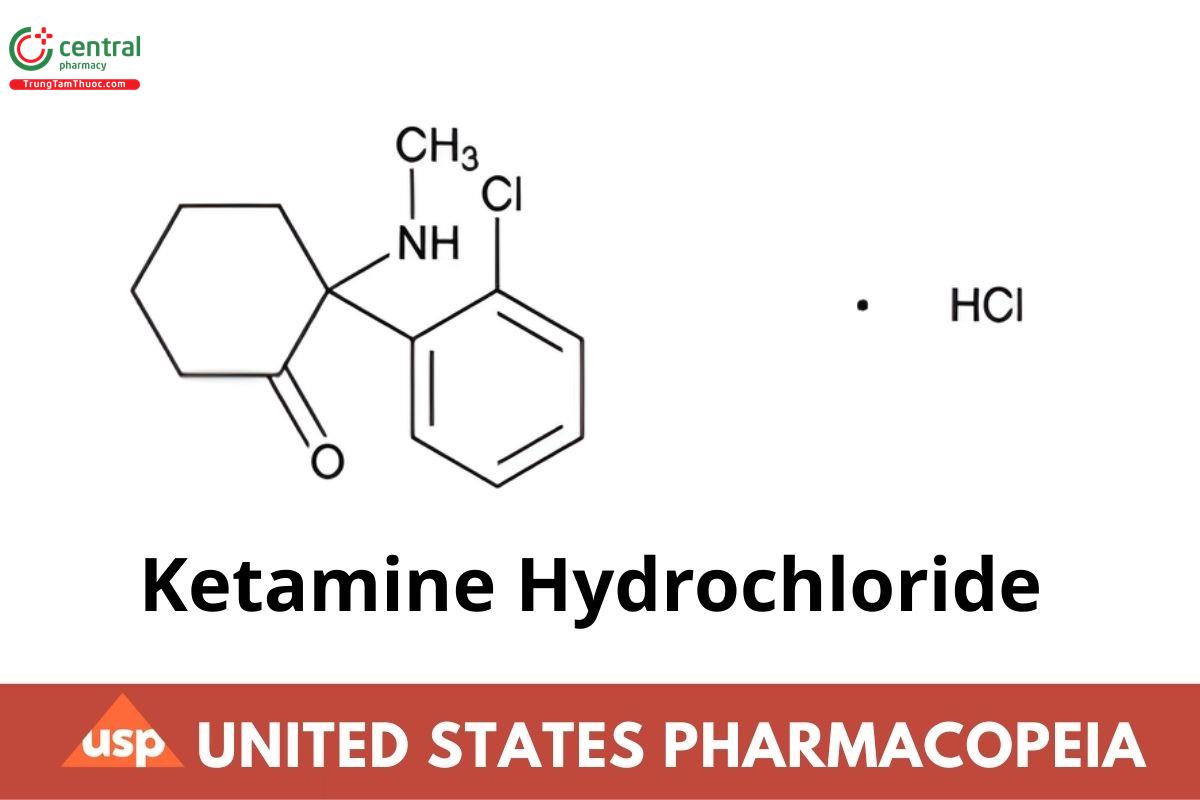

This article is compiled based on the United States Pharmacopeia (USP) – 2025 Edition
Issued and maintained by the United States Pharmacopeial Convention (USP)
To view the Notice from the Expert Committee that posted in conjunction with this accelerated revision, please click https://www.uspnf.com/rb-ketamine-hcl-20240726.
(RB 1-Aug-2024)
C13H16ClNO · HCl 274.19
Cyclohexanone, 2-(2-chlorophenyl)-2-(methylamino)-, hydrochloride;
(±)-2-(o-Chlorophenyl)-2-(methylamino)cyclohexanone hydrochloride CAS RN®: 1867-66-9; UNII: O18YUO0I83.
1 DEFINITION
Ketamine Hydrochloride contains NLT 98.0% and NMT 102.0% of ketamine hydrochloride (C13H16ClNO · HCl).
2 IDENTIFICATION
A. Spectroscopic Identification Tests 〈197〉, Infrared Spectroscopy: 197K. Do not dry specimens.
B.
Acid solvent
Standard solution: 0.33 mg/mL of USP Ketamine Hydrochloride RS in 0.1 N hydrochloric acid
Sample solution: 0.33 mg/mL in 0.1 N hydrochloric acid
Acceptance criteria: Both solutions exhibit maxima and minima at the same wavelengths, and the respective absorptivities, at the wavelengths of maximum absorbance at 269 and 276 nm, do not differ by more than 3.0%.
Basic solvent
Standard solution: 0.8 mg/mL of USP Ketamine Hydrochloride RS in 0.01 N sodium hydroxide in a mixture of water and methanol (1 in 20)
Sample solution: 0.8 mg/mL in 0.01 N sodium hydroxide in a mixture of water and methanol (1 in 20)
Acceptance criteria: Both solutions exhibit maxima and minima at the same wavelengths, and the respective absorptivities, at the wavelengths of maximum absorbance at 302 nm, do not differ by more than 3.0%.
3 ASSAY
Change to read:
Procedure
Buffer: Dissolve 5.75 g of monobasic ammonium phosphate in 1 L of water. Add 6 mL of triethylamine to each liter of this solution and adjust with phosphoric acid to a pH of 3.0.
Mobile phase: Methanol and Buffer (35:65)
System suitability solution: 0.025 mg/mL each of USP Ketamine Hydrochloride RS and USP Ketamine Related Compound A RS in Mobile phase. Sonicate to dissolve, if necessary.
Standard solution: 0.2 mg/mL of USP Ketamine Hydrochloride RS in Mobile phase. Sonicate to dissolve, if necessary.
Sample solution: 0.2 mg/mL of Ketamine Hydrochloride in Mobile phase. Sonicate to dissolve, if necessary.
Chromatographic system
(See Chromatography 〈621〉, System Suitability.)
Mode: LC
Detector: UV 220 nm
Column: 4.6-mm × 25-cm; 5-μm packing L1
Flow rate: 1 mL/min
Injection volume: 20 μL
System suitability
Samples: System suitability solution and Standard solution
[Note—The order of elution is ketamine followed by ketamine related compound A]
Suitability requirements
Resolution: NLT 2.0 between ketamine and ketamine related compound A, System suitability solution
(RB 1-Aug-2024)
Tailing factor: NMT 1.6 for ketamine, System suitability solution
Relative standard deviation: NMT 0.6%, Standard solution
Analysis
Samples: Standard solution and Sample solution
Calculate the percentage of ketamine hydrochloride (C13H16ClNO · HCl) in the portion of Ketamine Hydrochloride taken:
Result = (rU/rS)x(CS/CU ) × 100
rU = peak response of ketamine from the Sample solution
rS = peak response of ketamine from the Standard solution
CS = concentration of USP Ketamine Hydrochloride RS in the Standard solution (mg/mL)
CU = concentration of Ketamine Hydrochloride in the Sample solution (mg/mL)
Acceptance criteria: 98.0%–102.0%
4 IMPURITIES
Residue on Ignition 〈281〉: NMT 0.1%
Organic Impurities
Solution A: Acetonitrile and water (25:75)
Mobile phase: Dissolve 0.95 g of sodium 1-hexanesulfonate in 1 L of Solution A. Add 4 mL of acetic acid to each liter of this solution.
Standard solution: 0.005 mg/mL each of USP Ketamine Hydrochloride RS and USP Ketamine Related Compound A RS in Mobile phase.
Sonicate to dissolve, if necessary. Prepare immediately before use.
Sample solution: 1.0 mg/mL of Ketamine Hydrochloride in Mobile phase. Sonicate to dissolve, if necessary.
Chromatographic system
(See Chromatography 〈621〉, System Suitability.)
Mode: LC
Detector: UV 215 nm
Columns
Guard: 4.0-mm × 4.0-mm
Analytical: 4.0-mm × 12.5-cm; 5-μm packing L1
Flow rate: 1 mL/min
Injection volume: 20 μL
System suitability
Sample: Standard solution
[Note—The order of elution is ketamine followed by ketamine related compound A. The retention time of ketamine is between 3.0 and 4.5 min (if necessary, adjust the concentration of water and acetonitrile).]
Suitability requirements
Resolution: NLT 2.0 between ketamine and ketamine related compound A
Tailing factor: NMT 1.5
Analysis
Samples: Standard solution and Sample solution
Calculate the percentage of any impurity in the portion of Ketamine Hydrochloride taken:
Result = (rU/rS)x(CS/CU ) × 100
rU = peak response of each impurity from the Sample solution
rS = peak response of ketamine from the Standard solution
CS = concentration of USP Ketamine Hydrochloride RS in the Standard solution (mg/mL)
CU = concentration of Ketamine Hydrochloride in the Sample solution (mg/mL)
Acceptance criteria: See Table 1.
Table 1
| Name | Acceptance Criteria, NMT (%) |
| Ketamine related compound A | 0.1 |
| Any unknown impurity | 0.1 |
| Total impuritiesa | 0.3 |
a Sum of all the unknown impurities.
5 SPECIFIC TESTS
pH 〈791〉
Sample solution: 100 mg/mL of Ketamine Hydrochloride
Acceptance criteria: 3.5–4.1
Clarity and Color of Solution
Sample solution: 200 mg/mL of Ketamine Hydrochloride in water
Acceptance criteria: The solution is clear and colorless.
6 ADDITIONAL REQUIREMENTS
Change to read:
Packaging and Storage: Preserve in well-closed containers. Store at controlled room temperature. (RB 1-Aug-2024)
Change to read:
USP Reference Standards 〈11〉
USP Ketamine Hydrochloride RS
USP Ketamine Related Compound A RS
1-[(2-Chlorophenyl)(methylimino)methyl]cyclopentanol.
C13H16ClNO (RB 1-Aug-2024) 237.73

