
Itraconazole
If you find any inaccurate information, please let us know by providing your feedback here
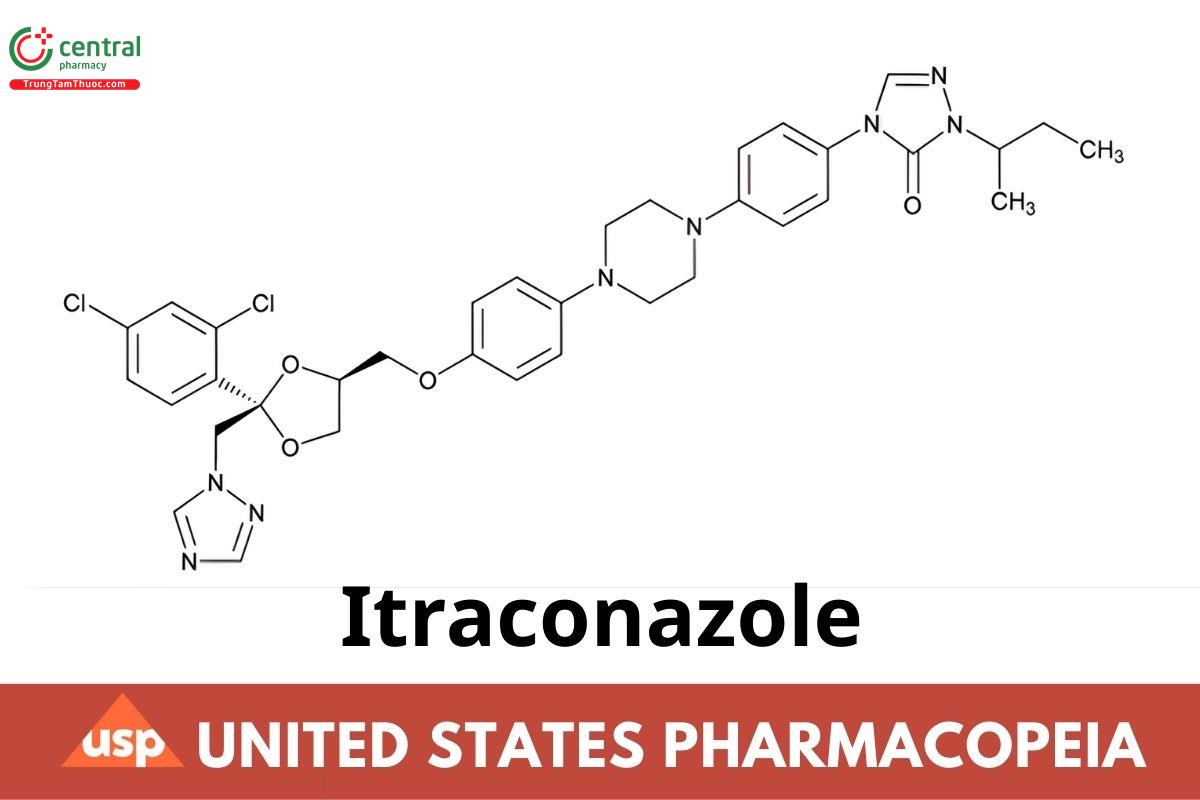

This article is compiled based on the United States Pharmacopeia (USP) – 2025 Edition
Issued and maintained by the United States Pharmacopeial Convention (USP)
C35H38Cl2N8O4 705.63
3H-1,2,4-Triazol-3-one, 4-[4-[4-[4-[[2-(2,4-dichlorophenyl)-2-(1H-1,2,4-triazol-1-ylmethyl)-1,3-dioxolan-4-yl]methoxy]phenyl]-1-
piperazinyl]phenyl]-2,4-dihydro-2-(1-methylpropyl)-;
(±)-1-sec-Butyl-4-[p-[4-[p-[[(2R*,4S*)-2-(2,4-dichlorophenyl)-2-(1H-1,2,4-triazol-1-ylmethyl)-1,3-dioxolan-4-yl]methoxy]phenyl]-1-piperazinyl]phenyl]- Δ 2 -1,2,4-triazolin-5-one CAS RN®: 84625-61-6; UNII: 304NUG5GF4.
1 DEFINITION
Itraconazole contains NLT 98.0% and NMT 102.0% of itraconazole (C35H38Cl2N8O4), calculated on the dried basis.
2 IDENTIFICATION
Change to read:
A. Spectroscopic Identification Tests 〈197〉, Infrared Spectroscopy: 197K (CN 1-May-2020)
B. The retention time of the major peak of the Sample solution corresponds to that of the Standard solution, as obtained in the Assay.
3 ASSAY
Procedure
Prepare the solutions containing itraconazole immediately before use.
Solution A: 13.6 g/L of tetrabutylammonium hydrogen sulfate in water
Solution B: Acetonitrile
Diluent: Dilute 4.0 mL of hydrochloric acid with methanol to 1 L.
Mobile phase: See Table 1.
Table 1
| Time (min) | Solution A (%) | Solution B (%) |
| 10 | 80 | 20 |
| 12 | 50 | 50 |
| 16 | 80 | 20 |
| 20 | 80 | 20 |
Standard solution: 0.3 mg/mL of USP Itraconazole RS in Diluent
Sample solution: 0.3 mg/mL of Itraconazole in Diluent
Chromatographic system
(See Chromatography 〈621〉, System Suitability.)
Mode: LC
Detector: UV 225 nm
Column: 4.6-mm × 10-cm; 3-μm packing L1
Column temperature: 30°
Flow rate: 1.5 mL/min
Injection volume: 10 μL
System suitability
Sample: Standard solution
Suitability requirements
Tailing factor: NMT 2.0
Relative standard deviation: NMT 2.0%
Analysis
Samples: Standard solution and Sample solution
Calculate the percentage of itraconazole (C35H38Cl2N8O4) in the portion of Itraconazole taken:
Result = (rU/rS) x (CS/CU) × 100
rU = peak response of itraconazole from the Sample solution
rS = peak response of itraconazole from the Standard solution
CS = concentration of USP Itraconazole RS in the Standard solution (mg/mL)
CU = concentration of Itraconazole in the Sample solution (mg/mL)
Acceptance criteria: 98.0%–102.0% on the dried basis
4 IMPURITIES
Residue on Ignition 〈281〉
Sample: 1.0 g
Acceptance criteria: NMT 0.1%
Organic Impurities
Solution B, Diluent, and Chromatographic system: Proceed as directed in the Assay.
Solution A: 27.2 g/L of tetrabutylammonium hydrogen sulfate in water
Mobile phase: See Table 2.
Table 2
| Time (min) | Solution A (%) | Solution B (%) |
| 0 | 80 | 20 |
| 2 | 80 | 20 |
| 22 | 50 | 50 |
| 27 | 50 | 50 |
System suitability solution: 10 mg/mL of USP Itraconazole System Suitability Mixture RS in Diluent
Standard solution: 10.0 μg/mL of USP Itraconazole RS in Diluent
Sample solution: 10 mg/mL of Itraconazole in Diluent
System suitability
Sample: System suitability solution
Suitability requirements
Peak-to-valley ratio: NLT 1.5
Calculate the peak-to-valley ratio (p/v), using the following:
p/v = Hp/Hv
Hp = height above the baseline of the peak due to the n-butyl isomer impurity
Hv = height above the baseline of the lowest point of the curve separating this peak from the itraconazole peak
Analysis
Samples: Standard solution and Sample solution
Calculate the percentage of each impurity in the portion of Itraconazole taken:
Result = (rU/rS) x (CS/CU) × 100
rU = peak response of each impurity from the Sample solution
rS = peak response of itraconazole from the Standard solution
CS = concentration of USP Itraconazole RS in the Standard solution (mg/mL)
CU = concentration of Itraconazole in the Sample solution (mg/mL)
Acceptance criteria: See Table 3. Disregard any peak less than 0.05%.
Table 3
| Name | Relative Retention Time | Acceptance Criteria, NMT (%) |
|---|---|---|
| 4-Methoxy derivativea | 0.20 | 0.5 |
| 4-Triazolyl isomerb | 0.74 | 0.5 |
| Propyl analogc | 0.86 | 0.5 |
| Isopropyl analogd | 0.86 | 0.5 |
| Epimere | 0.93 | 0.5 |
| Itraconazole | 1.0 | — |
| n-Butyl isomerf | 1.05 | 0.5 |
| Didioxolanyl analogg | 1.3 | 0.5 |
| Any unspecified impurity | — | 0.10 |
| Total impurities | — | 1.25 |
a 2-sec-Butyl-4-{4-[4-(4-methoxyphenyl)piperazin-1-yl]phenyl}-2H-1,2,4-triazol-3(4H)-one.
b 4-(4-{4-[4-({(2RS,4SR)-2-[(4H-1,2,4-Triazol-4-yl)methyl]-2-(2,4-dichlorophenyl)-1,3-dioxolan-4-yl}methoxy)phenyl]piperazin-1-yl}phenyl)-2-sec-butyl-2H-1,2,4-triazol-3(4H)-one.
c 4-(4-{4-[4-({(2RS,4SR)-2-[(1H-1,2,4-Triazol-1-yl)methyl]-2-(2,4-dichlorophenyl)-1,3-dioxolan-4-yl}methoxy)phenyl]piperazin-1-yl}phenyl)-2-propyl-2H-1,2,4-triazol-3(4H)-one.
d 4-(4-{4-[4-({(2RS,4SR)-2-[(1H-1,2,4-Triazol-1-yl)methyl]-2-(2,4-dichlorophenyl)-1,3-dioxolan-4-yl}methoxy)phenyl]piperazin-1-yl}phenyl)-2-isopropyl-2H-1,2,4-triazol-3(4H)-one.
e 4-(4-{4-[4-({(2RS,4RS)-2-[(1H-1,2,4-Triazol-1-yl)methyl]-2-(2,4-dichlorophenyl)-1,3-dioxolan-4-yl}methoxy)phenyl]piperazin-1-yl}phenyl)-2- sec-butyl-2H-1,2,4-triazol-3(4H)-one.
f 4-(4-{4-[4-({(2RS,4SR)-2-[(1H-1,2,4-Triazol-1-yl)methyl]-2-(2,4-dichlorophenyl)-1,3-dioxolan-4-yl}methoxy)phenyl]piperazin-1-yl}phenyl)-2- butyl-2H-1,2,4-triazol-3(4H)-one.
g 4-(4-{4-[4-({(2RS,4SR)-2-[(1H-1,2,4-Triazol-1-yl)methyl]-2-(2,4-dichlorophenyl)-1,3-dioxolan-4-yl}methoxy)phenyl]piperazin-1-yl}phenyl)-2-({(2RS,4SR)-2-[(1H-1,2,4-triazol-1-yl)methyl]-2-(2,4 dichlorophenyl)-1,3-dioxolan-4-yl}methyl)-2H-1,2,4-triazol-3(4H)-one.
5 SPECIFIC TESTS
Optical Rotation 〈781A〉, Procedures, Angular Rotation
Sample: 100 mg/mL in methylene chloride. [Note—Use methylene chloride to zero the instrument.]
Acceptance criteria: −0.10° to +0.10° at 20°
Loss on Drying 〈731〉
Sample: Dry 1 g at 105° for 4 h.
Acceptance criteria: NMT 0.5%
6 ADDITIONAL REQUIREMENTS
Packaging and Storage: Preserve in tight, light-resistant containers, and store at room temperature.
USP Reference Standards 〈11〉
USP Itraconazole RS
USP Itraconazole System Suitability Mixture RS
This mixture contains itraconazole and six other minor components (4-triazolyl isomer, propyl analog, isopropyl analog, epimer, n-butyl isomer, and didioxolanyl analog).

