
Isoxsuprine Hydrochloride
If you find any inaccurate information, please let us know by providing your feedback here
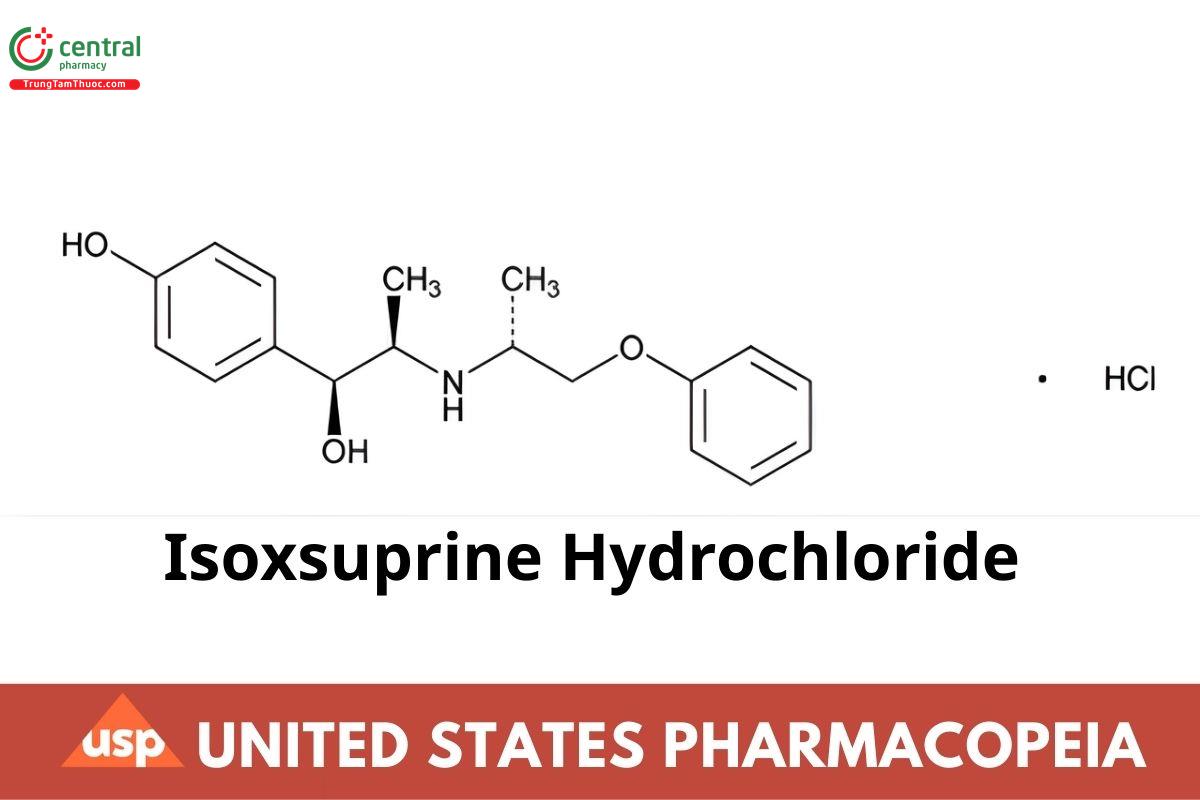

This article is compiled based on the United States Pharmacopeia (USP) – 2025 Edition
Issued and maintained by the United States Pharmacopeial Convention (USP)
C18H23NO3· HCl 337.84
Benzenemethanol, 4-hydroxy-α-[1-[(1-methyl-2-phenoxyethyl)amino]ethyl]-, hydrochloride, stereoisomer.
p-Hydroxy-α-[1-[(1-methyl-2-phenoxyethyl)amino]ethyl]benzyl alcohol hydrochloride.
(±)-(αR*)-p-Hydroxy-α-[(1S*)-1-[[(1S*)-1-methyl-2-phenoxyethyl]amino]ethyl]benzyl alcohol hydrochloride CAS RN®: 579-56-6; 34331-89-0;
UNII: V74TEQ36CO.
» Isoxsuprine Hydrochloride contains not less than 97.0 percent and not more than 103.0 percent of C18H23NO3· HCl, calculated on the dried basis.
Packaging and storage—Preserve in tight containers.
USP Reference standards 〈11〉—
USP Isoxsuprine Hydrochloride RS
Identification—
Change to read:
A: Spectroscopic Identification Tests 〈197〉, Infrared Spectroscopy: 197K (CN 1-May-2020) .
Change to read:
B: Spectroscopic Identification Tests 〈197〉, Ultraviolet-Visible Spectroscopy: 197U (CN 1-May-2020)
Solution: 50 μg per mL.
Medium: water.
C: To 1 mL of a solution (1 in 100), obtained by heating as necessary, add 3 mL of a 1 in 15 solution of sodium nitrite in 2 N sulfuric acid. Add ammonium hydroxide dropwise: a yellow precipitate is formed and it dissolves upon the addition of sodium hydroxide solution (1 in 5).
D: To 1 mL of a solution (1 in 100) add 1 mL of phosphomolybdic acid solution (1 in 100): a pale yellow to white precipitate is formed.
pH 〈791〉: between 4.5 and 6.0, in a solution (1 in 100).
Loss on drying 〈731〉—Dry it at 105° for 1 hour: it loses not more than 0.5% of its weight.
Residue on ignition 〈281〉: not more than 0.2%.
Related compounds—To 10 mg, accurately weighed in a suitable vial, add 1 mL of N-trimethylsilylimidazole, and heat at 65° for 10 minutes.
Add 5 mL of isooctane, wash with one 3-mL portion of water, and allow the layers to separate. Inject a 2-μL portion of the isooctane solution into a gas chromatograph equipped with a 0.3-cm × 2.0-m glass column packed with packing S1A containing 3% liquid phase G2 and a ame-ionization detector. The column temperature is maintained at 215°, and the injection port and detector are maintained at 250°. The carrier gas is nitrogen, flowing at the rate of 25 mL per minute. Adjust the instrument to provide full-scale response for the major component. Inject a second 2-μL portion of the isooctane solution with the attenuator adjusted to an 8-fold increase in sensitivity, and record the chromatogram from 0.5 to 1.5 relative to the retention time of the major peak. Measure the area of all minor peaks, and correct for differences in sensitivity settings. Calculate the percentage of related compounds present taken by the formula:
100A/B
in which A is the sum of the corrected area peaks for all minor peaks, and B is the sum of the corrected area peaks for the major and minor peaks. Not more than 2.0% is found.
Assay—Transfer about 50 mg of Isoxsuprine Hydrochloride, accurately weighed, to a 1000-mL volumetric flask, add water to volume, and mix.
Concomitantly determine the absorbances of this solution and of a Standard solution of USP Isoxsuprine Hydrochloride RS in the same medium having a known concentration of about 50 μg per mL in 1-cm cells at the wavelengths of maximum absorbance at about 269 and 300 nm, with a suitable spectrophotometer, using water as the blank. Calculate the quantity, in mg, of C18H23NO3· HCl in the Isoxsuprine
Hydrochloride taken by the formula:
C(AU269− AU300)/(AS269− AS300 )
in which C is the concentration, in μg per mL, of USP Isoxsuprine Hydrochloride RS in the Standard solution; and the parenthetic expression are the differences in the absorbances of the two solutions at the wavelengths indicated by the subscripts, for the assay solution (U) and the Standard solution (S), respectively.

