
Isomalt
If you find any inaccurate information, please let us know by providing your feedback here

Tóm tắt nội dung
This article is compiled based on the United States Pharmacopeia (USP) – 2025 Edition
Issued and maintained by the United States Pharmacopeial Convention (USP)
1 DEFINITION
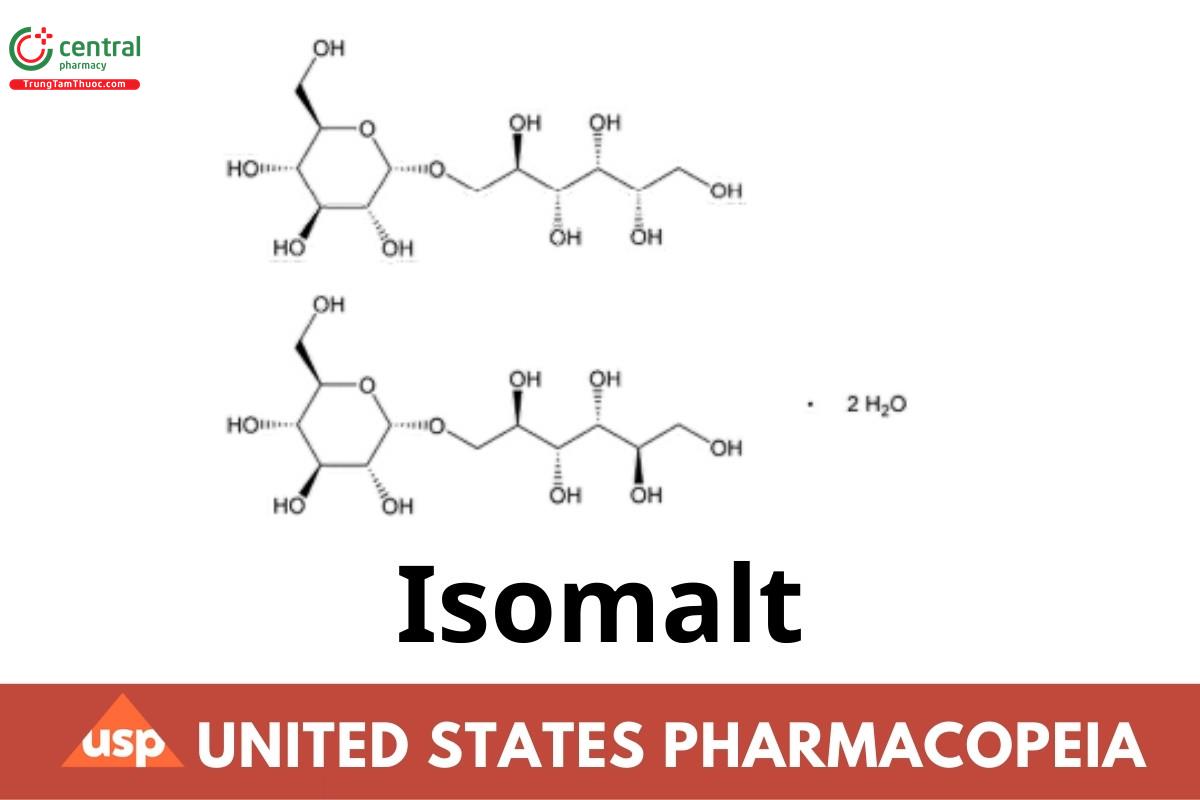
Isomalt contains NLT 98.0% and NMT 102.0% of a mixture of 6-O-α-d-glucopyranosyl-d-sorbitol (1,6-GPS) and 1-O-α-d-glucopyranosyl-d-mannitol (1,1-GPM), and neither of the two components is less than 3.0% of the mixture, calculated on the anhydrous basis.
2 IDENTIFICATION
2.1 A.
Thin-Layer Chromatographic Identification Test 〈201〉
Standard solution: 5 mg/mL of USP Isomalt RS
Sample solution: 5 mg/mL
Chromatographic system
Adsorbent: 0.25-mm layer of chromatographic silica gel mixture containing a uorescent indicator having optimal intensity at 254 nm Application volume: 1 µL
Developing solvent system: Ethyl acetate, pyridine, water, acetic acid, and propionic acid (10:10:2:1:1)
Analysis
Samples: Standard solution and Sample solution
Proceed as directed in the chapter. Thoroughly dry the starting points in warm air. Develop over 10 cm using the Developing solvent system, dry the plate in a current of hot air, and dip for 3 s in a 1-mg/mL solution of sodium periodate. Dip the plate for 3 s in a mixture of dehydrated alcohol, sulfuric acid, acetic acid, and anisaldehyde (90:5:1:1). Dry the plate in a current of hot air until colored spots become visible. The background color may be brightened by exposure to warm steam. Examine in daylight.
Acceptance criteria: The principal spots of the Sample solution are similar in position and color to those of the Standard solution.
2.2 B.
The retention times of the two principal peaks of the Sample solution correspond to those of the Standard solution, as obtained in the Assay.
3 ASSAY
3.1 Procedure
Mobile phase: Water
Standard solution: 20 mg/mL of USP Isomalt RS
Sample solution: 20 mg/mL of Isomalt
Chromatographic system
(See Chromatography 〈621〉, System Suitability.)
Mode: LC
Detector: Refractive index, maintained at a constant temperature (40° for example)
Columns
Guard: 4.6-mm × 3-cm; packing L19
Analytical: 7.8-mm × 30-cm; packing L19
Column temperature: 80 ± 3°
Flow rate: 0.5 mL/min
Injection volume: 20 µL
System suitability
Sample: Standard solution
[Note—The relative retention times for 1,1-GPM and 1,6-GPS are about 1.0 and 1.2, respectively.]
Suitability requirements
Resolution: NLT 2.0 between 1,1-GPM and 1,6-GPS
Relative standard deviation: NMT 2.0% for the 1,6-GPS and 1,1-GPM peaks
Analysis
Samples: Standard solution and Sample solution
Calculate the percentage of 1,6-GPS in the portion of Isomalt taken:
Result = (ru/rs) × (Cs/Cu) × 100
ru = peak response of 1,6-GPS from the Sample solution
rs = peak response of 1,6-GPS from the Standard solution
Cs = concentration of 1,6-GPS in the Standard solution, with calculation based on the declared 1,6-GPS content of USP Isomalt RS (mg/mL)
Cu = concentration of Isomalt in the Sample solution (mg/mL)
Calculate the percentage of 1,1-GPM in the portion of Isomalt taken:
Result = (ru/rs) × (Cs/Cu) × 100
ru = peak response of 1,1-GPM from the Sample solution
rs = peak response of 1,1-GPM from the Standard solution
Cs = concentration of 1,1-GPM in the Standard solution, with calculation based on the declared 1,1-GPM content of USP Isomalt RS (mg/mL)
Cu = concentration of Isomalt in the Sample solution (mg/mL)
Acceptance criteria: 98.0%–102.0% of a mixture of 6-O-α-d-glucopyranosyl-d-sorbitol (1,6-GPS) and 1-O-α-d-glucopyranosyl-d-mannitol (1,1- GPM), and neither of the two components is less than 3.0% of the mixture, calculated on the anhydrous basis
4 IMPURITIES
4.1 Limit of Nickel
[Note—The purity of the reagents and the water used must be suitable for trace analysis, and the reagents and water must be free of nickel.] Sample solution: Dissolve 10.0 g of Isomalt in 30 mL of dilute acetic acid (115–125 g/L), add water, and shake to dissolve. Dilute with water to 100.0 mL. Add 2.0 mL of saturated ammonium pyrrolidinedithiocarbamate TS and 10.0 mL of water-saturated methyl isobutyl ketone (C6H12O, 4-methyl-2-pentanone), and then shake for 30 s, protected from bright light. Allow the layers to separate and use the methyl isobutyl ketone layer.
Standard solutions: Prepare three reference solutions in the same manner as the Sample solution except add 0.5 mL, 1.0 mL, and 1.5 mL, respectively, of nickel standard solution TS (10 ppm Ni) in addition to the 10.0 g of the substance to be examined. Blank solution: Treat water-saturated methyl isobutyl ketone as described for preparation of the Sample solution omitting the Isomalt. Instrumental conditions
(See Atomic Absorption Spectroscopy 〈852〉.)
Mode: Atomic absorption spectrophotometry
Analytical wavelength: 232.0 nm
Lamp: Nickel hollow-cathode
Flame: Air–acetylene
Analysis
Samples: Sample solution, Standard solutions, and Blank solution
Set the zero of the instrument using the Blank solution. Record the average of the steady readings for each of the Standard solutions and the Sample solution. Between each measurement, rinse with water and ascertain that the reading returns to zero with the Blank solution. Plot the absorbances of the Standard solutions and the Sample solution versus the added quantity of nickel. Extrapolate the line joining the points on the graph until it meets the concentration axis. The distance between this point and the intersection of the axes represents the concentration of nickel in the Sample solution.
Acceptance criteria: NMT 1 µg/g, calculated on the anhydrous basis
4.2 Organic Impurities
Mobile phase, Sample solution, and Chromatographic system: Proceed as directed in the Assay.
System suitability solution: 20 mg/mL of USP Isomalt RS and 0.1 mg/mL each of USP Mannitol RS and USP Sorbitol RS in water Standard solution: 0.1 mg/mL each of USP Sorbitol RS and USP Mannitol RS
System suitability
Sample: System suitability solution
[Note—The relative retention times for 1,1-GPM, 1,6-GPS, mannitol, and sorbitol are about 1.0, 1.2, 1.6, and 2.0, respectively. The typical retention time for 1,1-GPM is about 12.3 min.]
Suitability requirements
Resolution: NLT 2.0 between 1,1-GPM and 1,6-GPS
Analysis
Samples: Sample solution and Standard solution
Calculate the percentage of mannitol or sorbitol in the portion of Isomalt taken:
Result = (ru/rs) × (Cs/Cu) × 100
ru = peak response of mannitol or sorbitol from the Sample solution
rs = peak response of mannitol or sorbitol from the Standard solution
Cs = concentration of USP Mannitol RS or USP Sorbitol RS in the Standard solution (mg/mL)
Cu = concentration of Isomalt in the Sample solution (mg/mL)
Calculate the percentage of any unknown impurity in the portion of Isomalt taken:
Result = (ru/rs) × (Cs/Cu) × 100
ru = peak response of each unknown impurity from the Sample solution
rs = peak response of sorbitol from the Standard solution
Cs = concentration of USP Sorbitol RS in the Standard solution (mg/mL)
Cu = concentration of Isomalt in the Sample solution (mg/mL)
Acceptance criteria: See Table 1. [Note—Disregard any impurity peak that is less than 0.1%.]
Table 1
| Name | Acceptance Criteria, NMT (%) |
| Mannitol | 0.5 |
| Sorbitol | 0.5 |
| Any unknown impurity | 0.5 |
| Total impurities | 2.0 |
4.3 Reducing Sugars
Sample solution: Dissolve 3.3 g in 10 mL of Puried Water with the aid of gentle heat. Cool and add 20 mL of cupric citrate TS and a few glass beads. Heat so that boiling begins after 4 min, and maintain boiling for 3 min. Cool rapidly, and add 100 mL of a 2.4% (v/v) solution of glacial acetic acid and 20 mL of 0.025 M iodine VS. With continuous shaking, add 25 mL of a mixture of hydrochloric acid and water (6:94).
Analysis: After the precipitate has dissolved, titrate the excess iodine with 0.05 N sodium thiosulfate VS, using 1 mL of starch TS, added toward the end of the titration as an indicator.
Acceptance criteria: NLT 12.8 mL of 0.05 N sodium thiosulfate VS is required, corresponding to NMT 0.3% of reducing sugars, determined on the anhydrous basis as Glucose.
5 SPECIFIC TESTS
5.1 Water Determination 〈921〉, Method I
Sample: 0.3 g
Analysis: Add the Sample to a mixture of anhydrous methanol and formamide (1:1) at 50 ± 5°.
Acceptance criteria: NMT 7.0%
5.2 Conductivity
Sample solution: Dissolve 20 g in carbon dioxide-free water with gentle heating (40°–50°), cool, and dilute with the same solvent to 100 mL. Analysis: Using an appropriate conductivity meter that has been standardized with a potassium chloride conductivity calibration standard, measure the conductivity of the Sample solution while gently stirring with a magnetic stirrer.
Acceptance criteria: NMT 20 µS/cm
6 ADDITIONAL REQUIREMENTS
6.1 Packaging and Storage:
Preserve in well-closed containers. No storage requirements are specied.
6.2 Labeling:
Label it to indicate the percentage content of 1,6-GPS and 1,1-GPM.
6.3 USP Reference Standards 〈11〉
USP Isomalt RS
USP Mannitol RS
USP Sorbitol RS

