
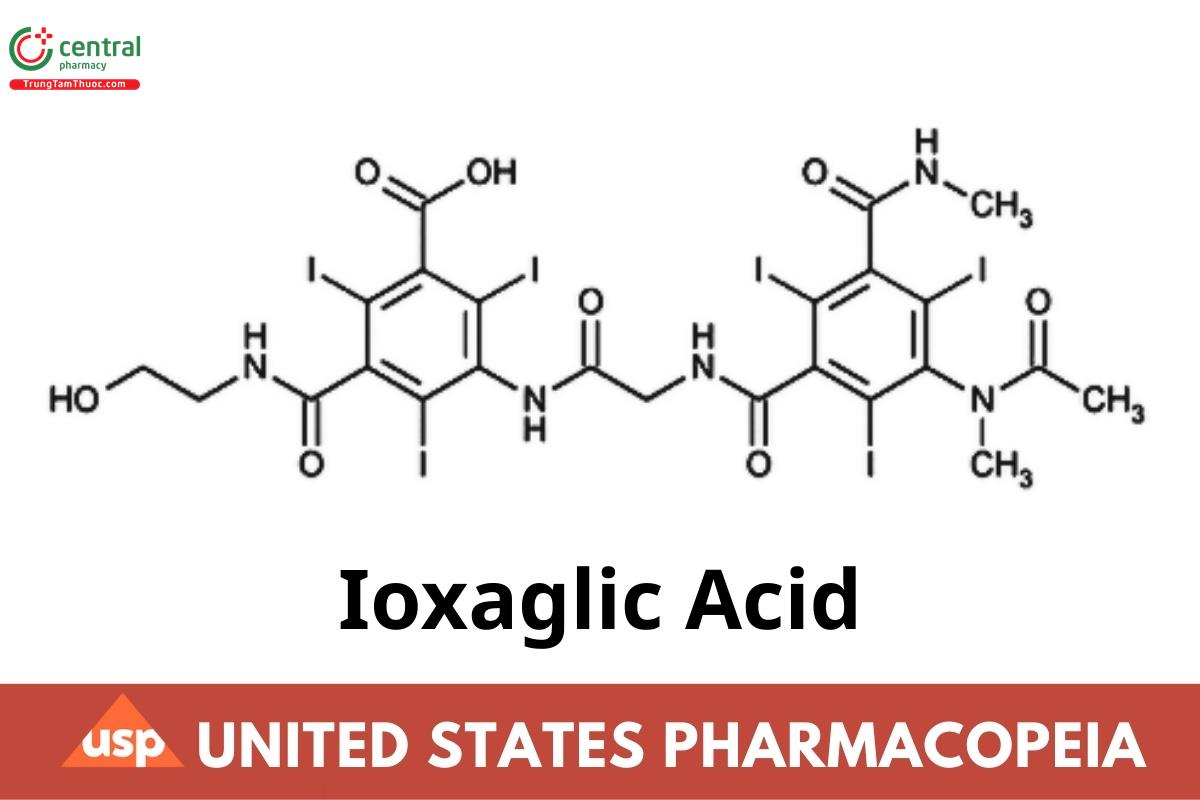
Ioxaglic Acid
If you find any inaccurate information, please let us know by providing your feedback here

Tóm tắt nội dung
This article is compiled based on the United States Pharmacopeia (USP) – 2025 Edition
Issued and maintained by the United States Pharmacopeial Convention (USP)
C24H21I6N5O8 1268.88
Benzoic acid, 3-[[[[3-(acetylmethylamino)-2,4,6-triiodo-5-[(methylamino) carbonyl] benzoyl)amino] acetyl)amino]-5- [[(2-hydroxyethyl)amino]carbonyl]-2,4,6-triiodo-.
N-(2-Hydroxyethyl)-2,4,6-triiodo-5[2-[2,4,6-triiodo-3-(N-methylacetamido)-5-(methylcarbamoyl)benz amido]acetamido]isophthalamic acid CAS RN®: 59017-64-0; UNII: Z40X7E12AF.
loxaglic Acid contains not less than 98.5 percent and not more than 101.5 percent of C24H211NO, calculated on the anhydrous basis.
Packaging and storage-Preserve in well-closed containers. Store at 25°, excursions permitted between 15° and 30°.
1 USP REFERENCE STANDARDS (11)
USP loxaqlic Acid RS
2 Identification
A: Thin-Layer Chromatographic Identification Test (201)-
Test solution-Dissolve 50 mg in 5 mL of methanol.
Application volume: 5 µL.
Developing solvent system: butyl alcohol, water, and acetic acid (50:25:11).
Procedure-Proceed as directed in the chapter. The RF values of the two spots obtained from the Test solution correspond to those obtained from the Standard solution.
B: Heat about 500 mg in a crucible: violet vapors are evolved.
WATER DETERMINATION, Method I (921): not more than 5%.
RESIDUE ON IGNITION (281): not more than 0.1%, the residue being moistened with 2 mL of 35% sulfuric acid and ignited at 600°.
3 Free iodine and iodide
Test solution-Dissolve 2 g of loxaglic Acid in 20 mL of 0.1 N sodium hydroxide in a 50-mL centrifuge tube. Add 15 mL of 2 N sulfuric acid, mix on a vortex mixer, centrifuge for 15 minutes, and decant the supernatant layer into a glass-stoppered 100-mL graduated cylinder. Repeat the sulfuric acid washing and centrifugation twice more, decanting each supernatant layer into the 100-mL graduated cylinder.
Procedure-Add 5 mL of toluene, shake vigorously, and allow the layers to separate: the toluene layer shows no red color. Add 1 mL of sodium nitrite solution (1 in 50), shake, and allow the layers to separate: any red color in the toluene layer is not darker than that obtained when a mixture of 2.0 mL of potassium iodide solution (1 in 4000), 25 mL of water, and 15 mL of 2 N sulfuric acid is substituted for the Test solution (0.02% of iodide).
Assay-Transfer about 500 mg of loxaglic Acid, accurately weighed, to a glass-stoppered 125-mL conical flask, and add 12 mL of 5 N sodium hydroxide, 20 mL of water, and 1 g of powdered zinc. Connect the flask to a reflux condenser, and reflux for 30 minutes. Cool the flask to room temperature, rinse the condenser with 20 mL of water, disconnect the flask from the condenser, and filter the mixture. Rinse the flask and the filter thoroughly, adding the rinsing to the filtrate. Add 40 mL of 2 N sulfuric acid, and titrate immediately with 0.05 N silver nitrate VS, determining the endpoint potentiometrically, using silver-calomel electrodes and an agar-potassium nitrate salt bridge. Each mL of 0.05 N silver nitrate is equivalent to 10.57 mg of C24H21I6N5O8.

