
Iodoquinol
If you find any inaccurate information, please let us know by providing your feedback here

Tóm tắt nội dung
This article is compiled based on the United States Pharmacopeia (USP) – 2025 Edition
Issued and maintained by the United States Pharmacopeial Convention (USP)
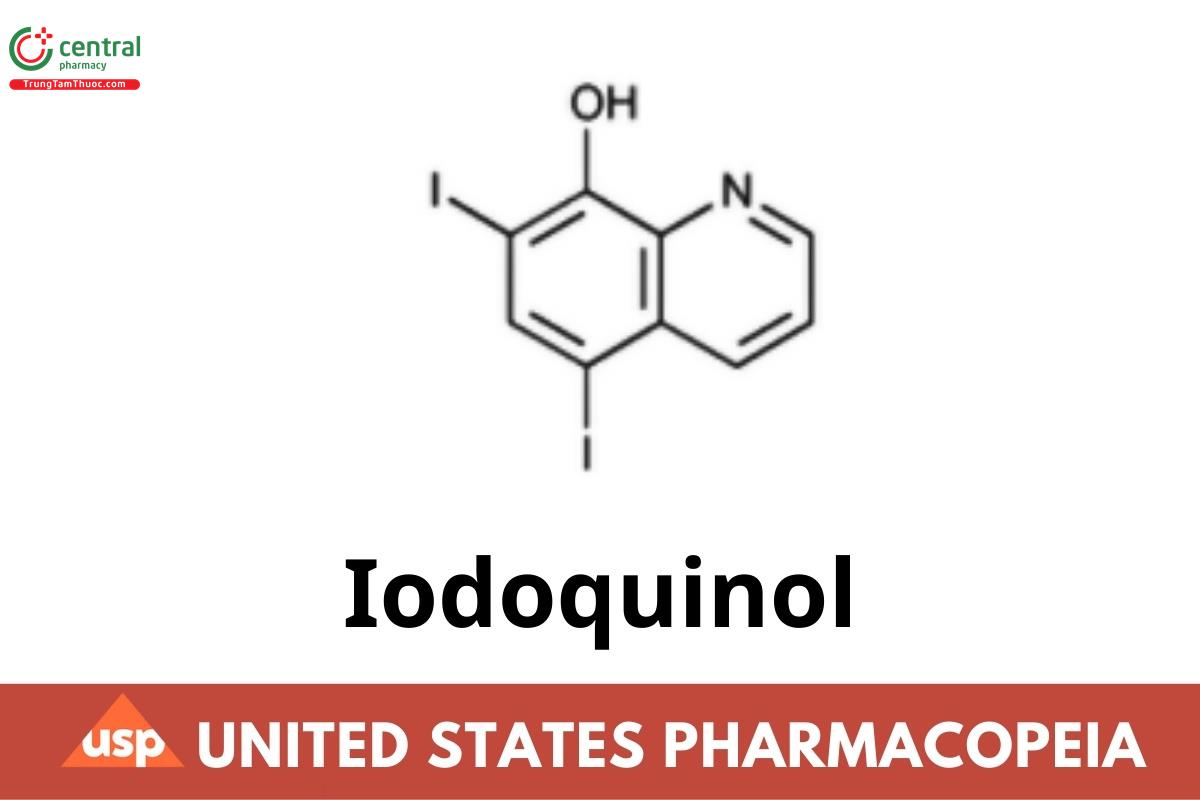
C9H5I2NO 396.95
8-Quinolinol, 5,7-diiodo-;
5,7-Diiodo-8-quinolinol CAS RN®: 83-73-8; UNII: 63W7IE88K8.
1 DEFINITION
lodoquinol contains NLT 96.0% and NMT 100.5% of iodoquinol (C9H5I2NO), calculated on the dried basis.
2 IDENTIFICATION
2.1 A. INFRARED ABSORPTION
Standard solution: 5 mg/mL of USP lodoquinol RS in carbon disulfide. Warm slightly, if necessary, to effect a complete solution.
Sample solution: 5 mg/mL of lodoquinol in carbon disulfide. Warm slightly, if necessary, to effect a complete solution.
Instrumental conditions
Mode: IR
Wavelength range: 7-11 µm
Cell: 3-mm sodium chloride
Blank: Carbon disulfide
Acceptance criteria: The spectrum of the Sample solution exhibits absorption maxima and minima only at the same wavelengths as those of the Standard solution.
2.2 B.
Analysis: Warm a small quantity of lodoquinol with 1 mL of sulfuric acid.
Acceptance criteria: Violet vapors of iodine are evolved.
3 ASSAY
3.1 PROCEDURE
Sample solution: 14 mg of lodoquinol. Proceed as directed in oxygen Flask Combustion (471) using a mixture of 10 mL of sodium hydroxide solution (1 in 100) and 1 mL of freshly prepared sodium bisulfite solution (1 in 100) as the absorbing liquid. When the combustion is complete, place a few mL of water around the stopper of the flask. Loosen the stopper. Then rinse the stopper, the specimen holder, and the sides of the flask with 20 mL of water, added in small portions. Add 1 mL of an oxidizing solution prepared by adding 5 mL of bromine to 100 mL of a solution (1 in 10) of sodium acetate in glacial acetic acid. Insert the stopper in the flask, and shake vigorously for 1 min. Add 0.5 mL of formic acid, replace the stopper, and shake vigorously for 1 min. Remove the stopper. Then rinse the stopper, the specimen holder, and the sides of the flask with several small portions of water. Bubble nitrogen through the flask to remove the oxygen and excess bromine. Add 500 mg of potassium iodide, swirl to dissolve, add 3 mL of 2 N sulfuric acid, and allow to stand for 2 min.
Titrimetric system
Titrant: 0.02 N sodium thiosulfate VS
Endpoint detection: Visual
Analysis: Titrate with Titrant, adding 3 mL of starch TS as the endpoint is approached. Each mL of 0.02 N sodium thiosulfate is equivalent to 0.6616 mg of iodoquinol (C9H5I2NO).
Acceptance criteria: 96.0%-100.5% on the dried basis
4 IMPURITIES
RESIDUE ON IGNITION (281): NMT 0.5%
5 SPECIFIC TESTS
5.1 LOSS ON DRYING (731)
Analysis: Dry over silica gel for 4 h.
Acceptance criteria: NMT 0.5%
5.2 FREE IODINE AND IODIDE
Sample solution: 50 mg/mL of lodoquinol in water. Shake the Sample solution for 30 s, allow to stand for 5 min, and filter.
Control solution: Dilute 2 mL of potassium iodide solution (1 in 6000) with water to 10 mL. Add 6 mL of 2 N sulfuric acid, 1 mL of potassium dichromate TS, and 2 mL of chloroform; and shake for 15 s.
Analysis: To 10 mL of the filtrate from the Sample solution add 1 mL of 2 N sulfuric acid, then add 2 mL of chloroform, and shake; no violet color appears in the chloroform (free iodine). To the mixture add 5 mL of 2 N sulfuric acid and 1 mL of potassium dichromate TS, and shake for 15 s.
Acceptance criteria: The color in the chloroform layer is not deeper than that produced for the Control solution (0.05% of iodide).
6 ADDITIONAL REQUIREMENTS
PACKAGING AND STORAGE: Preserve in well-closed containers.
USP REFERENCE STANDARDS (11)
USP lodoquinol RS

