
Iobenguane I 123 Injection
If you find any inaccurate information, please let us know by providing your feedback here
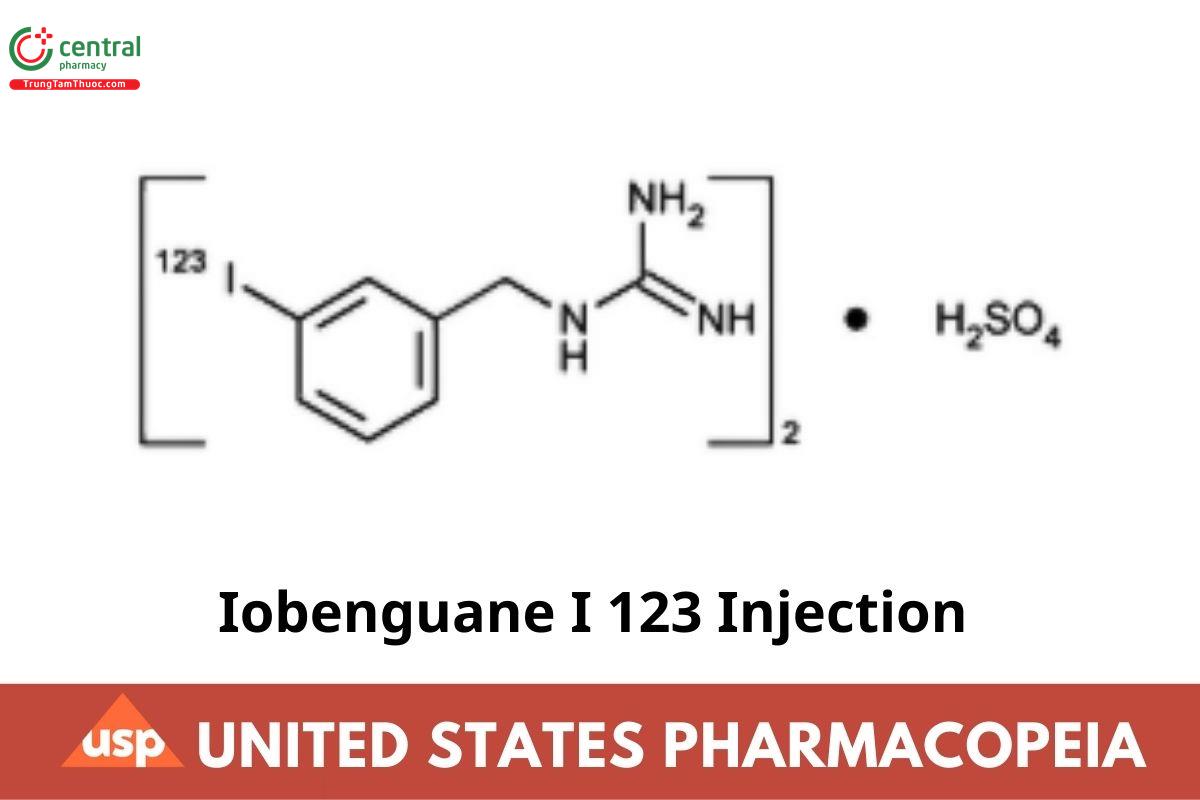

This article is compiled based on the United States Pharmacopeia (USP) – 2025 Edition
Issued and maintained by the United States Pharmacopeial Convention (USP)
» Iobenguane I 123 Injection is a sterile solution containing iobenguane sulfate in which a portion of the molecules contain radioactive iodine (¹²³I) in the molecular structure. Iobenguane I 123 Injection contains not less than 90.0 percent and not more than 110.0 percent of the labeled amount of I 123 as iobenguane expressed in megabecquerels (or in millicuries) per mL at the time indicated in the labeling. It contains not less than 90.0 percent and not more than 110.0 percent of the labeled amount of iobenguane. It may contain preservatives or stabilizers.
1 Packaging and storage—
Preserve in single-dose or in multiple-dose containers that are adequately shielded. Store in a freezer.
2 Labeling—
Label it to include the following: the time and date of calibration; the amount of ¹²³I as iobenguane expressed as total megabecquerels (or millicuries) per mL at the time of calibration; the name and quantity of any added preservative or stabilizer; the expiration time; and the statement “Caution—Radioactive Material.” The labeling indicates that in making dosage calculations, correction is to be made for radioactive decay, and also indicates that the radioactive half-life of ¹²³I is 13.2 hours.
Radionuclidic identification (see Radioactivity 〈821〉)—
Its gamma-ray spectrum is identical to that of a specimen of ¹²³I of known purity that exhibits a major photopeak having an energy of 159 KeV.
Bacterial Endotoxins Test 〈85〉—
It contains not more than 175/V USP Endotoxin Unit per mL of the Injection, when compared with the USP Endotoxin RS, in which V is the maximum recommended total dose, in mL, at the expiration time.
pH 〈791〉:
between 6.0 and 7.5.
Radionuclidic purity (see Radioactivity 〈821〉)—
Using a suitable counting assembly, determine the radionuclidic purity of the Injection: not less than 97% of the total radioactivity is present as ¹²³I.
3 Radiochemical purity—
Method 1 (High-pressure liquid chromatographic method)—
Mobile phase, Standard preparation, and Chromatographic system—Proceed as directed in the Assay for iobenguane sulfate, except that the liquid chromatograph is also equipped with a collimated radiation detector (see Radioactivity 〈821〉).
Test preparation—Use Iobenguane I 123 Injection.
Procedure—Inject a volume (about 20 µL) of Injection, equivalent to 1.6 to 2.7 MBq (44 to 64 µCi) of the Injection into the chromatograph, record the chromatogram, and measure the areas for the major peaks. The radioactivity of the iobenguane ¹²³I peak is not less than 90% of the total radioactivity measured, and its retention time is within 10% of that in the chromatogram of the Standard preparation obtained in the Assay for iobenguane sulfate.
Method 2 (Thin-layer chromatographic method)—
Apply 0.2 to 0.4 µL of the Injection 10 mm from one end of a 20- × 200-mm silica gel glass plate (see Chromatography 〈621〉), and allow to dry. Develop the chromatogram by ascending chromatography until the solvent front has moved 100 mm from the origin (about 20 minutes), using a solvent system consisting of a mixture of alcohol, ethyl acetate, and ammonium hydroxide (20:20:1). Air-dry the chromatogram, and determine the radioactivity distribution by scanning the chromatogram with a collimated radiation detector: not less than 90% of the total radioactivity is found as ¹²³I at the origin.
Other requirements—
It meets the requirements under Injections and Implanted Drug Products 〈1〉, except that the Injection may be distributed or dispensed prior to the completion of the test for Sterility Tests 〈71〉, the latter test being started on the day of final manufacture, and except that it is not subject to the recommendation on Container Content.
4 Assay for iobenguane sulfate—
Mobile phase—Prepare a filtered and degassed mixture of water and acetonitrile (900:100). Add 3.04 g of triethylamine per liter, and adjust with phosphoric acid to a pH of 4. Make adjustments if necessary (see System Suitability under Chromatography 〈621〉).
Standard preparation—Using an accurately weighed quantity of iobenguane sulfate, prepare a solution in water having a known concentration of about 1 mg per mL.
Assay preparation—Use the Injection, which has not yet been brought to full volume with bacteriostatic saline.
Chromatographic system (see Chromatography 〈621〉)—The liquid chromatograph is equipped with a 229-nm detector and a 4.6-mm × 25-cm column that contains 10-µm packing L1. The flow rate is about 1.5 mL per minute. Chromatograph the Standard preparation, and record the peak responses as directed under Procedure: the column efficiency is not less than 1000 theoretical plates, the tailing factor is not more than 1.2, and the relative standard deviation for replicate injections is not more than 1.5%.
Procedure—Separately inject equal volumes (about 20 µL) of the Standard preparation and the Assay preparation into the chromatograph, record the chromatograms, and measure the responses for the major peaks. Calculate the quantity, in mg, of iobenguane sulfate in each mL of the Injection taken by the formula:
C(rᵤ/rₛ)
in which C is the concentration, in mg per mL, of iobenguane sulfate in the Standard preparation; and rᵤ and rₛ are the iobenguane peak responses obtained from the Assay preparation and the Standard preparation, respectively.
Assay for radioactivity—
Using a counting assembly, determine the radioactivity, in MBq (or µCi), per mL, of the Injection by use of a calibrated system as directed under Radioactivity 〈821〉.

