
Hyoscyamine Hydrobromide
If you find any inaccurate information, please let us know by providing your feedback here
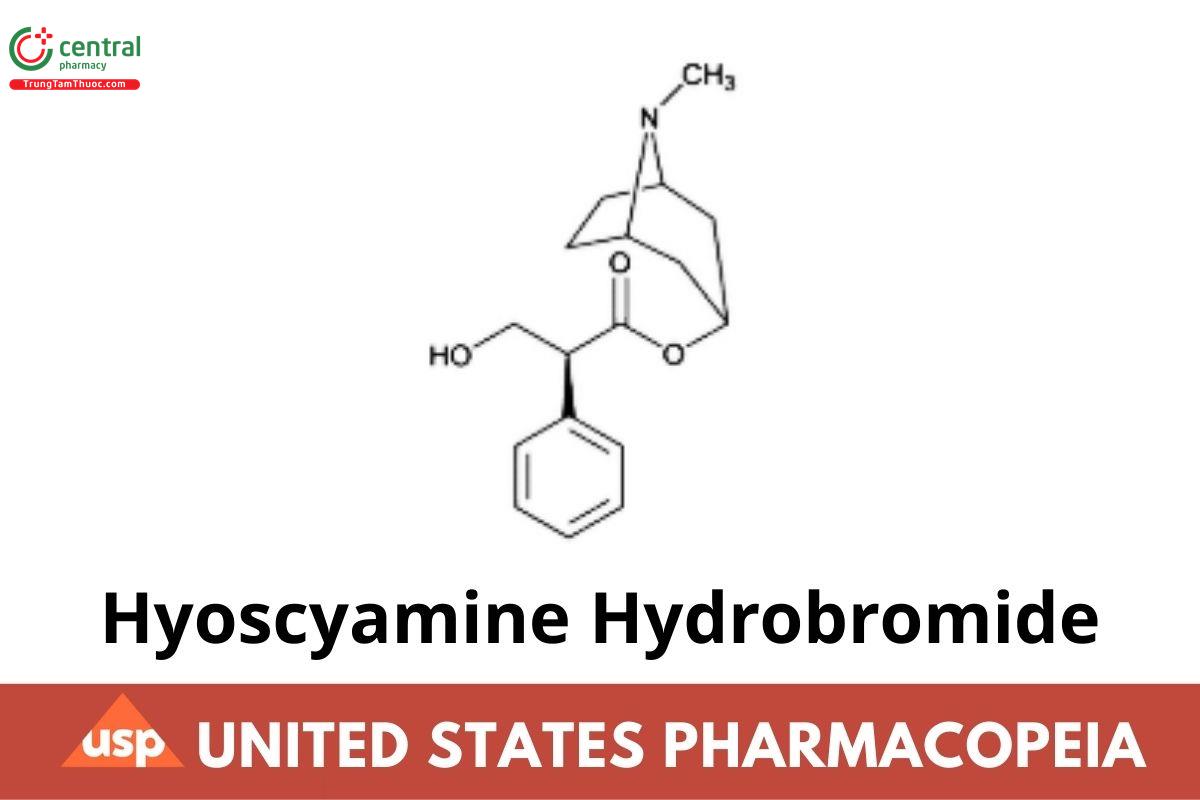

This article is compiled based on the United States Pharmacopeia (USP) – 2025 Edition
Issued and maintained by the United States Pharmacopeial Convention (USP)
1 DEFINITION
Hyoscyamine Hydrobromide contains NLT 98.5% and NMT 100.5% of hyoscyamine hydrobromide (C₁₇H₂₃NO₃ · HBr), calculated on the dried basis.
[Caution—Handle Hyoscyamine Hydrobromide with exceptional care, since it is highly potent.]
2 IDENTIFICATION
A.
Standard solution: Transfer 36 mg of USP Hyoscyamine Sulfate RS to a 60-mL separator with the aid of 5 mL of water. Add 1.5 mL of 1 N sodium hydroxide and 10 mL of chloroform to the separator. Shake for 1 min, allow the layers to separate, and pass the chloroform extracts through a filter of about 2 g of anhydrous granular sodium sulfate supported on a pledget of glass wool. Extract the aqueous layer with two additional 10-mL portions of chloroform, filtering and combining with the main extract. Evaporate the chloroform solution, under reduced pressure, to dryness, and dissolve the residue in 10 mL of carbon disulfide.
Sample solution: Prepare as directed in the Standard solution using 30 mg of Hyoscyamine Hydrobromide.
Acceptance criteria: The IR absorption spectrum (determined in a 1-mm cell) of the Sample solution exhibits maxima only at the same wavelengths as those of the Standard solution.
B.
Sample solution: 1 in 20
Analysis: To 1 mL of the Sample solution, add gold chloride TS, dropwise with shaking, until a definite precipitate separates. Add a small amount of 3 N hydrochloric acid, dissolve the precipitate with the aid of heat, and then allow the solution to cool.
Acceptance criteria: Lustrous reddish-brown scales that may be accompanied by reddish-brown needles are formed (distinction from atropine and Scopolamine).
C.
Sample solution: 1 in 20
Analysis: To the Sample solution, add silver nitrate TS.
Acceptance criteria: A yellowish-white precipitate is formed, and it is insoluble in nitric acid.
3 ASSAY
Procedure
Sample: 700 mg
Analysis: Dissolve the Sample in a mixture of 50 mL of glacial acetic acid and 10 mL of mercuric acetate TS. Add 1 drop of crystal violet TS. Titrate with 0.1 N perchloric acid VS to a blue-green endpoint. Perform a blank determination, and make any necessary correction. Each mL of 0.1 N perchloric acid is equivalent to 37.03 mg of hyoscyamine hydrobromide (C₁₇H₂₃NO₃ · HBr).
Acceptance criteria: 98.5%–100.5% on the dried basis
4 IMPURITIES
Residue on Ignition 〈281〉: NMT 0.2%
Other Alkaloids
Sample solution: Dissolve 250 mg of Hyoscyamine Hydrobromide in 1 mL of 0.1 N hydrochloric acid, and dilute with water to 15 mL.
Analysis 1: To 5 mL of the Sample solution, add a few drops of platinic chloride TS.
Acceptance criteria 1: No precipitate is formed immediately.
Analysis 2: To another 5-mL portion of the Sample solution, add 2 mL of 6 N ammonium hydroxide.
Acceptance criteria 2: The mixture may develop a slight opalescence, but no turbidity or precipitate is formed immediately.
5 SPECIFIC TESTS
Melting Range or Temperature 〈741〉: NLT 149°
Optical Rotation, Specific Rotation 〈781S〉
Sample solution: 50 mg/mL in water
Acceptance criteria: NLT −24°
Loss on Drying 〈731〉
Analysis: Dry at 105° for 2 h.
Acceptance criteria: NMT 1.0%
6 ADDITIONAL REQUIREMENTS
Packaging and Storage: Preserve in tight, light-resistant containers.
USP Reference Standards 〈11〉
USP Hyoscyamine Sulfate RS

