
Hydroxypropyl Betadex
If you find any inaccurate information, please let us know by providing your feedback here
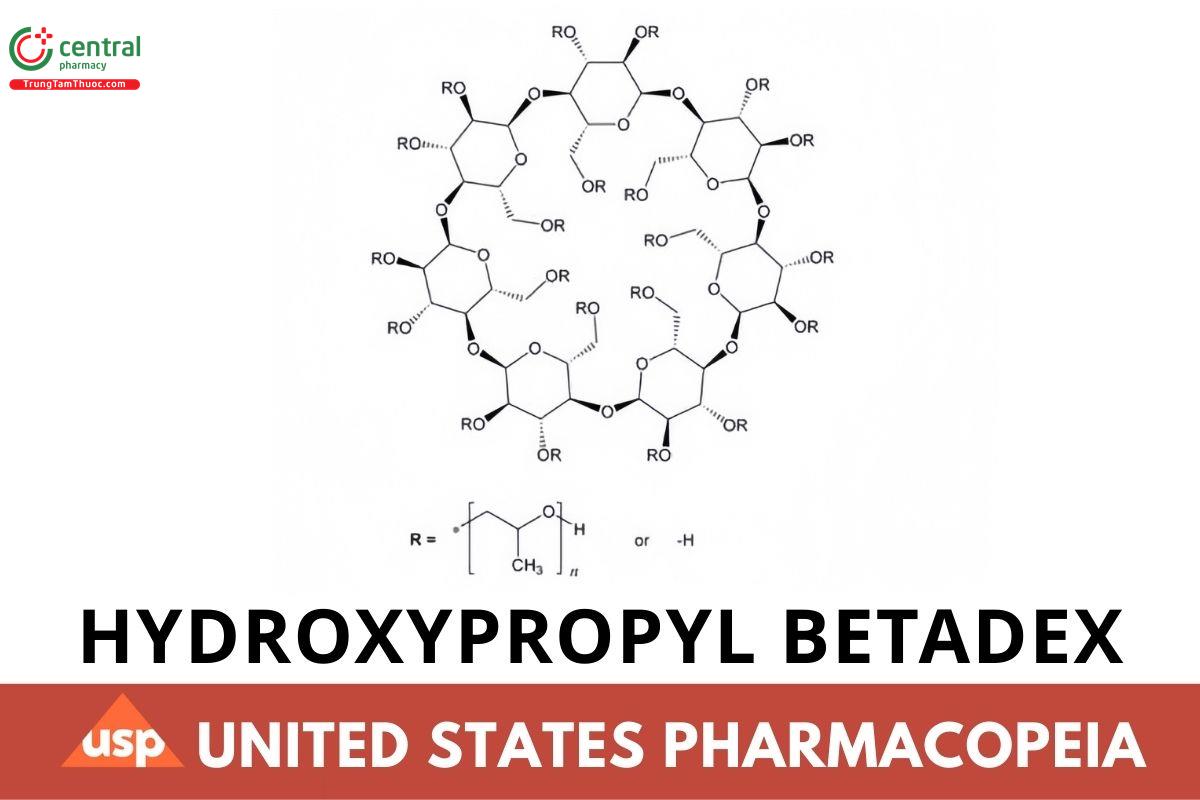

This article is compiled based on the United States Pharmacopeia (USP) – 2025 Edition
Issued and maintained by the United States Pharmacopeial Convention (USP)
42 353 C42H70O35(C3H6O)x where x = 7 x MS, MS being molar substitution
Beta cyclodextrin, 2-hydroxypropyl ether
CAS RN®: 128446-35-5.
1 DEFINITION
Hydroxypropyl Betadex is a partially substituted poly(hydroxypropyl) ether of Betadex. The number of hydroxypropyl groups per anhydroglucose unit expressed as molar substitution (MS) is NLT 0.40 and NMT 1.50 and is within 10% of the value stated on the label.
2 IDENTIFICATION
A. SPECTROSCOPIC IDENTIFICATION TESTS (197), Infrared Spectroscopy: 197K. The spectrum obtained with Hydroxypropyl Betadex shows the same absorption bands as the spectrum acquired with USP Hydroxypropyl Betadex RS. Due to the difference in the substitution of the substance, the intensity of some absorption bands may vary.
B. It meets the requirements of the test for Clarity of Solution.
3 ASSAY
3.1 MOLAR SUBSTITUTION
The molar substitution (MS) is calculated from the ratio between the signal from the three protons of the methyl group, contained in the hydroxypropyl functional group, and the signal from the proton attached to the carbon C1 (glycosidic proton) of the anhydroglucose units.
Use a Fourier-transform nuclear magnetic resonance (NMR) spectrometer having a magnetic field strength of at least 6 Tesla and that is capable of performing quantitative analysis using proton NMR spectroscopy at a temperature of at least 25°.
Sample solution: Mix NLT the equivalent of 10.0 mg of dried Hydroxypropyl Betadex with 0.75 mL of deuterium oxide thoroughly in an NMR tube. Place the tube into an NMR probe.
Analysis: Adjust the spectrometer settings so that a high-resolution proton NMR spectrum can be acquired that will provide quantitative data. Acquire a free induction decay (FID) with at least 8 transients using a spectral window from at least 0-6.2 ppm, with the solvent peak located at 4.8 ppm at 25°. Zero fill the spectrum at least three times, and Fourier transform the FID with no Gaussian line broadening and no more than 0.2 Hz of Lorenzian line broadening.
Determine the peak areas of the doublet from the methyl protons of the hydroxypropyl functional group at 1.2 ppm (A1) and the peak areas from the glycosidic protons, which are located between 5 and 5.4 ppm (A2).
Calculate the MS:
Result = A1/(3A2)
A1 = area of the methyl group of hydroxypropyl
A2 = area of the glycosidic proton
The degree of substitution is the number of hydroxypropyl groups per molecule of betadex and is obtained by multiplying the MS by 7.
Acceptance criteria: 0.40-1.50 and within 10% of the value stated on the label
4 IMPURITIES
Change to read:
4.1 LIMIT OF BETADEX, PROPYLENE GLYCOL, AND OTHER RELATED SUBSTANCES
Mobile phase: Water
Standard solution A: 15 mg/mL of USP Beta Cyclodextrin RS and 25 mg/mL of USP Propylene Glycol RS
Standard solution B: 1.0 mL of Standard solution A diluted with water to 10.0 mL
Sample solution: Dissolve 2.50 g of Hydroxypropyl Betadex, accurately weighed and calculated on the dried basis, in water with the aid of heat. Cool, and dilute with water to 25.0 mL. The resulting solution is 100 mg/mL of Hydroxypropyl Betadex, calculated on the dried basis, in water.
Chromatographic system
(See Chromatography (621), System Suitability..)
Mode: LC
Detector: Differential refractometer
Columns
Guard: Packing L11
Analytical: 3.9-mm x 30-cm; packing L11
Temperatures
Detector: 40°
Columns: 40° ▲(ERR 1-Feb-2025)
Flow rate: 1.5 mL/min
Injection volume: 20 µL
System suitability
Samples: Standard solution A and Standard solution B
ACIAL [NOTE-The retention time of propylene glycol is about 2.5 min, and the relative retention times with reference to that of propylene glycol for betadex and hydroxypropyl betadex are about 4.2 and about 6, respectively; Hydroxypropyl Betadex elutes as a very wide peak or several peaks.]
Suitability requirements
Resolution: NLT 4 between betadex and propylene glycol, Standard solution A
Relative standard deviation: NMT 2.0%, Standard solution B
Analysis
Samples: Standard solution B and Sample solution
Acceptance criteria: Disregard any peaks eluting before propylene glycol and after the hydroxypropyl betadex peak.
Betadex: NMT 1.5%; the area of the betadex peak in the Sample solution is NMT the area of the corresponding peak from Standard solution B.
Propylene glycol: NMT 2.5%; the area of the propylene glycol peak in the Sample solution is NMT the area of the corresponding peak from Standard solution B.
Any other single impurity: NMT 0.25%; the area from any other single impurity peak is NMT 0.1 times the area of propylene glycol in the chromatogram of Standard solution B.
Total impurities excluding betadex and propylene glycol: NMT 1%; the total area from all impurity peaks, excluding betadex and propylene glycol, is NMT 0.4 times the area of propylene glycol from Standard solution B.
Disregard limit: 0.1%; disregard any peaks that are less than 0.04 times the area of propylene glycol from Standard solution B.
4.2 LIMIT OF PROPYLENE OXIDE
Ether stock solution: Add 75 µL of ether to 30 mL of dimethylacetamide in a 50-mL volumetric flask, dilute with dimethylacetamide to volume, and mix. This solution contains 1.0 mg/mL of ether.
Internal standard solution: Add 30 µL of Ether stock solution to 70 mL of dimethylacetamide in a 100-mL volumetric flask, dilute with dimethylacetamide to volume, and mix.
Propylene oxide stock solution
[CAUTION-Propylene oxide is toxic and flammable. Prepare this solution in a well-ventilated fume hood.]
Add 30 mL of dimethylacetamide into a 50-mL volumetric flask. Weigh the flask and contents accurately, add 60 µL of propylene oxide (cooled in a refrigerator) into the flask with a 100-µL cooled microsyringe, weigh again, and calculate the weight of propylene oxide added, by difference. Dilute with dimethylacetamide to volume, and mix. This solution contains 1.0 mg/mL of propylene oxide.
[NOTE-Propylene oxide is a gas at room temperature. It is usually stored in a lecture-type gas cylinder or small metal pressure bomb. Chill the cylinder in a refrigerator before use. Transfer 5 mL of the liquid propylene oxide to a 100-mL beaker chilled in wet ice. Use a gas-tight syringe that has been chilled in a refrigerator.]
System suitability solution: Add 30 µL of Ether stock solution and 20 µL of Propylene oxide stock solution to 70 mL of dimethylacetamide in a 100-mL volumetric flask, dilute with dimethylacetamide to volume, and mix.
Standard stock solutions: Add 7 mL of dimethylacetamide into each of four 10-mL volumetric flasks. Transfer the following amounts of Propylene oxide stock solution into each of the four flasks using a microsyringe, with one amount per flask: 40, 100, 200, and 400 µL. Dilute with dimethylacetamide to volume, and mix. The Standard stock solutions contain about 4, 10, 20, and 40 µg/mL of propylene oxide, respectively.
Standard solutions: Into each of four 10-mL headspace vials, transfer 200 ± 5 mg of Hydroxypropyl Betadex, calculated on the dried basis. Pipet 1.0 mL of the Internal standard solution into each vial, and close the vial with septum and cap. Into each of the vials add 10 µL of each of the Standard stock solutions using a 10-µL syringe, respectively. Allow each vial to stand, and gently shake until the sample is dissolved. The Standard solutions contain, respectively, about 0.04, 0.1, 0.2, and 0.4 µg/mL of propylene oxide.
Sample solution: Transfer 200 ± 5 mg of Hydroxypropyl Betadex, calculated on the dried basis, into a 10-mL headspace autosampler vial.
Pipet 1.0 mL of the Internal standard solution into the vial, and close the vial with a septum and cap. Add 10 µL of dimethylacetamide using a 10-µL syringe. Allow the vial to stand, and gently shake until the sample is dissolved.
Chromatographic system
(See Chromatography (621), System Suitability.)
Mode: GC with a balanced pressure automatic headspace sampler
Detector: Flame ionization
Column: 0.32-mm x 10 - m fused-silica capillary; coated with a 10-um layer of stationary phase S3
Temperatures
Injection port: 120°
Detector: 250°
Column: See Table 1.
Table 1
| Initial Temperature (°) | Temperature Ramp (°/min) | Final Temperature (°) | Hold Time at Final Temperature (min) |
| 50 | — | 50 | 10 |
| 50 | 10 | 100 | 10 |
| 100 | 20 | 220 | 4 |
Transfer line: 120°
Carrier gas: Helium
Flow rate: 2 mL/min, corresponding to the linear velocity of 44 cm/s
Injection volume: 1.0 mL
Injection type: Split injection; the split ratio is 1:1.
System suitability
Sample: System suitability solution
[NOTE-The relative retention times for propylene oxide and ether are about 1.0 and 1.3, respectively.]
Suitability requirements
Resolution: NLT 2.0 between ether and propylene oxide
Analysis
Samples: Standard solutions and Sample solution
Separately place the vials containing the Standard solutions and the Sample solution in the automated sampler, and start the sequence so that the vial is heated at a temperature of 100° for 30 min before a suitable portion of its headspace is injected into the chromatograph.
Using a 2-mL gas syringe preheated in an oven at 110°, separately inject the headspace from each vial into the chromatograph.
Chromatograph the Standard solutions and the Sample solution, record the chromatograms, and measure the area ratios of the peak responses of propylene oxide and ether.
Determine, based on a retention time comparison, whether propylene oxide is detected in the Sample solution. Plot the area ratios of the peak responses of propylene oxide and ether of the Sample solution and the Standard solutions versus the content, in µg, of propylene oxide in each vial, as furnished by the Standard stock solutions, draw the straight line best fitting the five points, and calculate the correlation coefficient for the line. [NOTE-The Sample solution should be plotted as if it had a content of added propylene oxide equivalent to 0 µg.]
A suitable system is one that yields a line having a correlation coefficient of NLT 0.99. Extrapolate the line until it meets the content axis on the negative side. The distance between this point and the intersection of the axes represents the total amount, TU, in µg, of propylene oxide in the Sample solution.
Calculate the percentage of propylene oxide in the portion of sample taken:
Result = (TU/W) x 100
TU = total amount of propylene oxide from the graph in the Sample solution (µg)
W = weight of Hydroxypropyl Betadex taken to prepare the Sample solution (µg)
Acceptance criteria: NMT 0.0001%
5 SPECIFIC TESTS
5.1 MICROBIAL ENUMERATION TESTS (61), and TESTS FOR SPECIFIED MICROORGANISMS (62)
The total aerobic microbial count does not exceed 103 cfu/g, and the total combined molds and yeasts count does not exceed 102 cfu/g.
5.2 LOSS ON DRYING (731)
Sample: 1 g
Analysis: Dry the Sample at 120° for 2 h.
Acceptance criteria: NMT 10.0%
5.3 CLARITY OF SOLUTION
Sample: 1.0 g
Analysis: Dissolve the Sample in 2.0 mL of water, and heat.
Acceptance criteria: The resulting solution is clear and remains transparent after cooling to room temperature.
5.4 BACTERIAL ENDOTOXINS TEST (85)
The level of bacterial endotoxins is such that the requirement under the relevant dosage form monograph(s) in which Hydroxypropyl Betadex is used can be met. Where the label states that Hydroxypropyl Betadex must be subjected to further processing during the preparation of injectable dosage forms, the level of bacterial endotoxins is such that the requirement under the relevant dosage form monograph(s) in which Hydroxypropyl Betadex is used can be met.
5.5 STERILITY TESTS (71)
Where the label states that Hydroxypropyl Betadex is sterile, it meets the requirements for Sterility Tests (71), in the relevant dosage form monograph(s) in which Hydroxypropyl Betadex is used.
5.6 CONDUCTIVITY
Sample solution: 100 mg/mL of Hydroxypropyl Betadex, calculated on the dried basis in previously boiled and cooled to room temperature water
Apparatus: Use a conductivity meter or resistivity meter that measures the resistance of the column of liquid between the electrodes of the immersed measuring device. The apparatus is supplied with alternating current to avoid the effects of electrode polarization. It is equipped with a temperature compensation device or a precision thermometer.
Standard solutions: Prepare three standard solutions of potassium chloride containing 0.7455, 0.0746, and 0.0149 g, respectively, of potassium chloride per 1000.0 g of solution. These solutions should be prepared using water, which has been previously boiled and cooled to room temperature and has conductivity that does not exceed 2 µS · cm-1. The conductivity and resistivity of these three Standard solutions at 20° are given in Table 2.
Table 2
| Concentration of Solution (g/1000.0 g) | Conductivity (µS · cm−1)) | Resistivity (Ω · 2 cm) |
| 0.7455 | 1330 | 752 |
| 0.0746 | 133.0 | 7519 |
| 0.0149 | 26.6 | 37,594 |
Calibration
Samples: Standard solutions
Choose a conductivity cell that is appropriate for the conductivity of the solution to be examined. The higher the expected conductivity, the higher the cell constant that must be chosen. Commonly used conductivity cells have cell constants on the order of 0.1, 1, and 10 cm-1.
Use a Standard solution of potassium chloride that is appropriate for the measurement. The conductivity value of the Standard solution of potassium chloride should be near the expected conductivity value of the Sample solution.
Rinse the cell several times with water, which has been previously boiled and cooled to room temperature, and at least twice with the Standard solution (potassium chloride solution) used for the determination of the cell constant of the conductivity cell.
Measure the resistance of the conductivity cell using the Standard solution (potassium chloride solution) at 20 ± 0.1°.
Calculate the constant of the conductivity cell, C (in cm-1):
C=RKCl x KKCl
RKCl = measured resistance, expressed in mega-ohms
KKCl = conductivity of the Standard solution of potassium chloride used, expressed in µS · cm-1 KCI
Calibration acceptance criteria: The measured constant, C, of the conductivity cell must be within 5% of the given value.
Analysis
Sample: Sample solution
Rinse the conductivity cell several times with water, which has been previously boiled and cooled to room temperature, and at least twice with the Sample solution. Measure the conductivity of the Sample solution, while gently stirring with a magnetic stirrer.
Acceptance criteria: NMT 200 µS · cm-1
6 ADDITIONAL REQUIREMENTS
PACKAGING AND STORAGE: Preserve in well-closed containers. Store at room temperature.
LABELING: Label it to indicate the molar substitution (MS). Where Hydroxypropyl Betadex is intended for use in the manufacture of injectable dosage forms, it is so labeled. Where Hydroxypropyl Betadex must be subjected to further processing during the preparation of injectable dosage forms to ensure acceptable levels of bacterial endotoxins, it is so labeled. Where Hydroxypropyl Betadex is sterile, it is so labeled.
USP REFERENCE STANDARDS (11).
USP Beta Cyclodextrin RS
USP Hydroxypropyl Betadex RS
USP Propylene Glycol RS

