
Hydrogenated Castor Oil
If you find any inaccurate information, please let us know by providing your feedback here

This article is compiled based on the United States Pharmacopeia (USP) – 2025 Edition
Issued and maintained by the United States Pharmacopeial Convention (USP)
1 DEFINITION
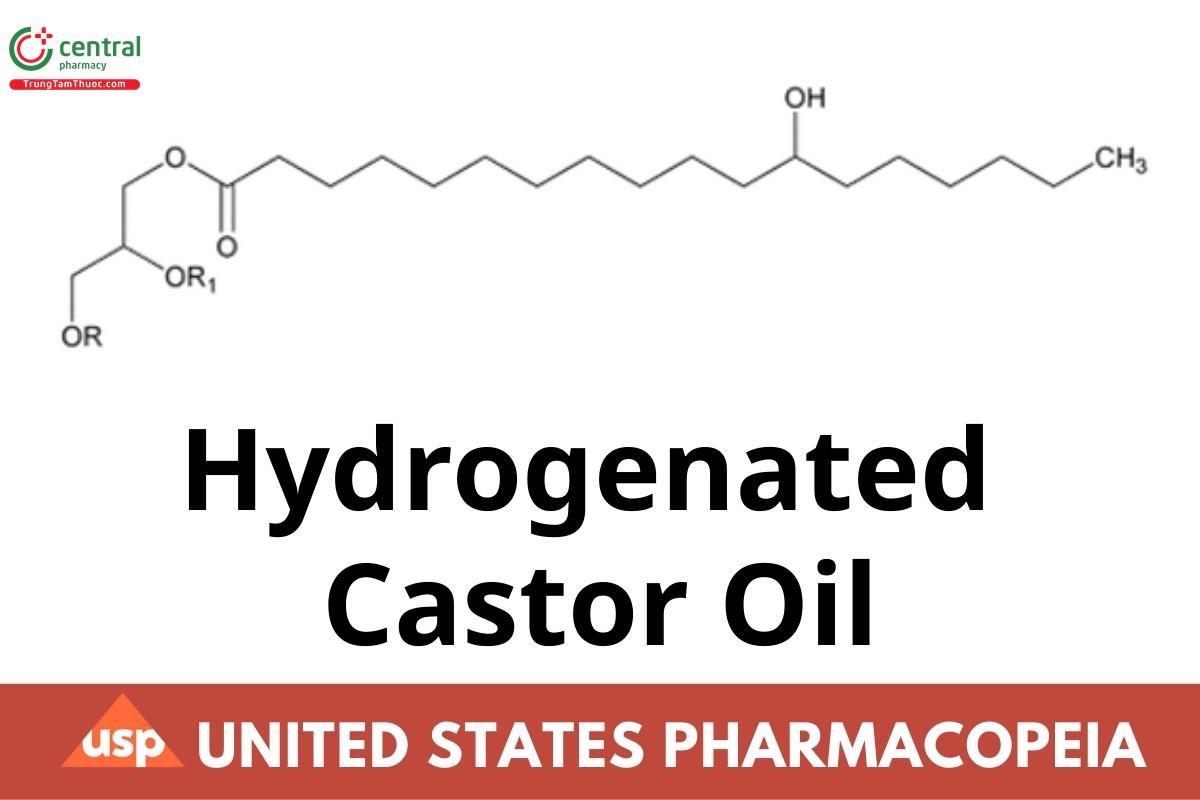
Hydrogenated Castor Oil is refined, bleached, hydrogenated, and deodorized Castor Oil, consisting mainly of NLT 70.0% of the triglyceride of hydroxystearic acid.
2 IDENTIFICATION
2.1 A. IDENTITY BY FATTY ACID COMPOSITION
Diluent: Chloroform
Standard solution 1: 0.8 mg/mL each of methyl palmitate, methyl arachidate, and methyl 12-ketostearate, 8 mg/mL of methyl stearate, and 0.4 mg/mL of methyl 12-hydroxystearate, from USP Methyl Palmitate RS, methyl arachidate, methyl 12-ketostearate, USP Methyl Stearate RS, and USP Methyl 12-Hy droxystearate RS, in Diluent
Standard solution 2: 4 mg/mL each of methyl stearate and methyl 12-hydroxystearate, from USP Methyl Stearate RS and USP Methyl 12- Hy droxystearate RS, in Diluent
Sample solution: Transfer 140 mg of Hydrogenated Castor Oil to a 10-mL screw-cap test tube, add 3.0 mL of Diluent, and mix well. Add 0.5 mL of 0.5 M sodium methoxide in methanol,1 and mix with the sample. Allow the reaction to proceed at room temperature for 2 h. After 2 h, add 5 mL of water, and mix. Centrifuge the test tube at 1000 × g for 5–15 min at 4° until a clear organic layer forms. Separate the organic layer, and remove the aqueous layer. Place an aliquot of the organic layer into an autosampler vial.
2.1.1 Chromatographic system
(See Chromatography 〈621〉, System Suitability.) Mode: GC
Detector: Flame ionization
Column: 0.32-mm × 30-m fused silica capillary bonded with a 0.25-µm layer of phase G16
Temperatures
Injection port: 240°
Detector: 250°
Column: See Table 1 for oven program.
Table 1
Carrier gas: Hydrogen
Flow rate: 5.0 mL/min, constant flow mode Injection volume: 1.0 µL
Injection type: Split ratio, 120:1 or 60:1
Liner: Single taper, low-pressure drop liner with deactivated wool
Run time: 55 min
2.1.2 System suitability
Sample: Standard solution 1
[NOTE—See Table 2 for relative retention times.]
Table 2
Suitability requirements
Resolution: NLT 5 between any two adjacent peaks
Relative standard deviation: NMT 2.0% for the peak area ratio of methyl 12-hydroxystearate to methyl 12-ketostearate
2.1.3 Analysis
Samples: Standard solution 1, Standard solution 2, and Sample solution Calculate the relative response factor, F, for methyl 12-hydroxystearate:
F = (rS/rR) × (CR/CS)
rS = peak area of methyl stearate from Standard solution 2
rR = peak area of methyl 12-hydroxystearate from Standard solution 2
CR = concentration of USP Methyl 12-Hy droxystearate RS in Standard solution 2 (mg/mL)
CS = concentration of USP Methyl Stearate RS in Standard solution 2 (mg/mL)
Correct the peak area of methyl 12-hydroxystearate in the Sample solution by multiplying by F. Calculate the percentage of each fatty acid component in the portion of sample taken:
Result = (rU/rT) × 100
rU = peak area of each individual fatty acid methyl ester, except for the uncorrected peak area of methyl 12-hydroxystearate (or the corrected peak area of methyl 12-hydroxystearate), from the Sample solution
rT = sum of all the peak areas, excluding the solvent and methyl 12-hydroxystearate peaks and including the corrected peak area of methyl 12-hydroxystearate, from the Sample solution
Acceptance criteria: Hydrogenated Castor Oil exhibits the composition profile of fatty acids shown in Table 3.
Table 3
2.2 B. MELTING RANGE OR TEMPERATURE 〈741〉 , Procedures, Procedure for Class II
85°–88°
3 ASSAY
3.1 TRIGLYCERIDE COMPOSITION
Solution A: Methanol Solution B: 2-Propanol Mobile phase: See Table 4.
Table 4
Diluent: Methylene chloride
System suitability solution: 3.0 mg/mL of USP Hy drogenated Castor Oil RS in Diluent. [NOTE—Due to low solubility, sonicate the solution for about 2–3 min.]
Sample solution: 3.0 mg/mL of Hydrogenated Castor Oil in Diluent. [NOTE—Due to low solubility, sonicate the solution for about 2–3 min.]
3.1.1 Chromatographic system
(See Chromatography 〈621〉, System Suitability.) Mode: LC
Detector: Evaporative light-scattering Column: 4.6-mm × 25-cm; 5-µm packing L1
Temperatures
Column: 25°
Detector: 40°
Flow rate: 1.0 mL/min Injection volume: 5 µL Run time: 35 min
[NOTE—Depending on the different settings of the Detector, the Temperatures and Flow rate can be adjusted as long as system suitability requirements are met.]
3.1.2 System suitability
Sample: System suitability solution
[NOTE—See Table 5 for relative retention times.]
Table 5
Suitability requirements
Resolution: NLT 1.5 between glyceryl tri(12-hydroxystearate) and di(12-hydroxystearoyl)-(12-oxostearoyl)-glycerol Tailing factor: 0.8–1.8 for the glyceryl tri(12-hydroxystearate) peak
Relative standard deviation: NMT 2% for the peak area of glyceryl tri(12-hydroxystearate) Analysis
Samples: System suitability solution and Sample solution
Calculate the percentage of each of the triglycerides in the portion of sample taken:
Result = (rU/rT) × 100
rU = peak area of each individual triglyceride from the Sample solution
rT = sum of all the peak areas, excluding the solvent peak, from the Sample solution
Acceptance criteria: Hydrogenated Castor Oil exhibits the composition profile shown in Table 6 .
Table 6
4 IMPURITIES
4.1 LIMIT OF NICKEL
[CAUTION—When using closed high-pressure digestion vessels and laboratory microwave equipment, the safety precautions and operating instructions given by the manufacturer must be followed.]
[NOTE—If an alternative apparatus is used, adjustment of the instrument parameters may be necessary.]
Nickel standard stock solution: Dilute nickel standard solution TS two-fold with water. This solution contains the equivalent of 5 µg/mL of nickel.
Standard solutions: Transfer 25, 50, 75, and 100 µL of Nickel standard stock solution to four identical 25-mL volumetric flasks. To each flask add 0.5 mL of a 10-mg/mL solution of magnesium nitrate, 0.5 mL of a 100-mg/mL solution of monobasic ammonium phosphate, and 6.0 mL of nickel-free nitric acid. Dilute with water to volume, and mix well. [NOTE—Content of nickel in the nickel-free nitric acid is NMT 0.005 ppm.] The Standard solutions contain 0.005, 0.01, 0.015, and 0.02 µg/mL of nickel, respectively.
Sample solution: Transfer about 250 mg of Hydrogenated Castor Oil to a suitable high-pressure-resistant digestion vessel (fluoropolymer or quartz glass), and add 6.0 mL of nickel-free nitric acid and 2.0 mL of 30% hydrogen peroxide. Place the closed vessel in a laboratory microwave oven, and digest using an appropriate program (e.g., 1000 W for 40 min). Allow the digestion vessel to cool before opening. Add
2.0 mL of 30% hydrogen peroxide, and repeat the digestion step. Allow the digestion vessel to cool down before opening. Quantitatively transfer to a 25-mL volumetric flask, add 0.5 mL of a 10-mg/mL solution of magnesium nitrate and 0.5 mL of a 100-mg/mL solution of monobasic ammonium phosphate. Dilute with water to volume, and mix well.
Blank solution: Place 6.0 mL of nickel-free nitric acid and 2.0 mL of 30% Hydrogen peroxide in a suitable high-pressure-resistant digestion vessel. Prepare as directed in Sample solution, beginning with “Place the closed vessel in a laboratory microwave oven, and digest using an appropriate program (e.g., 1000 W for 40 min).”
Zero solution: In a 50-mL volumetric flask, introduce 1.0 mL of a 10-mg/mL solution of magnesium nitrate, 1.0 mL of a 100-mg/mL solution of monobasic ammonium phosphate, and 12.0 mL of nickel-free nitric acid. Dilute with water to volume, and mix well.
4.1.1 Instrumental conditions
(See Atomic Absorption Spectroscopy 〈852〉.)
Mode: Atomic absorption, equipped with a graphite furnace, a background compensation system, and a coated tube resistant to pyrolysis Analytical wavelength: 232.0 nm
Lamp: Nickel hollow-cathode
Temperature: Maintain the drying temperature of the furnace at 120° for 35 s after a 5-s ramp; maintain the ashing temperature at 1100° for 10 s after a 30-s ramp; maintain the cooling temperature at 800° for 5 s after a 5-s decrease; and maintain the atomization temperature at 2600° for 7 s. [NOTE—The temperature program may be modified to obtain optimum furnace temperatures.]
4.1.2 Analysis
Samples: Standard solutions, Sample solution, and Blank solution
Concomitantly determine the absorbances of the Samples using the Instrumental conditions described above. Use the Zero solution to set the instrument to zero. Plot the absorbances of the Standard solutions versus the concentration, in µg/mL, of nickel, and draw the straight line best fitting the plotted points. From this graph, determine the concentration, C , in µg/mL, of nickel in the Sample solution, and determine the concentration, C , in µg/mL, of nickel in the Blank solution. If necessary, dilute with the Zero solution to obtain a reading within the calibrated absorbance range.
Calculate the quantity, in µg, of nickel in each g of Hydrogenated Castor Oil taken:
Result = V × (CT − CB)/W
V = volume of the Sample solution and the Blank solution, 25 mL
CT = concentration of nickel in the Sample solution (µg/mL)
CB = concentration of nickel in the Blank solution (µg/mL)
W = weight of Hydrogenated Castor Oil taken to prepare the Sample solution (g) Acceptance criteria: NMT 20 µg/g
4.2 ALKALINE IMPURITY
Sample: 1.0 g
Analysis: Dissolve the Sample by gently heating in a mixture of 1.5 mL of alcohol and 3.0 mL of toluene. Add 0.05 mL of bromophenol blue TS, and titrate with 0.01 N hydrochloric acid VS to a yellow endpoint.
Acceptance criteria: NMT 0.2 mL of 0.01 N hydrochloric acid.
5 SPECIFIC TESTS
FATS AND FIXED OILS 〈401〉 , Procedures, Iodine Value: NMT 5
FATS AND FIXED OILS 〈401〉 , Procedures, Saponification Value: 176–182
FATS AND FIXED OILS 〈401〉 , Procedures, Acid Value
Sample solution: Melt 20 g in a conical flask on a steam bath, add 75 mL of hot alcohol that has previously been neutralized with 0.1 N sodium hydroxide to phenolphthalein TS, swirl, and add 1 mL of phenolphthalein TS.
Analysis: Titrate with 0.1 N sodium hydroxide VS, swirling vigorously, until the solution remains faintly pink after being shaken for 60 s. Acceptance criteria: NMT 11.0 mL of 0.1 N sodium hydroxide VS, corresponding to NMT 3.1 for acid value
FATS AND FIXED OILS 〈401〉 , Procedures, Hydroxyl Value
Sample solution: 2 g in a glass-stoppered, 250-mL conical flask. Add 5.0 mL of a freshly prepared mixture of acetic anhydride and pyridine (1:3), and swirl to mix. Connect the flask to a reflux condenser, and heat on a steam bath for 2 h. Add 10 mL of water through the condenser, swirl to mix, heat on a steam bath for an additional 10 min. The titration can be performed on a warm solution of 50°–65° to avoid a flocculation of the substance. Add through the condenser 15 mL of normal butyl alcohol that has previously been neutralized to phenolphthalein, remove the condenser, wash the tip of the condenser and the sides of the flask with an additional 10 mL of neutralized normal butyl alcohol, and add 1 mL of phenolphthalein TS.
Analysis: Titrate with 0.5 N alcoholic potassium hydroxide VS to a faint pink endpoint. Perform a blank determination on a 5.0-mL portion of the acetic anhydride–pyridine mixture. To determine the amount of free acid in Hydrogenated Castor Oil, weigh 10 g into a 250-mL conical flask, add 10 mL of pyridine that has previously been neutralized to phenolphthalein, swirl to mix, add 1 mL of phenolphthalein TS, and titrate with 0.5 N alcoholic potassium hydroxide VS to a faint pink endpoint.
Calculate the hydroxyl value in the portion of Hydrogenated Castor Oil taken:
Result = Mr × N × [A + (B × W/D) − C]/W
Mr = molecular weight of potassium hydroxide, 56.1
N = normality of the alcoholic potassium hydroxide solution
A = volume of 0.5 N alcoholic potassium hydroxide consumed by the blank (mL)
B = volume consumed in the free-acid titration (mL) W = weight of Hydrogenated Castor Oil taken (g)
D = weight of Hydrogenated Castor Oil used in the free-acid titration (g) C = volume consumed in the sample titration (mL)
Acceptance criteria: 154–163
6 ADDITIONAL REQUIREMENTS
PACKAGING AND STORAGE: Preserve in tight containers, and avoid exposure to excessive heat.
USP REFERENCE STANDARDS 〈11〉
USP Hydrogenated Castor Oil RS USP Methyl 12-Hydroxystearate RS USP Methyl Palmitate RS
USP Methyl Stearate RS
1 0.5 M sodium methoxide in methanol is available from Sigma-Aldrich (www.sigmaaldrich.com), product #403067. Any other equivalent reagent can be used as well.

