
Histamine Test Method
If you find any inaccurate information, please let us know by providing your feedback here
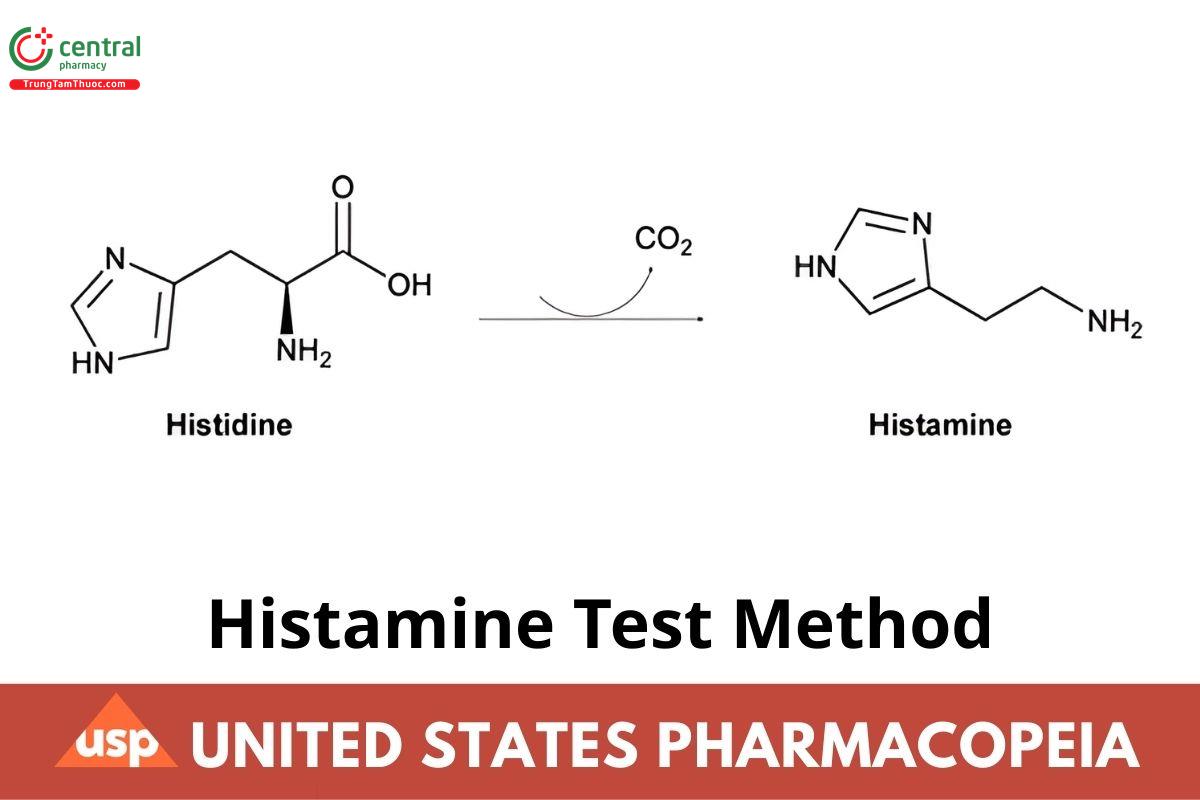

This article is compiled based on the United States Pharmacopeia (USP) – 2025 Edition
Issued and maintained by the United States Pharmacopeial Convention (USP)
1 INTRODUCTION
High levels of histamine in drug products can lead to severe adverse drug reactions, including flushing, itching, hives, shortness of breath, decreased blood pressure, increased heart rate, and even fatality.
A potential source of histamine impurity is peptone of animal origin, particularly fish peptone, which is a critical raw material used as a protein source in the fermentation process. Free histidine is a naturally-occurring Amino acid present in animals that can be converted to histamine by histidine decarboxylase.
Fish peptone has a higher histamine contamination risk than other animal-derived peptones because some species of fish have larger quantities of histidine. Special attention must be paid to histamine levels when peptones of animal origin are used in the manufacturing process. This general chapter is intended to provide users with validated analytical methods to quantify the histamine levels in antibiotics.
Applicable requirements for histamine content are determined by the appropriate regulatory agency.
This chapter contains an LC-MS method to determine the histamine content. This method is validated for use with Gentamicin sulfate, and must be validated for use with other drug substances.
2 HISTAMINE CONTENT IN GENTAMICIN SULFATE
Procedure
Solution A: Acetonitrile
Solution B: 10 mM ammonium formate in 0.1% formic acid
Sensitivity solution: 2 ng/mL solution of USP Histamine Dihydrochloride RS
Standard solutions: Accurately weigh an appropriate amount of USP Histamine Dihydrochloride RS, and dissolve and dilute with Solution B.
Dilute further with Solution B to obtain a series of standard solutions (NLT 3) appropriately spaced and at concentrations appropriate for the assay within the range from 2 to 20 ng/mL.
Sample solution: Accurately weigh a suitable quantity of gentamicin sulfate, and dissolve and dilute with Solution B to prepare a 1 mg/mL solution.
Check standard: Accurately weigh an appropriate amount of USP Histamine Dihydrochloride RS, and dissolve and dilute with Solution B.
Dilute further with Solution B to obtain a check standard within the range of the concentrations prepared for the Standard curve.
Mobile phase gradient: See Table 1.
Table 1
| Time (min) | Solution A (% v/v) | Solution B (% v/v) |
|---|---|---|
| 0 | 90 | 10 |
| 4 | 40 | 60 |
| 5 | 40 | 60 |
| 5.01 | 90 | 10 |
| 7 | 90 | 10 |
Chromatographic system
(See Chromatography 〈621〉, System Suitability.)
Mode: LC
Detector: MS
MS conditions
Ionization mode: Electrospray (+) ionization
Single-ion monitoring (SIM) mode: m/z 112.1
Probe temperature: 600°
Column: 2.1-mm × 10-cm; 1.7-μm packing L68
Column temperature: 35°
Flow rate: 0.5 mL/min
Injection volume: 1 μL
[Note - The approximate retention time of the histamine peak is 2.8 min.]
Standard curve
Samples: Standard solutions
Inject 1 μl of a series of Standard solutions and record the chromatograms and peak area of MS signals. Using the linear regression method, plot the histamine peak areas of the Standard solutions versus the histamine concentrations, and determine the standard curve best fitting the plotted points.
System suitability
Samples: Sensitivity solution, Standard solutions, and Check standard
Suitability requirements
Linearity: The correlation coefficient (R) of the Standard curve should be NLT 0.99.
Percent recovery of the Check standard: 80%–120%
Relative standard deviation: Inject 3 replicates of the Standard solution prepared at 10 ng/mL, and record the histamine peak areas. The percent relative standard deviation (%RSD) of the histamine peak areas is NMT 10%. If the sample MS signals are lower than the Standard curve, the %RSD is not required.
Signal-to-noise ratio: NLT 10 of the histamine peak, Sensitivity solution
Analysis
Sample: Sample solution
Inject 1 μl of the Sample solution, and record chromatograms and peak area of MS signals.
Calculation: From the Standard curve obtained and the histamine peak area of the Sample solution, determine the histamine concentration, C, in the Sample solution. Calculate the content of histamine, in ng/mg (ppm), in the gentamicin sulfate sample:
Result = C/S
C = concentration of histamine in the Sample solution (ng/mL)
S = concentration of gentamicin sulfate in the Sample solution (mg/mL)
3 ADDITIONAL REQUIREMENTS
USP Reference Standards 〈11〉
USP Histamine Dihydrochloride RS C5H9N3 · 2HCl 184.07 (USP 1-May-2022)

