
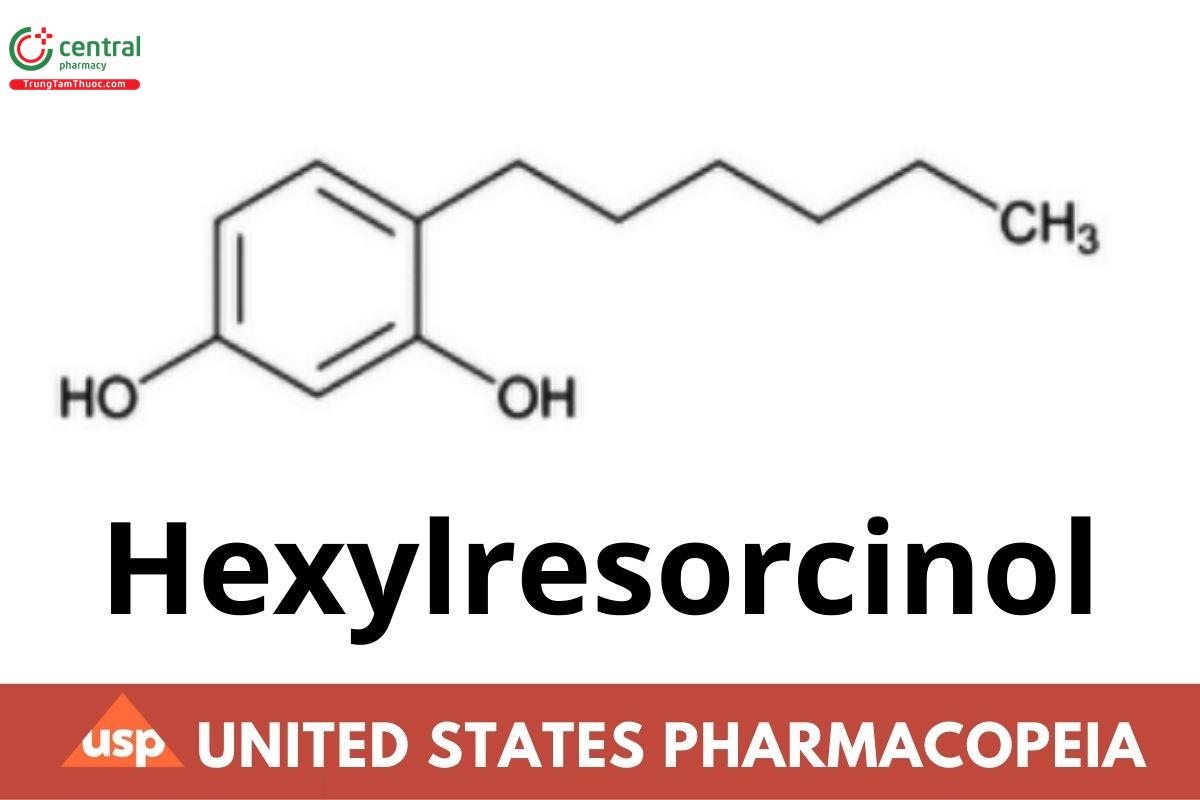
Hexylresorcinol
If you find any inaccurate information, please let us know by providing your feedback here

Tóm tắt nội dung
This article is compiled based on the United States Pharmacopeia (USP) – 2025 Edition
Issued and maintained by the United States Pharmacopeial Convention (USP)
C12H18O2 194.27
1,3-Benzenediol, 4-hexyl-;
4-Hexylresorcinol CAS RN®: 136-77-6; UNII: R9QTB5E82N.
1 DEFINITION
Hexylresorcinol, dried over silica gel for 4 h, contains NLT 98.0% and NMT 100.5% of Hexylresorcinol (C12H18O2).
[Caution—Hexylresorcinol is irritating to the oral mucosa and respiratory tract and to the skin, and its solution in alcohol has vesicant properties.]
2 IDENTIFICATION
A.
Sample solution: 1 mL of a saturated solution
Analysis: To the Sample solution, add 1 mL of nitric acid.
Acceptance criteria: A light red color appears.
B.
Sample solution: 1 mL of a saturated solution
Analysis: To the Sample solution, add 1 mL of bromine TS.
Acceptance criteria: A yellow, occulent precipitate is formed. Add 2 mL of 6 N ammonium hydroxide. The precipitate dissolves, producing a yellow solution.
3 ASSAY
Procedure
Sample solution: Dissolve 70–100 mg of Hexylresorcinol, previously dried over silica gel for 4 h and weighed, in 10 mL of methanol in a 250- mL iodine ask. Add 30.0 mL of 0.1 N bromine VS, then add quickly 5 mL of hydrochloric acid, and insert the stopper in the ask immediately. Cool the ask under running water to room temperature, shake vigorously for 5 min, then set aside for 5 min. Add 6 mL of potassium iodide TS around the stopper, cautiously loosen the stopper, again insert the stopper tightly, and swirl gently. Add 1 mL of chloroform.
3.1 Titrimetric system
(See Titrimetry 〈541〉.)
Mode: Residual titration
Titrant: 0.1 N bromine VS
Back-titrant: 0.1 N sodium thiosulfate VS
Endpoint detection: Visual
3.2 Analysis
Titrate the liberated iodine with Back-titrant, adding 3 mL of starch TS as the endpoint is approached. Perform a blank determination.
Calculate the percentage of hexylresorcinol (C12H18O2) in the sample taken. Each milliliter of Titrant is equivalent to 4.857 mg of hexylresorcinol (C12H18O2).
Acceptance criteria: 98.0%–100.5%, dried over silica gel for 4 h
4 IMPURITIES
Delete the following:
Mercury
Select all reagents for this test to have as low a content of mercury as practicable, and store all reagent solutions in containers of borosilicate glass. Glassware used in this test shall be specially cleaned by being soaked in warm 8 N nitric acid for 30 min and rinsed with water. Keep asks for this determination separate from other asks, and use only for mercury determinations.
Standard solution: Transfer 34.0 mg of mercuric chloride to a 250-mL volumetric flask. Add 1 drop of hydrochloric acid, add water to dissolve, and dilute with water to volume. Transfer 1.0 mL of this solution to a 100-mL volumetric flask, add 1 drop of hydrochloric acid, and dilute with water to volume. Transfer 1.0 mL of this solution to a 500-mL volumetric flask, add 1 drop of hydrochloric acid, and dilute with water to volume.
Sample solution: Transfer 134 mg to a 250-mL beaker, and cautiously add 10 mL of 11 N nitric acid and 10 mL of 18 N sulfuric acid. Digest, with the aid of heat, in a well-ventilated hood until the evolution of brown fumes ceases. Cautiously add an additional 10 mL of 11 N nitric acid, and continue heating until no more fumes are evolved. Cool, transfer to a 200-mL volumetric flask, and dilute with water to volume. Instrumental conditions
Mode: Atomic absorption spectrophotometry
Analytical wavelength: 253.65 nm
Lamp: Mercury hollow-cathode (and an absorption cell that permits the flameless detection of mercury)
Analysis: Transfer 100 mL of Standard solution to a 300-mL mercury analysis reaction vessel, and add 2 drops of potassium permanganate solution (1 in 20) (the solution should be purple; add additional permanganate solution dropwise, if necessary). Add 5 mL of 11 N nitric acid, stir, and allow to stand for NLT 15 s. Add 5 mL of 18 N sulfuric acid, stir, and allow to stand for NLT 45 s. Add 5 mL of hydroxylamine hydrochloride solution (3 in 200), stir, and allow to stand until the solution turns light yellow or colorless. Add 5 mL of stannous chloride solution (1 in 10). Disregard the presence of insoluble matter in this solution. Mix before use. Immediately insert the aerator connected to the air pump. Connect in a closed system, with a circulating air pump, a calcium chloride drying tube and an aerator inserted in a 300-mL reaction vessel so that air passed through the treated solution contained in the reaction vessel evaporates any metallic mercury present. In a similar manner, treat 100 mL of the Sample solution and 100 mL of water (reagent blank), and determine the maximum absorbances at the same wavelength.
Check the zero setting of the instrument frequently.
Acceptance criteria: 3 ppm; the absorbance of the solution from the Sample solution does not exceed that of the solution from the Standard solution. (USP 1-May-2022)
Residue on Ignition 〈281〉: NMT 0.1%
Resorcinol and Other Phenols
Sample: 1 g
Analysis: Shake the Sample with 50 mL of water for a few min, filter, and to the filtrate add 3 drops of ferric chloride TS. Acceptance criteria: No red or blue color is produced.
5 SPECIFIC TESTS
Acidity
Sample: 250 mg
Analysis: Dissolve the Sample in 500 mL of water, add methyl red TS, and titrate with 0.020 N sodium hydroxide.
Acceptance criteria: NMT 1.0 mL is required for neutralization.
Melting Range or Temperature 〈741〉, Class I: 62°–67°
6 ADDITIONAL REQUIREMENTS
Packaging and Storage: Preserve in tight, light-resistant containers.

