
Gonadorelin Hydrochloride
If you find any inaccurate information, please let us know by providing your feedback here
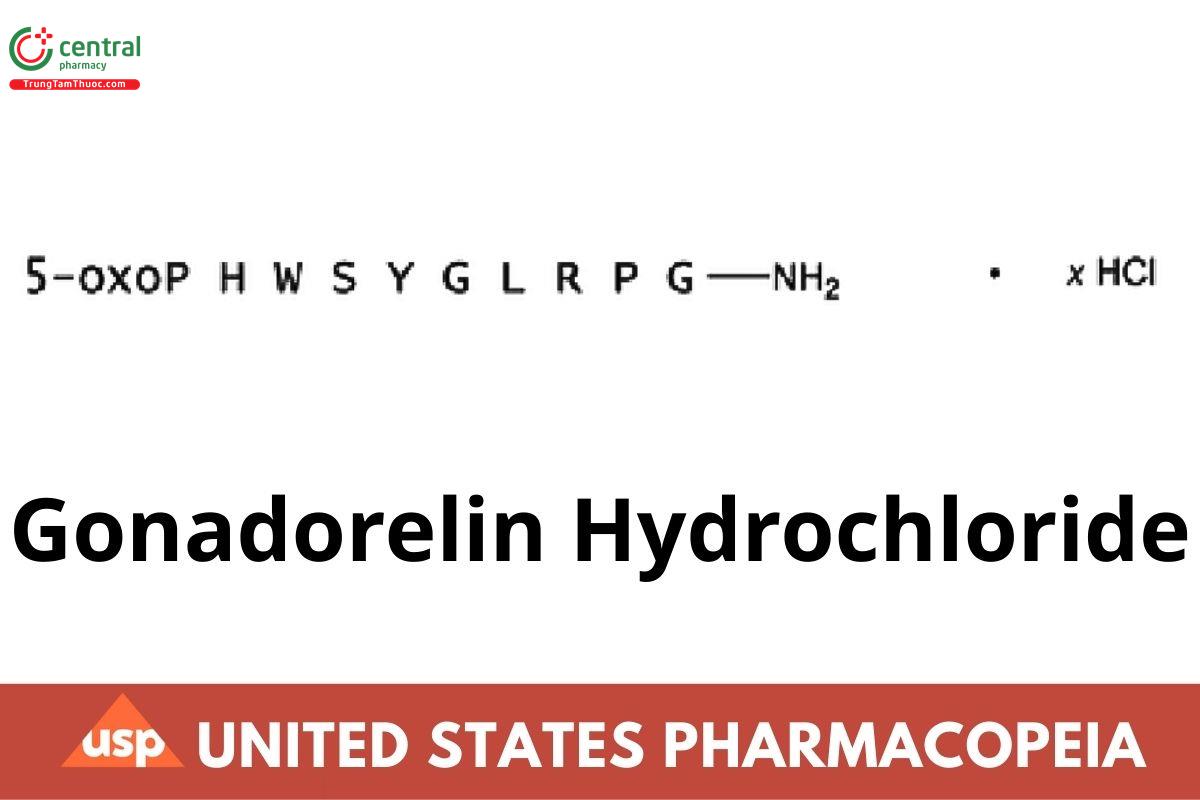

This article is compiled based on the United States Pharmacopeia (USP) – 2025 Edition
Issued and maintained by the United States Pharmacopeial Convention (USP)
C55H75N17O13×HCl 1182.30 (free base)
Gonadorelin hydrochloride;
5-Oxo-l-prolyl-l-histidyl-l-tryptophyl-l-seryl-l-tyrosylglycyl-l-leucyl-l-arginyl-l-prolylglycinamide hydrochloride salt CAS RN®: 51952-41-1; UNII: 3PFC574ITA.
DEFINITION
Gonadorelin Hydrochloride is a synthetic polypeptide hormone having the property of stimulating the release of the luteinizing hormone from the hypothalamus. It contains NLT 95.0% and NMT 102.0% of gonadorelin (C55H75N17O13), calculated on the anhydrous and hydrochloride-free basis.
[Caution—Gonadorelin Hydrochloride is extremely hygroscopic. Protect from exposure to moisture, and store in a desiccator.]
1 IDENTIFICATION
A. The monoisotopic mass by Mass Spectrometry 〈736〉 is 1181.6 ± 1 mass units.
[Note—This quantity corresponds to m/z = 1182.6 ± 1 for (M + H)+ or m/z = 591.8 ± 0.5 for (M + 2H)2+.]
B. HPLC
Buffer, Mobile phase, Standard solution, Sample solution, Chromatographic system, and System suitability: Proceed as directed in the Assay.
Identity sample solution: Mix equal volumes of the Standard solution and the Sample solution.
1.1 Analysis
Samples: Standard solution, Sample solution, and Identity sample solution
Examine the chromatograms of the Standard solution, the Sample solution, and the Identity sample solution.
Acceptance criteria: The retention time of the major peak of the Sample solution corresponds to that of the Standard solution, and the major peak of the Identity sample solution elutes as a single peak.
2 ASSAY
Procedure
[Note—Perform all manipulations involving the weighing of the gonadorelin hydrochloride and the Reference Standard in a low-humidity glove box.]
Buffer: Dissolve 6.8 g of monobasic potassium phosphate in water and dilute to 1 L. Adjust with 1 N potassium hydroxide to a pH of 6.5. Mobile phase: Acetonitrile and Buffer (18:82)
Standard solution: 0.10 mg/mL of USP Gonadorelin Hydrochloride RS in Mobile phase
[Note—Standard solution may be stored in a refrigerator for 2 months. Remove suitable portions and warm to room temperature before use.] Sample solution: 0.10 mg/mL of Gonadorelin Hydrochloride in Mobile phase
2.1 Chromatographic system
(See Chromatography 〈621〉, System Suitability.)
Mode: LC
Detector: UV 220 nm
Column: 4.6-mm × 15-cm; 5-µm packing L1
Flow rate: 1.5 mL/min
[Note—Condition the column with Mobile phase until a stable baseline is obtained.]
Injection volume: 20 µL
2.2 System suitability
Sample: Standard solution
Suitability requirements
Retention time: 8–11 min for the gonadorelin peak
Tailing factor: NMT 2.5
Relative standard deviation: NMT 3.0%
2.3 Analysis
Samples: Standard solution and Sample solution
Calculate the percentage of gonadorelin (C55H75N17O13) in the portion of Gonadorelin Hydrochloride taken:
Result = (rU /rS ) × (CS /CU) × F × [100/(100 − W − HCl)] × 100
rU = peak response of gonadorelin from the Sample solution
rS = peak response of gonadorelin from the Standard solution
CS = concentration of USP Gonadorelin Hydrochloride RS in the Standard solution (mg/mL)
CU = concentration of Gonadorelin Hydrochloride in the Sample solution (mg/mL)
F = conversion factor, (1182.3/1255.2)
W = water content in Gonadorelin Hydrochloride sample (%)
HCl = hydrochloride content in Gonadorelin Hydrochloride sample (%) [Note—%HC = %Cl × (36.46/35.45).]
Acceptance criteria: 95.0–102.0% on the anhydrous and hydrochloride-free basis
3 OTHER COMPONENTS
Counter Ion: Chloride
Sample: 25 mg of Gonadorelin Hydrochloride
Titrimetric system
(See Titrimetry 〈541〉.)
Mode: Direct titration
Titrant: 0.01 N silver nitrate VS
Blank: To 1 mL of methanol, add 10 mL of water and 1 drop of glacial acetic acid.
Endpoint detection: Potentiometric
Analysis: Dissolve the Sample in 1 mL of methanol, and add 10 mL of water and 1 drop of glacial acetic acid. Titrate with Titrant and perform a blank determination.
Calculate the percentage of chloride (Cl−) in the portion of Gonadorelin Hydrochloride taken:
Result = [(VS − VB ) × N × F × 100]/W
VS = Titrant volume consumed by the Sample (mL)
VB = Titrant volume consumed by the Blank (mL)
N = actual normality of the Titrant (Eq/L = mEq/mL)
F = equivalency factor for chloride, 35.45 mg/mEq
W = Sample weight (mg)
Acceptance criteria: 4.0%–6.0%
4 IMPURITIES
4.1 Gonadorelin Related Impurities
[Note—The Sample solution may be stored at room temperature for up to 20 min or at 4° for up to 8 h.]
Solution A: Dissolve 6.8 g of monobasic potassium phosphate in water and dilute to 1 L. Adjust with 1 N potassium hydroxide to a pH of 6.5. Solution B: Acetonitrile
Mobile phase: See Table 1.
Table 1
Time (min) | Solution A (%) | Solution B (%) |
0 | 100 | 0 |
3 | 82 | 18 |
20 | 82 | 18 |
30 | 30 | 70 |
35 | 30 | 70 |
38 | 100 | 0 |
[Note—Pump Solution A through the column at a ow rate of 1 mL/min for 30 min or until a stable baseline is obtained, then inject 100 µL of Solution A, and run the gradient elution program to completion to condition the column. Again inject 100 µL of Solution A, and run the gradient elution program to completion.]
Standard stock solution: 1 mg/mL of USP Gonadorelin Hydrochloride RS in Solution A
Standard solution: 5 µg/mL of USP Gonadorelin Hydrochloride RS in Solution A from Standard stock solution
System suitability solution: 0.01 mg/mL of USP Gonadorelin Acetate Related Compound A RS and 1 mg/mL of USP Gonadorelin Hydrochloride RS in Solution A
Sample solution: 1 mg/mL of Gonadorelin Hydrochloride in Solution A
4.1.1 Chromatographic system
(See Chromatography 〈621〉, System Suitability.)
Mode: LC
Detector: UV 220 nm
Column: 4.6-mm × 15-cm; 5-µm packing L1
Flow rate: 1 mL/min
Injection volume: 100 µL
Autosampler temperature: 4°
4.1.2 System suitability
Samples: Standard solutionandSystem suitability solution
[Note—The relative retention times for gonadorelin related compound A and gonadorelin are 0.98 and 1.0, respectively.]
Suitability requirements
Retention time: 24–30 min for the gonadorelin peak, Standard solution
Resolution: The valley point between gonadorelin related compound A and gonadorelin is visible, System suitability solution. Tailing factor: NMT 2.0, Standard solution
[Note—If necessary, adjust the ow rate to between 0.8 and 2 mL/min, or, alternatively, change by NMT 3% the percentages of Solution A and Solution B at 3 min and at 20 min.]
4.1.3 Analysis
Samples: Solution A, Standard solution, and Sample solution
Calculate the percentage of each impurity in the portion of Gonadorelin Hydrochloride taken:
Result = (rU /rS ) × (CS /CU) × F × 100
rU = peak response of each impurity from the Sample solution
rS = peak response of gonadorelin from the Standard solution
CS = concentration of USP Gonadorelin Hydrochloride RS in the Standard solution (µg/mL)
CU = concentration of Gonadorelin Hydrochloride in the Sample solution (mg/mL)
F = conversion factor, 0.001 mg/µg
Acceptance criteria
Any individual impurity: NMT 2.0%
Total impurities: NMT 3.0%
Acetic Acids in Peptides 〈503〉: NMT 1.0%
4.2 Limit of Trifluoroacetic Acid
Perform if trifluoroacetic acid is used in the manufacturing process.
Buffer: 7.0 mL/L of phosphoric acid and 5.0 mL/L of ammonium hydroxide in water
Solution A: Methanol and Buffer (2:100)
Solution B: Acetonitrile and water (1:1)
Mobile phase: See Table 2.
Table 2
Time (min) | Solution A (%) | Solution B (%) |
0 | 100 | 0 |
5 | 100 | 0 |
6 | 0 | 100 |
14 | 0 | 100 |
15 | 100 | 0 |
25 | 100 | 0 |
Diluent: 5 mL/L of phosphoric acid in water
Trifluoroacetic acid stock solution: 10 mg/mL of trifluoroacetic acid in water prepared as follows. Add about 50 mL of water to a 100-mL volumetric ask with a stopper. Tare the stoppered ask on an analytical balance until there is no further significant drift in the reading. Transfer 670 µL of trifluoroacetic acid to the ask, stopper immediately, and weigh. Dilute with water to volume.
Standard solutions: Transfer 10 mL, 2 mL, and 100 µL of the Trfliuoroacetic acid stock solution into three separate 100-mL volumetric asks, and dilute each with Diluent to obtain Standard solutions having known concentrations, respectively, of about 1 mg/mL, 0.2 mg/mL, and 0.01 mg/mL of trifluoroacetic acid in Diluent.
Sample solution: 4.0 mg/mL of Gonadorelin Hydrochloride in Diluent
4.2.1 Chromatographic system
(See Chromatography 〈621〉, System Suitability.)
Mode: LC
Detector: UV 210 nm
Column: 4.6-mm × 25-cm; 5-µm packing L1
Flow rate: 1.5 mL/min
Injection volume: 20 µL
4.2.2 System suitability
Samples: Standard solutions
Suitability requirements
Correlation coefficient (r2): NLT 0.995, determined by plotting the peak areas of the Standard solutions versus concentration, in mg/mL, and determining the regression line using the least-squares method
Relative standard deviation: NMT 2.0%, the most concentrated Standard solution
4.2.3 Analysis
Samples: Standard solutions and Sample solution
From the graph of the Standard solutions and the concentration of the Sample solution, determine the percentages of trifluoroacetic acid in the sample.
Acceptance criteria: NMT 0.25%
4.3 Limit of Fluoride
Perform if fluoride is used in the manufacturing process. Use polypropylene vessels for preparation of sample and Standards. Standard solutions: Prepare a series of calibration standards containing 0.05, 0.1, 1, and 10 ppm of fluoride dissolved in an ionic strength adjustment buffer suitable for the electrode in use (pH of 5).
Sample solution: 2.2–3.6 mg/mL of Gonadorelin Hydrochloride in the same buffer as that used to prepare the Standard solutions
Analysis: Using a fluoride ion-selective electrode connected to a pH/ion meter, measure the potential of each Standard solution, and plot the response versus the logarithm of the concentration. Determine the regression line using the least-squares method. The slope of the calibration curve is −54 to −60 mV/decade, and the square of the correlation coefficient curve (r2) is NLT 0.995.
From the calibration curve and the concentration of the Sample solution, determine the amount of uoride in the sample. Acceptance criteria: NMT 0.1%
5 SPECIFIC TESTS
Water Determination, Method I〈921〉: NMT 7.0%
Bacterial Endotoxins Test 〈85〉: NMT 70 USP Endotoxin Units/mg
Microbial Enumeration Tests 〈61〉andTests for Specified Microorganisms 〈62〉: The total aerobic microbial count is NMT 100 cfu/g. The total yeast and mold count is NMT 100 cfu/g.
6 ADDITIONAL REQUIREMENTS
Packaging and Storage: Preserve in tight, well-sealed containers.
USP Reference Standards 〈11〉
USP Gonadorelin Hydrochloride RS
USP Gonadorelin Acetate Related Compound A RS
Gonadorelin free acid.
C55H74N16O14 1183.3

