
Glycerin
If you find any inaccurate information, please let us know by providing your feedback here
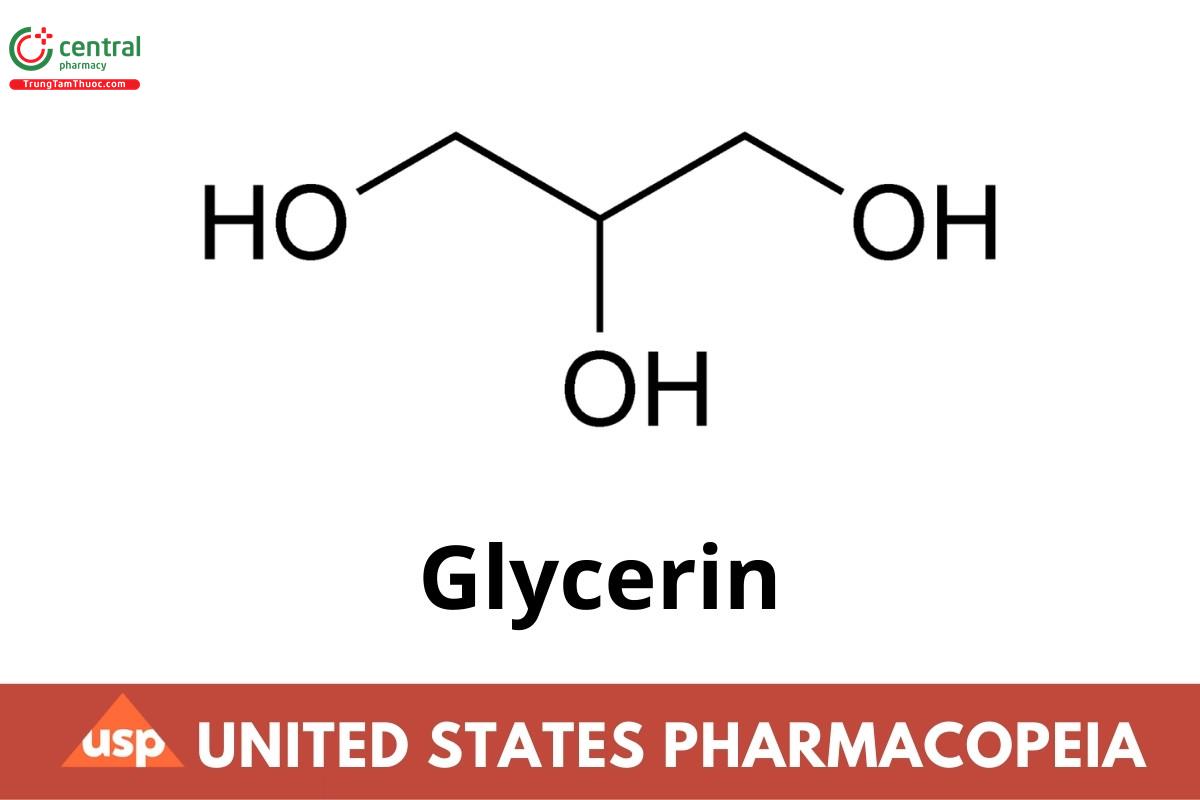

This article is compiled based on the United States Pharmacopeia (USP) – 2025 Edition
Issued and maintained by the United States Pharmacopeial Convention (USP)
C3H8O3 92.09
1,2,3-Propanetriol;
Glycerol CAS RN®: 56-81-5.
1 DEFINITION
Glycerin contains NLT 99.0% and NMT 101.0% of C3H8O3, calculated on the anhydrous basis.
2 IDENTIFICATION
[NOTE-Compliance is determined by meeting the requirements for Identification tests A, B, and C.]
A. SPECTROSCOPIC IDENTIFICATION TESTS (197), Infrared Spectroscopy: 197F
B. LIMIT OF DIETHYLENE GLYCOL AND ETHYLENE GLYCOL
Standard solution: 2.0 mg/mL of USP Glycerin RS, 0.050 mg/mL of USP Ethylene Glycol RS, 0.050 mg/mL of USP Diethylene Glycol RS, and 0.10 mg/mL of 2,2,2-trichloroethanol (internal standard) in methanol
Sample solution: 50 mg/mL of Glycerin and 0.10 mg/mL of 2,2,2-trichloroethanol (internal standard) in methanol
Chromatographic system
(See Chromatography (621), System Suitability.)
Mode: GC
Detector: Flame ionization
Column: 0.53-mm x 30-m fused-silica analytical column
coated with 3.0-µm G43 stationary phase, and a deactivated split liner with glass wool
Temperature
Injector: 220°
Detector: 250°
Column: See the temperature program table.
| Initial Temperature (°) | Temperature Ramp (°/min) | Final Temperature (°) | Hold Time at Final Temperature (min) |
| 100 | — | 100 | 4 |
| 100 | 50 | 120 | 10 |
| 120 | 50 | 220 | 6 |
Carrier gas: Helium
Injection size: 1.0 µL
Flow rate: 4.5 mL/min
Injection type: Split ratio, about 10:1
System suitability
Sample: Standard solution
[NOTE-The relative retention times for ethylene glycol, 2,2,2-trichloroethanol, diethylene glycol, and glycerin are about 0.3, 0.6, 0.8 and 1.0, respectively.]
Suitability requirements
Resolution: NLT 1.5 between diethylene glycol and glycerin
Analysis
Sample: Sample solution
Acceptance criteria: If a peak at the retention times for the diethylene glycol or ethylene glycol is present in the Sample solution, the peak response ratio relative to 2,2,2-trichloroethanol is NMT the peak response ratio for diethylene glycol or ethylene glycol relative to 2,2,2-trichloroethanol in the Standard solution; NMT 0.10% each for diethylene glycol and ethylene glycol is found.
C. Examine the chromatograms obtained in Identification test B. The retention time of the glycerin peak of the Sample solution corresponds to that obtained in the Standard solution.
3 ASSAY
PROCEDURE
Sodium periodate solution: Dissolve 60 g of sodium metaperiodate in sufficient water containing 120 mL of 0.1 N sulfuric acid to make 1000 mL. Do not heat to dissolve the periodate. If the solution is not clear, pass through a sintered-glass filter. Store the solution in a glass-stoppered, light-resistant container. Test the suitability of this solution as follows. Pipet 10 mL into a 250-mL volumetric flask, and dilute with water to volume. To 550 mg of Glycerin dissolved in 50 mL of water, add 50 mL of the diluted periodate solution with a pipet. For a blank, pipet 50 mL of the solution into a flask containing 50 mL of water. Allow the solutions to stand for 30 min, then to each add 5 mL of hydrochloric acid and 10 mL of potassium iodide TS, and rotate to mix. Allow to stand for 5 min, add 100 mL of water, and titrate with 0.1 N sodium thiosulfate, shaking continuously and adding 3 mL of starch TS as the endpoint is approached. The ratio of the volume of 0.1 N sodium thiosulfate required for the glycerin-periodate mixture to that required for the blank should be between 0.750 and 0.765.
Analysis: Transfer 400 mg of Glycerin to a 600-mL beaker, dilute with 50 mL of water, add bromothymol blue TS, and acidify with 0.2 N sulfuric acid to a definite green or greenish yellow color. Neutralize with 0.05 N sodium hydroxide to a definite blue endpoint, free from green color. Prepare a blank containing 50 mL of water, and neutralize in the same manner. Pipet 50 mL of the Sodium periodate solution into each beaker, mix by swirling gently, cover with a watch glass, and allow to stand for 30 min at room temperature (not exceeding 35°) in the dark or in subdued light. Add 10 mL of a mixture of equal volumes of ethylene glycol and water, and allow to stand for 20 min. Dilute each solution with water to 300 mL, and titrate with 0.1 N sodium hydroxide VS to a pH of 8.1 ± 0.1 for the specimen under assay and 6.5 ± 0.1 for the blank, using a pH meter. Each mL of 0.1 N sodium hydroxide, after correction for the blank, is equivalent to 9.210 mg of C3H8O3.
Acceptance criteria: 99.0%-101.0% on the anhydrous basis
Change to read:
4 IMPURITIES
4.1 INORGANIC IMPURITIES
4.1.1 CHLORIDE AND SULFATE, Chloride (221)
A 7.0-g portion shows no more chloride than corresponds to 0.10 mL of 0.020 N hydrochloric acid (NMT 10 ppm).
4.1.2 CHLORIDE AND SULFATE, Sulfate (221)
A 10-g portion shows no more sulfate than corresponds to 0.20 mL of 0.020 N sulfuric acid (NMT 20 ppm).
4.1.3 RESIDUE ON IGNITION (281)
Heat 50 g in an open, shallow 100-mL porcelain dish until it ignites, and allow it to burn without further application of heat in a place free from drafts. Cool, moisten the residue with 0.5 mL of sulfuric acid, and ignite to constant weight: the weight of the residue does not exceed 5 mg (0.01%).
4.2 ORGANIC IMPURITIES
4.2.1 PROCEDURE 1: RELATED COMPOUNDS
System suitability solution: 0.5 mg/mL each of USP Diethylene Glycol RS and USP Glycerin RS
Sample solution: 50 mg/mL of Glycerin
Chromatographic system
(See Chromatography (621), System Suitability.)
Mode: GC
Detector: Flame ionization
Column: 0.53-mm x 30-m fused-silica analytical column coated with 3.0-µm G43 stationary phase, and an inlet liner having an inverted cup or spiral structure
Temperature
Injector: 220°
Detector: 250°
Column: See the temperature program table below.
| Initial Temperature (°) | Temperature Ramp (°/min) | Final Temperature (°) | Hold Time at Final Temperature (min) |
| 100 | — | 100 | — |
| 100 | 7.5 | 220 | 4 |
Carrier gas: Helium
Injection size: 0.5 µL
Linear velocity: 38 cm/s
Injection type: Split ratio, about 10:1
System suitability
Sample: System suitability solution
Suitability requirements
Resolution: NLT 7.0 between diethylene glycol and glycerin
Analysis
Sample: Sample solution
Calculate the percentage of each impurity, excluding any solvent peaks and diethylene glycol, in the portion of Glycerin taken:
Result = (rU/rT) x 100
rU = peak response of each individual impurity from the Sample solution
rT = sum of the responses of all the peaks from the Sample solution
Acceptance criteria
Individual impurities: NMT 0.1%
Total impurities: NMT 1.0%
4.2.2 PROCEDURE 2: LIMIT OF CHLORINATED COMPOUNDS
Sample: 5 g of Glycerin
Analysis: Transfer the Sample into a dry, round-bottom, 100-mL flask. Add 15 mL of morpholine, and connect the flask by a ground joint to a reflux condenser. Reflux gently for 3 h. Rinse the condenser with 10 mL of water, receiving the washings in the flask, and cautiously acidify with nitric acid. Transfer the solution to a suitable comparison tube, add 0.50 mL of silver nitrate TS, and dilute with water to 50.0 mL.
Acceptance criteria: The turbidity is not greater than that of a blank to which 0.20 mL of 0.020 N hydrochloric acid has been added, the refluxing being omitted (NMT 30 ppm of CI).
4.2.3 PROCEDURE 3: FATTY ACIDS AND ESTERS
Sample solution: Mix 50 g of Glycerin with 50 mL of freshly boiled water and 5 mL of 0.5 N sodium hydroxide VS. Boil the mixture for 5 min, cool, and add phenolphthalein TS.
Analysis: Titrate the excess alkali with 0.5 N hydrochloric acid VS. Perform a blank determination (see Titrimetry (541)(CN 1-Aug-2024)).
Acceptance criteria: NMT 1 mL of 0.5 N sodium hydroxide is consumed.
5 SPECIFIC TESTS
5.1 COLOR
When viewed downward against a white surface in a 50-mL color-comparison tube, the color is not darker than the color of a standard made by diluting 0.40 mL of ferric chloride CS with water to 50 mL and similarly viewed in a color-comparison tube of approximately the same diameter and color as that containing the Glycerin.
5.2 SPECIFIC GRAVITY (841)
NLT 1.249
5.3 WATER DETERMINATION, Method (921)
NMT 5.0%
6 ADDITIONAL REQUIREMENTS
6.1 PACKAGING AND STORAGE
Preserve in tight containers.
6.2 USP REFERENCE STANDARDS (11)
USP Diethylene Glycol RS
USP Ethylene Glycol RS
USP Glycerin RS
1,2,3-Propanetriol.
C3H8O3 92.10

