
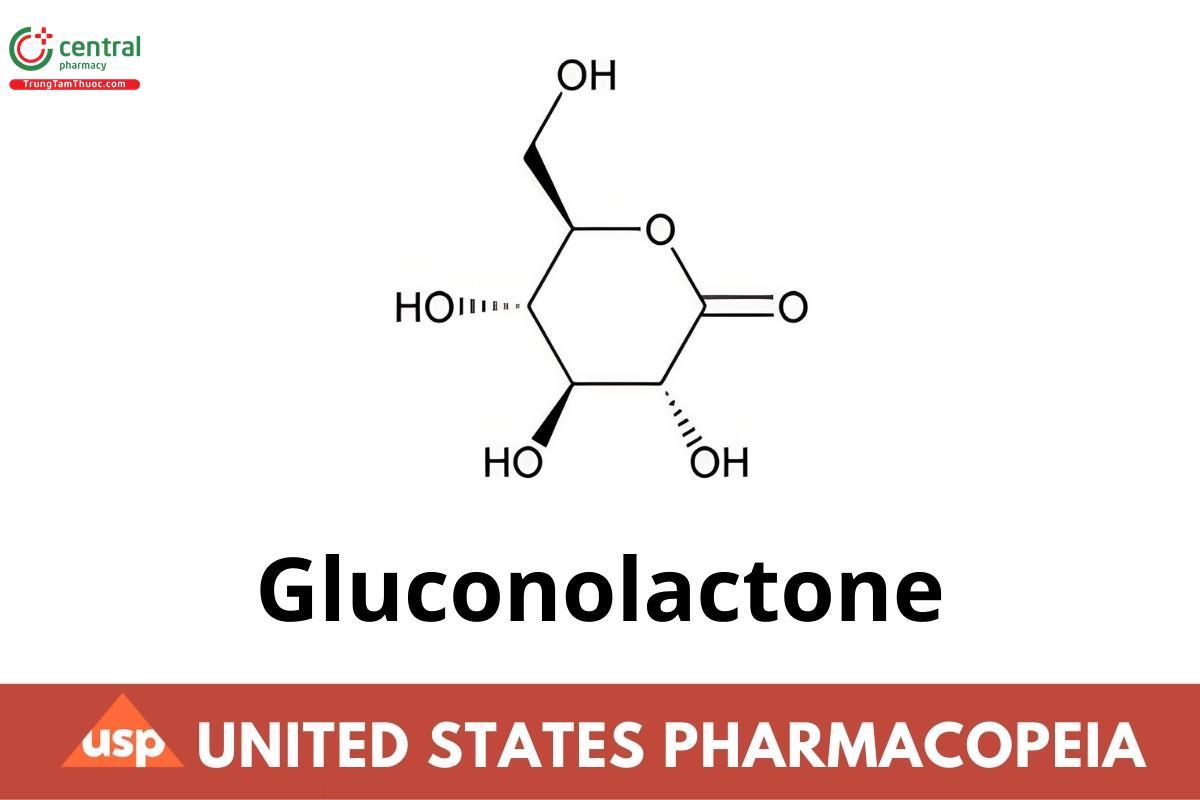
Gluconolactone
If you find any inaccurate information, please let us know by providing your feedback here

Tóm tắt nội dung
This article is compiled based on the United States Pharmacopeia (USP) – 2025 Edition
Issued and maintained by the United States Pharmacopeial Convention (USP)
C6H10O6 178.14
D-Gluconic acid δ-lactone;
Glucono δ-lactone CAS RN®: 90-80-2.
1 DEFINITION
Gluconolactone contains NLT 99.0% and NMT 101.0% of gluconolactone (C6H10O6).
2 IDENTIFICATION
A. SPECTROSCOPIC IDENTIFICATION TESTS (197), Infrared Spectroscopy: 197A or 197K
3 ASSAY
PROCEDURE
Sample: 600 mg
Titrimetric system
(See Titrimetry (541).)
Mode: Residual titration
Titrant: 0.1 N sodium hydroxide VS
Back-titrant: 0.1 N hydrochloric acid VS
Endpoint detection: Visual
Analysis: Dissolve the Sample in 100 mL of water in a 300-mL conical flask, add 50.0 mL of Titrant, and allow to stand for 15 min. Add phenolphthalein TS. Titrate excess alkali with Back-titrant. Perform a blank determination. Each milliliter of Titrant is equivalent to 17.81 mg of gluconolactone (C6H10O6).
Acceptance criteria: 99.0%-101.0%
4 IMPURITIES
Delete the following:
4.1 LEAD (251)
Test preparation: Prepare as directed in the chapter.
Analysis: Use 10 mL of Diluted standard lead solution (10 µg of lead) for the procedure.
Acceptance criteria: NMT 10 ppm (USP 1-Dec-2021)
4.2 REDUCING SUBSTANCES
Sample solution: Transfer 10.0 g to a 400-mL beaker, add 40 mL of water, and swirl to dissolve. Add 2 drops of phenolphthalein TS, and neutralize with sodium hydroxide solution (1 in 2). Dilute with water to 50 mL, and add 50 mL of alkaline cupric tartrate TS. Heat so that the solution begins to boil in 4 min, and allow boiling to continue for 120 s. Pass the suspension through a filtering crucible of medium pore size, and wash the filter with three 5-mL portions of water. Place the crucible in an upright position in the original beaker, add 5 mL of water and 3 mL of nitric acid to the crucible, mix with a glass rod to ensure complete solution of the cuprous oxide, and wash the solution from the crucible into a beaker with the aid of 5 mL of water. Add bromine TS, usually 5-10 mL, until the solution becomes yellow in color, and dilute with water to 75 mL. Add a few glass beads, boil until the bromine has been driven off, and cool. Slowly add ammonium hydroxide until a deep blue color appears, then adjust with glacial acetic acid to a pH of 4, and add water to make 100 mL.
Analysis: Add 4 g of potassium iodide to the Sample solution, and titrate with 0.1 N sodium thiosulfate VS, adding starch TS just before the endpoint is reached.
Acceptance criteria: NMT 16.1 mL of 0.1 N sodium thiosulfate is consumed.
5 ADDITIONAL REQUIREMENTS
5.1 PACKAGING AND STORAGE
Preserve in well-closed containers.
5.2 USP REFERENCE STANDARDS (11)
USP Gluconolactone RS

