
Glucagon
If you find any inaccurate information, please let us know by providing your feedback here

Tóm tắt nội dung
This article is compiled based on the United States Pharmacopeia (USP) – 2025 Edition
Issued and maintained by the United States Pharmacopeial Convention (USP)
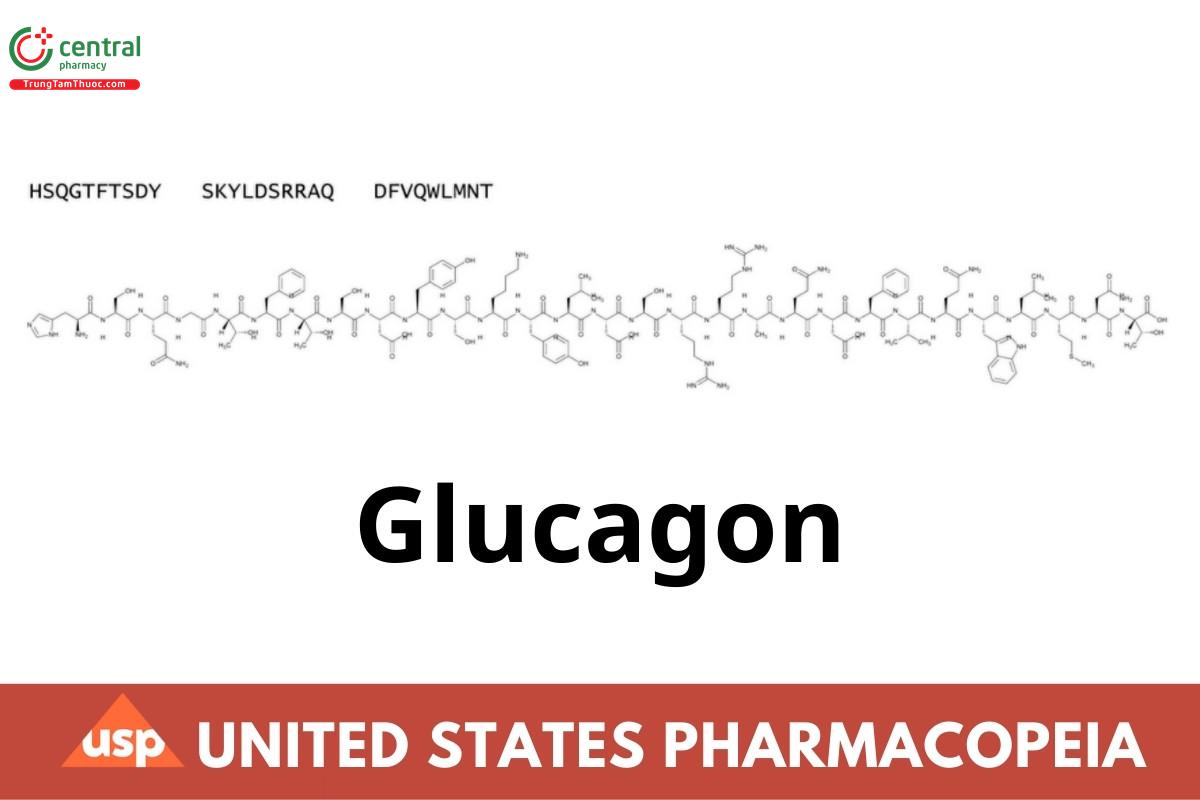
C153H225N43O49S 3482.80
Glucagon (human) CAS RN®: 16941-32-5; UNII: 76LA80IG2G.
1 DEFINITION
Glucagon is a peptide hormone that has the property of increasing the concentration of Glucose in the blood. It has the same structure (29 amino acids) as the hormone produced by the α-cells of the human pancreas. Glucagon is produced from either synthetic or microbial processes using recombinant DNA (rDNA) technology. When produced by microbial processes, the host cell-derived protein content and/or the host cell-derived or vector-derived DNA content are determined by validated methods. During the course of product development, it must be demonstrated that the manufacturing process produces Glucagon having a biological activity of NLT 0.80 USP Units/mg, using a validated bioassay approved by a competent authority. It contains NLT 93.0% and NMT 105.0% of glucagon (C153H225N43O49S) of synthetic origin, calculated on the anhydrous, acetic acid-, ammonium-, and chloride-free basis; and NLT 90% and NMT 105% of glucagon (C153H225N43O49S) of recombinant DNA origin, calculated on the anhydrous basis.
2 IDENTIFICATION
A.
Solution A, Solution B, Mobile phase, System suitability solution, Standard solution, Sample solution, Chromatographic system, and System suitability: Proceed as directed in the Assay.
Identity sample solution: Mix equal volumes of the Standard solution and the Sample solution.
Acceptance criteria: The retention time of the major peak of the Sample solution corresponds to that of the Standard solution, and the major peaks of the Identity sample solution elute as a single peak.
3 ASSAY
3.1 PROCEDURE
Solution A: Dissolve 16.3 g of potassium phosphate, monobasic in 750 mL of water, adjust with phosphoric acid to a pH of 2.7 (±0.05), add water to 800 mL, add 200 mL of acetonitrile, and degas.
Solution B: Prepare a degassed solution of acetonitrile and water (4:6).
Mobile phase: See Table 1.
[NOTE-The ratio of Solution A to Solution B can be adjusted to obtain a retention time of about 21 min for the main peak.]
Table 1
| Time (min) | Solution A (%) | Solution B (%) |
| 0 | 61 | 39 |
| 25a | 61 | 39 |
| 29 | 12 | 88 |
| 30 | 12 | 88 |
| 31 | 61 | 39 |
| 45 | 61 | 39 |
a The end time of the isocratic elution can be adjusted so that the gradient begins after the fourth desamido peak elutes (relative retention time of 1.4). The rest of the program is then adjusted accordingly with this offset.
System suitability solution: Reconstitute a vial of USP Glucagon (Human) RS in 0.01 N hydrochloric acid to obtain a solution having a concentration of about 0.5 mg/mL. Let stand at 50° for 48 h. Prolong the incubation period if necessary. At least 7% total of all four desamido glucagons [(Glu3)-glucagon, (Asp28)-glucagon, (Glu24)-glucagon, and (Glu20)-glucagon] should be present in the solution.
Standard solution: Reconstitute a vial of USP Glucagon (Human) RS in 0.01 N hydrochloric acid to obtain a solution having a concentration of about 0.5 mg/mL.
Sample solution: 0.5 mg/mL of Glucagon in 0.01 N hydrochloric acid
3.2 Chromatographic system
(See Chromatography (621), System Suitability.)
Mode: LC
Detector: UV 214 nm
Column: 3-mm × 15-cm; 3-µm packing L1
Temperatures
Autosampler: 2°-8°
Column: 45°
Flow rate: 0.5 mL/min
Injection volume: 15 µL
3.3 System suitability
Samples: System suitability solution and Standard solution
Suitability requirements
Resolution: Four peaks eluting after the glucagon peak that correspond to the desamido glucagons [(Glu3)-glucagon, (Asp28)-glucagon, (Glu24)-glucagon, and (Glu20)-glucagon] are clearly visible. The resolution between the main peak and the first eluting desamido peak [(Glu3)-glucagon] is NLT 1.5, System suitability solution
Tailing factor: NMT 1.8 for the glucagon peak, Standard solution
Relative standard deviation: NMT 2.0%, Standard solution
3.4 Analysis
Samples: Standard solution and Sample solution
Calculate the percentage of glucagon (C153H225N43O49S) in the portion of Glucagon taken:
Result = (rU/rS) x (CS/CU) x 100
rU = peak response from the Sample solution
rS = peak response from the Standard solution
CS = concentration of the Standard solution (mg/mL)
CU = concentration of the Sample solution (mg/mL)
Acceptance criteria
For glucagon of recombinant DNA origin: 90%-105% on the anhydrous basis
For glucagon of synthetic origin: 93.0%-105.0% on the anhydrous, acetic acid-, ammonium-, and chloride-free basis
4 PRODUCT-RELATED SUBSTANCES AND IMPURITIES
4.1 PROCEDURE
Solution A, Solution B, Mobile phase, System suitability solution, Standard solution, Sample solution, Chromatographic system, and
System suitability: Proceed as directed in the Assay.
4.2 Analysis
Sample: Sample solution
Calculate the percentage of each impurity in the portion of Glucagon taken:
Result = (rU/rT) x 100
rU = peak response for each impurity
rT = sum of the responses of all peaks
Acceptance criteria
See Table 2 for glucagon of recombinant DNA origin and Table 3 for glucagon of synthetic origin. The reporting threshold is 0.05%.
Table 2
| Name | Acceptance Criteria, NMT (%) |
| Total of all four desamido glucagonsa | 2.0 |
| Total impurities and related compounds | 6.0 |
a These are (Glu3)-glucagon, (Asp28)-glucagon, (Glu24)-glucagon, and (Glu20)-glucagon.
Table 3
| Name | Relative Retention Time | Acceptance Criteria, NMT (%) |
| Sum of Met(O27)-glucagon peaks | 0.25 and 0.27 (diastereomers of the sulfoxides) | 0.5 |
| (Glu3)-glucagon | 1.09 | 0.5 |
| (Asp28)-glucagon | 1.15 | 0.5 |
| (Glu24)-glucagon | 1.34 | 0.5 |
| (Glu20)-glucagon | 1.39 | 0.5 |
| Each unspecied impurity | — | 0.5 |
| Total impurities | — | 2.0 |
[NOTE-The manufacturer should determine the suitability of the monograph method for their process-related impurities, in particular for an unknown peak eluting at a relative retention time of 0.97, for (D-His1)-glucagon and (des-Thr5)-glucagon.]
5 PROCESS-RELATED IMPURITIES AND OTHER COMPONENTS
[NOTE-These tests only need to be performed for glucagon of synthetic origin.]
Change to read:
5.1 ACETIC ACID IN PEPTIDES
Mobile phase: 40 mM sodium hydroxide in water
Standard stock solution: 1.6 mg/mL of potassium acetate (equivalent to 1 mg/mL of acetic acid) in water
Standard solutions: Dilute the Standard stock solution with water to obtain 5 solutions with concentrations equivalent to 50, 30, 10, 5, and 1 µg/mL of acetic acid.
Sample solution: 3 mg/mL of Glucagon in Mobile phase
[NOTE-If the test solution is not clear, sonicate it for 30-60 min, and pass it through a disposable syringe filter.]
Blank: Mobile phase
Chromatographic system
(See Chromatography (621), System Suitability.)
Mode: IC
Detector: Conductivity with electrochemical suppressor
Columns
Guard: 4.0-mm × 5-cm; packing L112
Analytical: 4.0-mm × 25-cm; 8.5-µm packing L31
Column temperature: Ambient
Flow rate: 1.0 mL/min
Injection volume: 50 µL
System suitability
Samples: Standard solutions and Blank
Suitability requirements
Blank interference: No interfering peak in the elution region of acetate, Blank
Peak area drift: Within ±20%, ratio of the acetic acid concentration determined by the multilevel calibration to the theoretical concentration, 10-µg/mL Standard solution
Coefficient of determination (R2): NLT 0.9900 from the standard curve, Standard solutions
Relative standard deviation: NMT 5.0% for 6 replicate injections of the 10-µg/mL Standard solution
Tailing factor: 0.8-1.6, 10-µg/mL Standard solution
Analysis
Samples: Standard solutions and Sample solution
Calculate the concentration (CS) of acetic acid, in µg/mL, in each of the Standard solutions:
Result = CSPA x F
CSPA = concentration of potassium acetate in each of the Standard solutions (µg/mL) (ERR 1-Jan-2024)
F = conversion factor for potassium acetate to acetic acid, 0.6119
Construct a calibration curve by plotting the peak responses from the Standard solutions versus the concentration of acetic acid (CS).
Determine the concentration of acetic acid in the Sample solution (CU), in µg/mL, using the quadratic regression.
Determine the percentage of acetic acid in the portion of Glucagon taken:
Result = (CU x VU x 100)/(WU x F)
CU = concentration of acetic acid in the Sample solution, determined from the multilevel calibration (µg/mL)
VU = volume of the Sample solution (mL)
WU = weight of Glucagon used to prepare the Sample solution (mg)
F = conversion factor from mg to µg, 1000
Acceptance criteria: NMT 1.2%
Change to read:
5.2 AMMONIUM
Mobile phase: 18 mM methanesulfonic acid in water
Standard stock solution: 3 mg/mL of ammonium chloride (equivalent to 1 mg/mL of ammonium) in water
Standard solutions: Dilute the Standard stock solution with water to make 5 Standard solutions with ammonium concentrations of 10, 5, 2.5, 1, and 0.5 µg/mL.
Sample solution: 0.6 mg/mL of Glucagon in Mobile phase
[NOTE-If the test solution is not clear, sonicate it for 30-60 min, and pass it through a disposable syringe filter.]
Blank: Mobile phase
Chromatographic system
(See Chromatography (621), System Suitability.)
Mode: IC
Detector: Conductivity with electrochemical suppressor
Columns
Guard: 4.0-mm × 5-cm; packing L106
Analytical: 4.0-mm × 25-cm; 8.5-µm packing L106
Column temperature: Ambient
Flow rate: 1.0 mL/min
Injection volume: 50 µL
System suitability
Samples: Standard solutions and Blank
Suitability requirements
Blank interference: No interfering peak in the elution region of ammonium, Blank
Peak area drift: Within ±20%, ratio of the ammonium concentration determined by the multilevel calibration to the theoretical concentration, 2.5-µg/mL Standard solution
Coefficient of determination (R2): NLT 0.9900 from the standard curve, Standard solutions
Relative standard deviation: NMT 5.0% for 6 replicate injections of the 2.5-µg/mL Standard solution
Tailing factor: 0.8-2.5, 2.5-µg/mL Standard solution
Analysis
Samples: Standard solutions and Sample solution
Calculate the concentration of ammonium (CS), in µg/mL, in each of the Standard solutions:
Result = CSAC x F
CSAC = concentration of ammonium chloride in each of the Standard solutions (µg/mL) (ERR 1-Jan-2024)
F = conversion factor from ammonium chloride to ammonium, 0.3372
Construct a calibration curve by plotting the peak responses from each of the Standard solutions versus the concentration of ammonium (CS). Determine the concentration of ammonium in the Sample solution (CU), in µg/mL, using the quadratic regression.
Calculate the percentage of ammonium in the portion of Glucagon taken:
Result = (CU x VU x 100)/(WU x F)
CU = concentration of ammonium in the Sample solution, determined from the multilevel calibration (µg/mL)
VU = volume of the Sample solution (mL)
WU = weight of Glucagon used to prepare the Sample solution (mg)
F conversion factor from mg to µg, 1000
Acceptance criteria: NMT 1.2%
5.3 CHLORIDE CONTENT
NMT 4.0%
(See Titrimetry (541).)
6 SPECIFIC TESTS
6.1 PEPTIDE MAPPING
(See Biotechnology-Derived Articles-Peptide Mapping (1055).)
[NOTE-This test needs to be performed only on material of recombinant DNA origin.]
Determine the peptide fragments, using the following peptide mapping procedure.
Ammonium bicarbonate buffer: Prepare a 1 M ammonium bicarbonate solution, and adjust with ammonia TS to a pH of 10.3. Prepare a mixture of 1 M ammonium bicarbonate and water (1:9).
Enzyme solution: 2 mg/mL of a-chymotrypsin (peptide mapping grade) in Ammonium bicarbonate buffer
Solution A: Prepare a degassed mixture of 0.5 mL of trifluoroacetic acid and 1000 mL of water.
Solution B: Prepare a degassed mixture of 0.5 mL of trifluoroacetic acid, 600 mL of Ethanol, and 400 mL of water.
Mobile phase: See Table 4.
Table 4
| Time (min) | Solution A (%) | Solution A (%) |
| 0 | 100 | 0 |
| 35 | 53 | 47 |
| 45 | 0 | 100 |
| 46 | 100 | 0 |
| 75 | 100 | 0 |
Standard digest solution: Prepare a 5-mg/mL solution of USP Glucagon (Human) RS in 0.01 M hydrochloric acid. Mix 200 µL of this solution with 800 µL of Ammonium bicarbonate buffer. To this solution add 25 µL of Enzyme solution, and place in a closed vial at about 37° for 2 h. Remove the vial, and stop the reaction immediately by adding 120 µL of glacial acetic acid.
Sample digest solution: Prepare a 5-mg/mL solution of Glucagon in 0.01 M hydrochloric acid. Mix 200 µL of this solution with 800 µL of Ammonium bicarbonate buffer. To this solution add 25 µL of Enzyme solution, and place in a closed vial at about 37° for 2 h. Remove the vial, and stop the reaction immediately by adding 120 µL of glacial acetic acid.
Chromatographic system
(See Chromatography (621), System Suitability.)
Mode: LC
Detector: UV 215 nm
Column: 4.0-mm x 5-cm; 5-µm or finer packing L1
Flow rate: 1 mL/min
Injection volume: 20 µL
System suitability
Samples: Standard digest solution and Sample digest solution
Suitability requirements
Chromatogram similarity: The chromatogram from the Sample digest solution shows a peak pattern similar to that of the chromatogram from the Standard digest solution. The peak pattern varies with respect to the purity of the Chymotrypsin used for the digestion. If the chymotrypsin is very pure without trypsin, a chromatogram with 4 main peaks instead of 5 will be generated. Additional peptides due to minor cleavages may be seen, but where present, the pattern between the sample and reference is not different.
[NOTE-The chromatogram from the USP Glucagon (Human) RS certificate is provided as an example to demonstrate the assignment of the predominant cleavage fragments.]
Analysis
Samples: Standard digest solution and Sample digest solution
Acceptance criteria: The chromatographic profile of the Sample digest solution corresponds to that of the Standard digest solution.
6.2 MASS SPECTRAL ANALYSIS
[NOTE-These tests only need to be performed for glucagon of synthetic origin.]
(See Mass Spectrometry (736).)
Acceptance criteria: The monoisotopic mass is 3480.6 ± 0.5 mass units.
6.3 MICROBIAL ENUMERATION TESTS (61)
The total aerobic microbial count is NMT 102 cfu/g.
6.4 WATER DETERMINATION (921), Method I, Method Ic
NMT 10%
6.5 BACTERIAL ENDOTOXINS TEST (85)
The level of bacterial endotoxins is such that the requirement under the relevant dosage form monograph(s) in which Glucagon is used can be met. Where the label states that Glucagon must be subjected to further processing during the preparation of injectable dosage forms, the level of bacterial endotoxins is such that the requirement under the relevant dosage form monograph(s) in which Glucagon is used can be met.
7 ADDITIONAL REQUIREMENTS
7.1 PACKAGING AND STORAGE
Preserve in airtight containers, protected from light, and store in a freezer.
7.2 LABELING
The labeling states that the material is synthetic or of recombinant DNA origin.
7.3 USP REFERENCE STANDARDS (11)
USP Glucagon (Human) RS

