
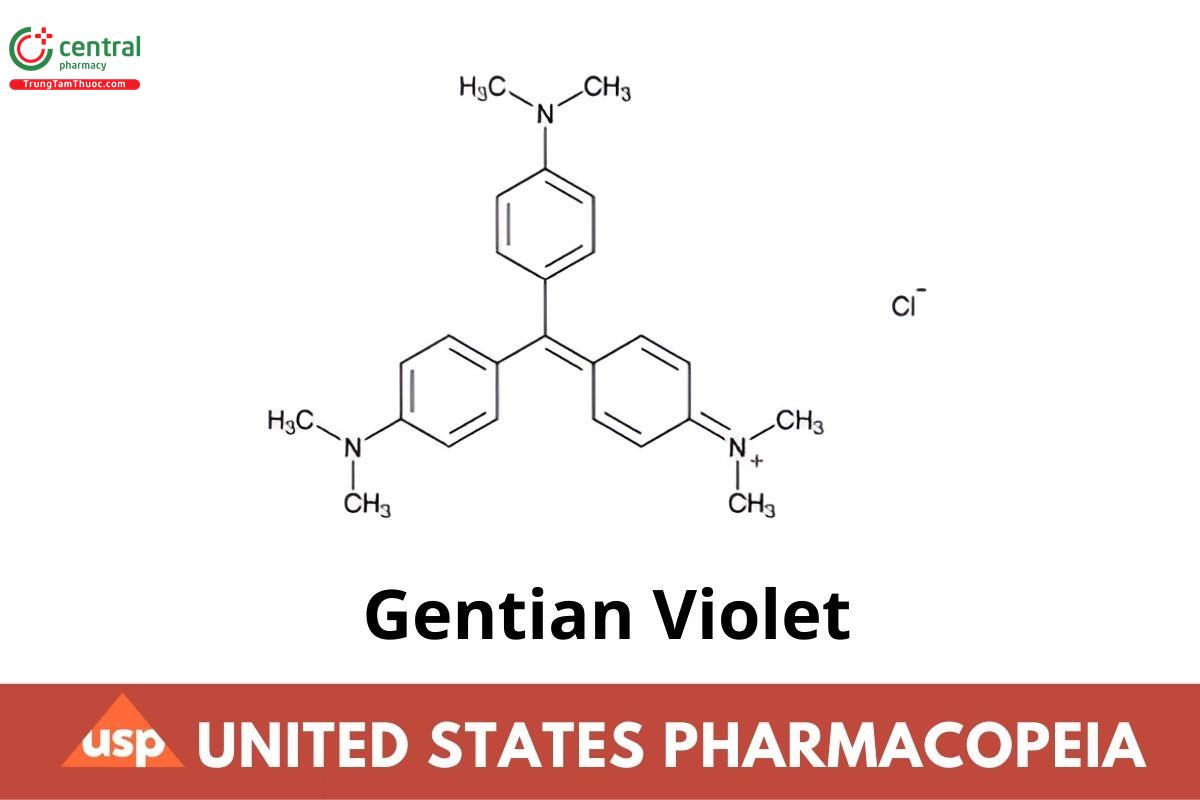
Gentian Violet
If you find any inaccurate information, please let us know by providing your feedback here

Tóm tắt nội dung
This article is compiled based on the United States Pharmacopeia (USP) – 2025 Edition
Issued and maintained by the United States Pharmacopeial Convention (USP)
C25H30ClN3 407.98
Methanaminium, N-[4-[bis[4-(dimethylamino)phenyl] methylene]-2,5-cyclohexadien-1-ylidene]-N-methyl-, chloride;
C. I. Basic violet 3;
[4-[Bis[p-(dimethylamino)phenyl]methylene]-2,5-cyclohexadien-1-ylidene] dimethylammonium chloride CAS RN®: 548-62-9; UNII: J4Z741D6O5.
1 DEFINITION
Gentian Violet contains NLT 96.0% and NMT 100.5% of gentian violet (C H ClN ), calculated on the anhydrous basis.
2 IDENTIFICATION
A.
Sample: 1 mg
Analysis: Sprinkle the Sample on 1 mL of sulfuric acid.
Acceptance criteria: The Sample dissolves in the acid with an orange or brown-red color. When this solution is diluted cautiously with water, the color changes to brown, then to green, and finally to blue.
B.
Sample: 20 mg
Analysis: Dissolve the Sample in 10 mL of water, and add 5 drops of hydrochloric acid. To 5 mL of this solution add tannic acid TS dropwise.
Acceptance criteria: A deep blue precipitate is formed.
C.
Sample: The remainder of the solution prepared for Identification test B
Analysis: To the Sample add about 500 mg of zinc dust, and warm the mixture.
Acceptance criteria: Rapid decolorization occurs. Place a drop of the decolorized solution adjacent to a drop of 6 N ammonium hydroxide on a filter paper: a blue color is produced at the zone of contact.
3 ASSAY
Procedure
Sample solution: Transfer about 400 mg of Gentian Violet to a 300-mL conical flask, add 25 mL of water and 10 mL of hydrochloric acid, displace the air in the flask with carbon dioxide, and pass a stream of carbon dioxide through the flask. Add 50.0 mL of 0.1 N titanium trichloride VS, heat to boiling, and boil gently for 10 min, swirling the liquid occasionally. Cool the solution, and add 5 mL of ammonium thiocyanate solution (1 in 10).
Analysis
Sample: Sample solution
Titrate with 0.1 N ferric ammonium sulfate VS until a faint red color is produced. Perform a blank determination. Each mL of 0.1 N titanium trichloride is equivalent to 20.40 mg of gentian violet (C25H30ClN3).
Acceptance criteria: 96.0%–100.5% on the anhydrous basis
4 IMPURITIES
Residue on Ignition 〈281〉: NMT 1.5%
4.1 Arsenic, Method I
Test preparation: Mix 300 mg with 2.5 g each of powdered potassium nitrate and anhydrous sodium carbonate, and heat the mixture in a crucible until the organic matter is completely oxidized. Dissolve the cooled residue in 15 mL of 2 N sulfuric acid, and evaporate the solution by heating until copious white fumes begin to evolve. Dissolve the residue in 35 mL of water.
Analysis: Proceed as directed in the chapter.
Acceptance criteria: NMT 10 ppm
4.2 Lead
Sample solution: Place 1.0 g in a small Kjeldahl flask, add 5 mL of sulfuric acid, and insert a small funnel into the flask. Gently rotate the flask until the sulfuric acid has completely wetted the sample, then heat gently until complete carbonization has taken place. Allow to cool, and add, in small quantities, 5 mL of nitric acid. Again heat gently until copious white fumes are evolved. Allow to cool, add another 5 mL of nitric acid, and again heat until white fumes are evolved. Allow to cool, cautiously add about 25 mL of water, and boil for a few min. After cooling, neutralize to litmus paper with ammonium hydroxide, and add 5 mL of nitric acid. Transfer the solution to a 100-mL volumetric flask, and dilute with water to volume.
Analysis: Use 20 mL of this solution for the limit test for Lead 〈251〉. Perform a blank determination.
Acceptance criteria: NMT 30 ppm
4.3 Zinc
Standard stock solution: 1 g/mL of zinc prepared as follows. Transfer 1 g of zinc to a 1000-mL volumetric flask, add 50 mL of nitric acid, and dilute with water to volume.
Standard solution: 0.50 μg/mL of zinc, from Standard stock solution in water
Sample solution: Weigh 0.50 g of Gentian Violet in a suitable tared crucible. Place in a low-temperature plasma ashing apparatus, and ash until a constant weight is attained. Pipet 10 mL of 6 N nitric acid into the crucible, and heat to dissolve the flash. Transfer the solution to a 500-mL volumetric flask, and dilute with water to volume. Prepare a reagent blank.
Instrumental conditions
(See Atomic Absorption Spectroscopy 〈852〉.)
Apparatus: Atomic absorption spectrophotometer
Analytical wavelength: Zinc emission line, 213.9 nm
Lamp: Zinc
Flame: Air–acetylene
Blank: Water
Analysis
Samples: Standard solution, Sample solution, and reagent blank
Acceptance criteria: 0.05%; the absorbance of the Sample solution, corrected for that of the reagent blank, is NMT the absorbance of the
Standard solution, similarly corrected.
4.4 Organic Impurities
Sample solution A: 1 mg/mL of Gentian Violet in methanol
Sample solution B: 0.01 mg/mL of Gentian Violet in methanol from Sample solution A
Chromatographic system
(See Chromatography 〈621〉, Thin-Layer Chromatography.)
Mode: TLC
Adsorbent: 0.25-mm layer of octadecylsilanized chromatographic silica gel
Application volume: 5 μL
Developing solvent system: Upper layer separated from a well-shaken mixture of butyl alcohol, glacial acetic acid, and water (80:20:100)
Analysis
Samples: Sample solution A and Sample solution B
Allow the spots to dry, and develop the chromatogram in a suitable chamber with a solvent system until the solvent front has moved about three-fourths of the length of the plate. Remove the plate from the chamber, allow the solvent to evaporate, and visually locate the spots on the plate.
Acceptance criteria: 1.0%; Sample solution A exhibits a principal spot and NMT one secondary spot, which, if present in the chromatogram from Sample solution A, is not more intense than the principal spot from Sample solution B.
5 SPECIFIC TESTS
Water Determination, Method I〈921〉: NMT 7.5%
Alcohol-Insoluble Substances
Sample: 1.0 g
Analysis: Boil the Sample with 50 mL of alcohol under a reflux condenser for 15 min, pass through a tared filtering crucible, wash the residue on the filter with hot alcohol until the last washing is not colored violet, and dry the crucible at 105° for 1 h.
Acceptance criteria: NMT 1.0% of insoluble residue remains.
6 ADDITIONAL REQUIREMENTS
Packaging and Storage: Preserve in well-closed containers.

