
Galantamine Hydrobromide
If you find any inaccurate information, please let us know by providing your feedback here
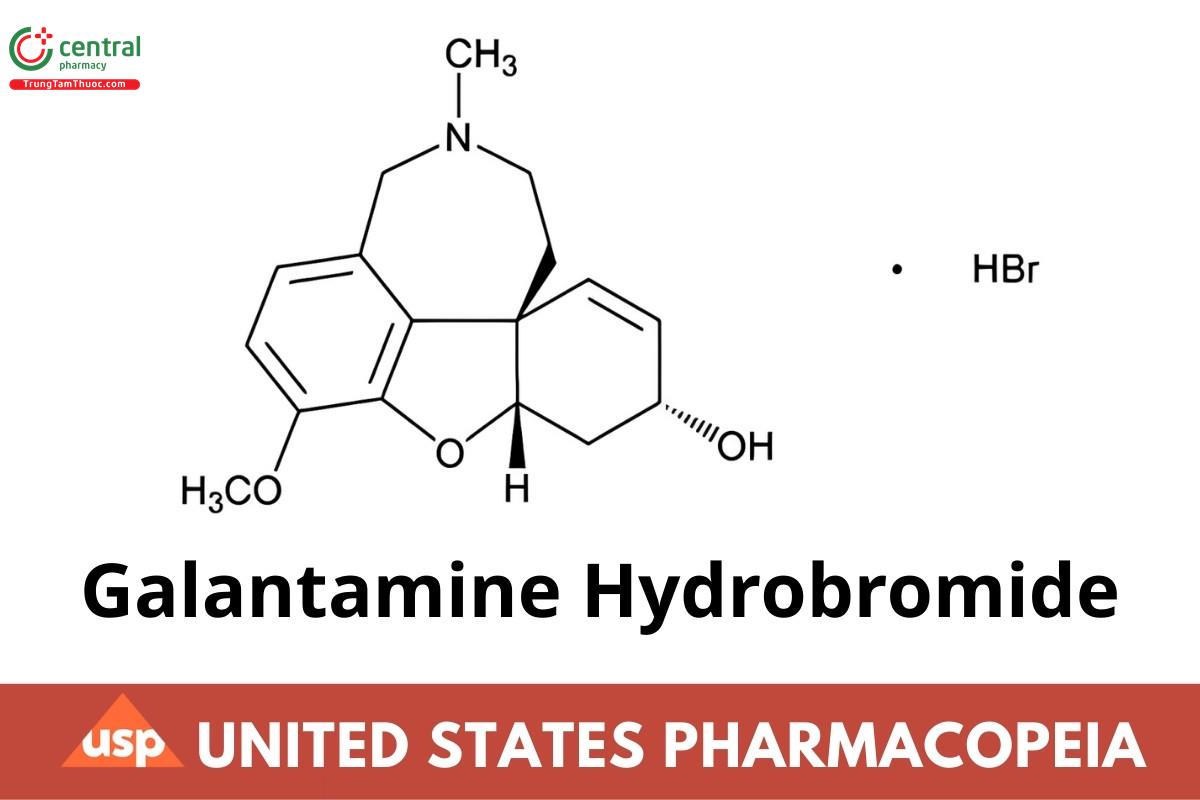

This article is compiled based on the United States Pharmacopeia (USP) – 2025 Edition
Issued and maintained by the United States Pharmacopeial Convention (USP)
C17H21NO3·HBr 368.27
6H-Benzofuro [3a,3,2-ef][2]benzazepin-6-ol, 4a,5,9,10,11,12-hexahydro-3-methoxy-11-methyl-, hydrobromide, (4aS,6R,8aS)-;
(4aS,6R,8aS)-3-Methoxy-11-methyl-4a,5,9,10,11,12-hexahydro-6H-benzofuro[3a,3,2-ef][2]benzazepin-6-ol hydrobromide;
(4aS,6R,8aS)-3-Methoxy-11-methyl-4a,5,9,10,11,12-hexahydro-6H-benzo[2,3]benzofuro[4,3-cd]azepin-6-ol hydrobromide CAS RN®: 1953-04-4.
1 DEFINITION
Galantamine Hydrobromide contains NLT 98.0% and NMT 102.0% of galantamine hydrobromide (C17H21NO3·HBr), calculated on the dried basis.
2 IDENTIFICATION
A. SPECTROSCOPIC IDENTIFICATION TESTS (197), Infrared Spectroscopy: 197K
[NOTE-Specimens are to be prepared using undried USP Galantamine Hydrobromide RS and the test article.]
B. The retention time of the major peak of the Sample solution corresponds to that of the System suitability solution, as obtained in the Assay.
C. IDENTIFICATION TESTS-GENERAL (191), Chemical Identification Tests, Bromide
Sample solution: 7 mg/mL of Galantamine Hydrobromide in water
Acceptance criteria: Meets the requirements of test B
3 ASSAY
3.1 PROCEDURE
Diluent: Methanol and water (5:95)
Buffer: 0.79 g/L of dibasic sodium phosphate dihydrate and 2.46 g/L of monobasic sodium phosphate anhydrous in water
Solution A: Methanol and Buffer (5:95)
Solution B: Acetonitrile
Mobile phase: See Table 1.
Table 1
| Time (min) | Solution A (%) | Solution B (%) |
| 0 | 100 | 0 |
| 6.0 | 100 | 0 |
| 20.0 | 95 | 5 |
| 35.0 | 85 | 15 |
| 50.0 | 80 | 20 |
| 51.0 | 40 | 60 |
| 55.0 | 40 | 60 |
| 56.0 | 100 | 0 |
| 60.0 | 100 | 0 |
System suitability solution: 1 mg/mL of USP Galantamine Hydrobromide Related Compounds Mixture RS in Diluent
Standard solution: 1.0 mg/mL of USP Galantamine Hydrobromide RS in Diluent
Sample solution: 1.0 mg/mL of Galantamine Hydrobromide in Diluent
3.2 Chromatographic system
(See Chromatography (621), System Suitability.)
Mode: LC
Detector: UV 230 nm
Column: 4.6-mm × 10-cm; 3.5-µm packing L1
Column temperature: 55°
Flow rate: 1.5 mL/min
Injection volume: 20 µL
3.3 System suitability
Samples: System suitability solution and Standard solution
[NOTE-For relative retention times, see Table 2.]
Suitability requirements
Resolution: NLT 4.5 between galantamine and 6S-galantamine, System suitability solution
Tailing factor: NMT 2.0 for galantamine, System suitability solution
Relative standard deviation: NMT 0.73%, Standard solution
3.4 Analysis
Samples: Standard solution and Sample solution
Calculate the percentage of galantamine hydrobromide (C17H21NO3·HBr) in the portion of Galantamine Hydrobromide taken:
Result = (rU/rS) x (CS/CU) x 100
rU = peak response from the Sample solution
rS = peak response from the Standard solution
CS = concentration of USP Galantamine Hydrobromide RS in the Standard solution (mg/mL)
CU = concentration of Galantamine Hydrobromide in the Sample solution (mg/mL)
Acceptance criteria: 98.0%-102.0% on the dried basis
4 IMPURITIES
4.1 RESIDUE ON IGNITION (281)
NMT 0.1%
Delete the following:
4.2 LIMIT OF PALLADIUM: Proceed as directed below or in Elemental Impurities-Procedures (233)
[NOTE-Perform this test only if palladium is a known inorganic impurity of the manufacturing process.]
Standard stock solution: 20 mg/L of palladium reference stock solution (NIST traceable) in water
Aqua regia: Under a hood, carefully mix hydrochloric acid and nitric acid (3:1).
[NOTE-To obtain each of the required Standard solutions, it is recommended that the required volume of Standard stock solution be mixed with a volume of Aqua regia equivalent to 5% of the final volume, followed by water.]
Standard solution A: 0.2 mg/L of palladium from the Standard stock solution in water
Standard solution B: 1.0 mg/L of palladium from the Standard stock solution in water
Standard solution C: 2.0 mg/L of palladium from the Standard stock solution in water
System suitability solution: Prepare a solution having a known concentration of 1.6 mg/L of palladium, as directed for the Standard solutions.
Sample solution: Weigh 1 g of Galantamine Hydrobromide. Transfer the sample to an appropriate digestion system, and digest using appropriate acids (e.g., nitric acid or mixtures of nitric acid and sulfuric acid and mixtures of nitric acid and Hydrogen peroxide). After digestion, heat to dryness. Add 0.5 mL of Aqua regia and 2 mL of water. Warm gently to dissolve any residue. Allow to cool. Transfer quantitatively to a 10-mL volumetric flask, and dilute with water to volume.
Digestion blank solution: Prepare this solution following the procedure for the Sample solution, without the test article.
Instrumental conditions
(See Atomic Absorption Spectroscopy (852).)
Mode: Atomic absorption spectroscopy (flame)
Analytical wavelength: 247.6 nm (0.2-nm slit width)
Lamp: Palladium hollow-cathode
Blank solution: Dilute 5 mL of Aqua regia with water to 100 mL.
System suitability
Samples: Standard solution A, Standard solution B, Standard solution C, System suitability solution, and Blank solution Using the Standard solutions and Blank solution, construct a calibration curve.
Suitability requirements
Correlation coefficient: NLT 0.99
Recovery: 87.5%-112.5%, System suitability solution. [NOTE-Recovery is calculated using the calibration curve.]
Analysis
Samples: Sample solution and Digestion blank solution
Calculate the concentration of palladium in the Sample solution, using the calibration curve, corrected for the Digestion blank solution and the sample weight. Calculate the amount of palladium in the Galantamine Hydrobromide taken to prepare the Sample solution.
Acceptance criteria: NMT 10 ppm (USP 1-May-2022)
4.3 ORGANIC IMPURITIES
Diluent, Buffer, Solution A, Solution B, Mobile phase, System suitability solution, and Chromatographic system: Proceed as directed in the Assay.
Sensitivity solution: 0.5 µg/mL of USP Galantamine Hydrobromide RS in Diluent
Standard solution: 5.0 µg/mL of USP Galantamine Hydrobromide RS in Diluent
Sample solution: 1000 µg/mL of Galantamine Hydrobromide in Diluent
System suitability
Samples: System suitability solution, Sensitivity solution, and Standard solution
[NOTE-For relative retention times, see Table 2.]
Suitability requirements
Resolution: NLT 4.5 between galantamine and 6S-galantamine, System suitability solution
Relative standard deviation: NMT 5.0%, Standard solution
Signal-to-noise ratio: NLT 10, Sensitivity solution
Analysis
Samples: Standard solution and Sample solution
Calculate the percentage of each impurity in the portion of Galantamine Hydrobromide taken, on the dried basis:
Result = (rU/rS) x (CS/CU) x (1/F) x [100/(100 - LOD)]
rU = peak response of each impurity from the Sample solution
rS = peak response of galantamine from the Standard solution
CS = concentration of USP Galantamine Hydrobromide RS in the Standard solution (µg/mL)
CU = concentration of the Sample solution (µg/mL)
F = relative response factor (see Table 2)
LOD = loss on drying (%)
Acceptance criteria: See Table 2. Disregard the bromide peak near the void volume. The reporting threshold is 0.05%.
Table 2
| Name | Relative Retention Time | Relative Response Factor | Acceptance Criteria, NMT (%) |
| N-Desmethyl galantaminea | 0.29 | 1.2 | 0.6 |
| O-Desmethyl galantamineb | 0.35 | 1.1 | 0.20 |
| Galantamine N-oxidec | 0.65 | 0.96 | 0.20 |
| Dihydrogalantamined | 0.82 | 0.81 | 0.35 |
| Galantamine | 1.00 | 1.0 | — |
| 6S-Galantaminee | 1.16 | 0.95 | 0.20 |
| Narwedinef | 1.64 | 1.9 | 0.15 |
| Anhydrogalantamineg | 2.05 | 1.2 | 0.40 |
| Any unspecied impurity | — | 1.0 | 0.10 |
| Total impuritiesh | — | — | 1.0 |
a (4aS,6R,8aS)-3-Methoxy-4a,5,9,10,11,12-hexahydro-6H-benzo[2,3]benzofuro [4,3-cd]azepin-6-ol.
b (4aS,6R,8aS)-11-Methyl-4a,5,9,10,11,12-Hexahydro-6H-benzofuro [3a,3,2-ef][2]benzazepine-3,6-diol.
c (4aS,6R,8aS)-6-Hydroxy-3-methoxy-11-methyl-4a,5,9,10,11,12-hexahydro-6H-benzo[2,3]benzofuro [4,3-cd]azepine 11-oxide.
d (4aS,6R,8aS)-3-Methoxy-11-methyl-4a,5,7,8,9,10,11,12-octahydro-6H-benzo[2,3]benzofuro[4,3-cd]azepin-6-ol.
e (4aS,6S,8aS)-3-Methoxy-11-methyl-4a,5,9,10,11,12-hexahydro-6H-benzo[2,3]benzofuro [4,3-cd]azepin-6-ol.
f (4aS,8aS)-3-Methoxy-11-methyl-4a,5,9,10,11,12-hexahydro-6H-benzo[2,3]benzofuro [4,3-cd]azepin-6-one. This is a process impurity that may be found in Galantamine Hydrobromide isolated from a natural source.
g (4aS,8aS)-3-Methoxy-11-methyl-9,10,11,12-tetrahydro-4aH-benzo[2,3]benzofuro[4,3-cd]azepine.
h Do not include the 4R,6S,8R isomer.
Change to read:
4.4 LIMIT OF THE 4R,6S,8R ISOMER
[NOTE-If Galantamine Hydrobromide is not isolated from a natural source, perform either Procedure 1 or Procedure 2.]
4.4.1 Procedure 1
Background electrolyte solution: 8.9 g/L of dibasic sodium phosphate dihydrate in water. Adjust with phosphoric acid to a pH of 3.0.
Run buffer: 19.6 g/L of alpha-cyclodextrin hydrate in Background electrolyte solution. Pass the solution through a filter of 0.22-um pore size.
Standard solution: 5 µg/mL of USP Galantamine Hydrobromide Racemic RS in water. Pass the solution through a filter of 0.22-µm pore size, discarding the first 8 mL.
Sample solution: 500 µg/mL of Galantamine Hydrobromide in water. Pass the solution through a filter of 0.22-µm pore size, discarding the first 8 mL.
Capillary rinse procedure: Use separate Run buffer vials for the capillary rinse and sample analysis. Proceed as directed in Table 3.
Table 3
| Step # | Solution/Gas | Time (min) |
| 1 | 0.1 N sodium hydroxide VS | 15 |
| 2 | Water | 10 |
| 3 | Suitable gas | 5 |
[NOTE-If a new or dry capillary is being used, rinse with 1 N sodium hydroxide VS for 30 min, followed by rinsing with water for 15 min. Dry it with air or nitrogen for 10 min.]
Electrophoretic system
Mode: CE
Detector: UV 214 nm
Column: 75-µm × 60-cm uncoated fused silica
Column temperature: 20°
Applied voltage: 250 V/cm, positive polarity
Run time: 35 min
System suitability
Sample: Standard solution. [NOTE-For the purpose of identification, the 4S,6R,8S isomer elutes at an approximate relative migration time (RMT) of 1.00, and the 4R,6S,8R isomer elutes at an RMT of about 1.05.]
Measure the migration times and peak responses: the migration times for the 4R,6S,8R isomer in the electropherograms of the Sample solution should not deviate by more than 5% of the migration time for the same component in the electropherogram of the Standard solution.
Suitability requirements
Resolution: NLT 2.5 between the two enantiomers
Relative standard deviation: NMT 10% for the 4R,6S,8R isomer peak
Analysis
Samples: Standard solution and Sample solution
Injection: [NOTE-Rinse the capillary between injections as follows: water for 5 min, followed by Run buffer for 5 min. Rinse times are based on a rinse pressure of 1.4 bar.]
Sample solution: 34.5 mbar for 4 s
Run buffer: 6.9 mbar for 5 s
Calculate the corrected peak responses:
Result = (r/m)
r = peak response
m = migration time of the peak (min)
Calculate the limit of the 4R,6S,8R isomer, in percent, in the portion of Galantamine Hydrobromide taken:
Result = (rCU/rCS) x (CS/CU) x P x 100
rCU = average corrected peak responses of the 4R,6S,8R isomer from the Sample solution
rCS = average corrected peak responses of the 4R,6S,8R isomer from the Standard solution
CS = concentration of USP Galantamine Hydrobromide Racemic RS in the Standard solution (µg/mL)
CU = concentration of Galantamine Hydrobromide in the Sample solution (µg/mL)
P = chiral purity of USP Galantamine Hydrobromide Racemic RS, 0.5
Acceptance criteria: NMT 0.10% of the 4R,6S,8R isomer
4.4.2 Procedure 2
[NOTE-Use low-actinic glassware and vials. It is recommended that precautions be taken to protect all solutions from light.]
Buffer: 8.2 g/L of anhydrous sodium acetate in water
Mobile phase: Acetonitrile and Buffer (2:98). Adjust with acetic acid to a pH of 6.5.
System suitability solution: 2.4 µg/mL of USP Galantamine Hydrobromide Racemic RS in water. [NOTE-This solution will contain about 1.2 µg/mL of the 4R,6S,8R isomer.]
Sample solution: 1.2 mg/mL of Galantamine Hydrobromide in water
Chromatographic system
(See Chromatography (621), System Suitability.)
Mode: LC
Detector: UV 230 nm
Column: 4.0-mm x 15-cm; 5-µm packing L41. [NOTE-Alternatively, a 2.0-mm x 15-cm (USP 1-May-2022) column containing 5-µm packing L41 can be used with a recommended flow rate of about 0.2 mL/min.]
Flow rate: 0.8 mL/min
Injection volume: 5 µL
Run time: NLT 3 times the retention time of galantamine
System suitability
Sample: System suitability solution. [NOTE-The 4R,6S,8R isomer elutes first as the minor peak followed by the major peak due to galantamine (which is the same as the 4S,6S,8S isomer).]
Suitability requirements
Resolution: NLT 3.0 between the 4R,6S,8R isomer and galantamine peaks
Relative standard deviation: NMT 5.0% for the 4R,6S,8R isomer peak
Analysis
Sample: Sample solution
Calculate the percentage of 4R,6S,8R isomer in the portion of Galantamine Hydrobromide taken:
Result = [r4R,6S,8R/(r4R,6S,8R + r4S,6R,8S)] x 100
r4R,6S,8R = peak area of the 4R,6S,8R isomer from the Sample solution
r4S,6R,8S = peak area of galantamine from the Sample solution
Acceptance criteria: NMT 0.10% of the 4R,6S,8R isomer
AL
5 SPECIFIC TESTS
5.1 LOSS ON DRYING (731)
Analysis: Dry at 105° for 4 h.
Acceptance criteria: NMT 0.5%
5.2 OPTICAL ROTATION (781S), Procedures, Specific Rotation
[NOTE-If Galantamine Hydrobromide is isolated from a natural source, perform the test for Optical Rotation.]
Sample solution: 20 mg/mL in water
Acceptance criteria: -90° to 100°
6 ADDITIONAL REQUIREMENTS
6.1 PACKAGING AND STORAGE
Store at room temperature. Preserve in well-closed containers.
6.2 LABELING
Label it to state if the source is naturally derived or is synthetic. If the source is not natural, perform either Procedure 1 or Procedure 2 of the test for the Limit of the 4R,6S,8R Isomer. If the source is natural, perform the test for Optical Rotation (781S), Procedures, Specific Rotation.
6.3 USP REFERENCE STANDARDS (11)
USP Galantamine Hydrobromide RS
USP Galantamine Hydrobromide Racemic RS
[NOTE-This is 50:50 mixture of the 4S,6R,8S and 4R,6S,8R isomers.]
(4aS,6R,8aS)-3-Methoxy-11-methyl-4a,5,9,10,11,12-hexahydro-6H-benzo[2,3]benzofuro [4,3-cd]azepin-6-ol hydrobromide.
(4aR,6S,8aR)-3-Methoxy-11-methyl-4a,5,9,10,11,12-hexahydro-6H-benzo[2,3]benzofuro [4,3-cd]azepin-6-ol hydrobromide. 368.27
C17H21NO3·HBr 368.27
USP Galantamine Hydrobromide Related Compounds Mixture RS
Contains a mixture of the following 5 compounds:
Galantamine hydrobromide.
Galantamine N-oxide;
(4aS,6R,8aS)-6-Hydroxy-3-methoxy-11-methyl-4a,5,9,10,11,12-hexahydro-6H-benzo[2,3]benzofuro [4,3-cd]azepine 11-oxide.
C17H21NO4 303.35
Dihydrogalantamine;
(4aS,6R,8aS)-3-Methoxy-11-methyl-4a,5,7,8,9,10,11,12-octahydro-6H-benzo[2,3]benzofuro[4,3-cd]azepin-6-ol.
C17H23NO3 289.37
6S-Galantamine;
(4aS,6S,8aS)-3-Methoxy-11-methyl-4a,5,9,10,11,12-hexahydro-6H-benzo[2,3]benzofuro [4,3-cd)azepin-6-ol.
C17H21NO3 287.35
Anhydrogalantamine;
(4aS,8aS)-3-Methoxy-11-methyl-9,10,11,12-tetrahydro-4aH-benzo[2,3] benzofuro [4,3-cd]azepine.
C17H19NO2 269.34
[NOTE-The contents have previously been referred to as galantamine hydrobromide, 6β-hexahydrogalantamine, 6β-octahydrogalantamine, 6α-hexahydrogalantamine, and tetrahydrogalantamine, respectively.]

