
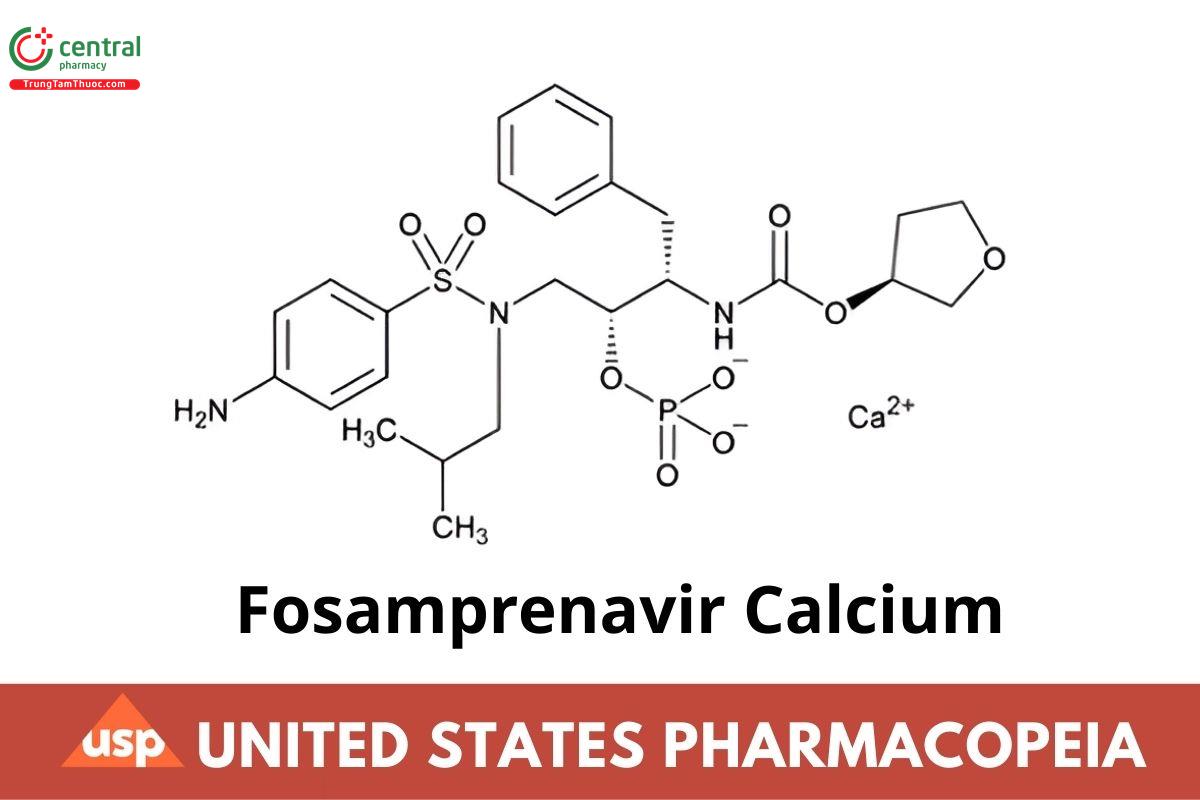
Fosamprenavir Calcium
If you find any inaccurate information, please let us know by providing your feedback here

Tóm tắt nội dung
This article is compiled based on the United States Pharmacopeia (USP) – 2025 Edition
Issued and maintained by the United States Pharmacopeial Convention (USP)
C25H34CaN3O9PS 623.67
Carbamic acid, [(1S,2R)-3-[[(4-aminophenyl)sulfonyl](2-methylpropyl)amino]-1-(phenylmethyl)-2-(phosphonooxy)propyl]-, C-[(3S)-tetrahydro-3-furanyl] ester, calcium salt (1:1);
(3S)-Tetrahydro-3-furyl [(αS)-α-[(1R)-1-hydroxy-2-(N1-isobutylsulfanilamido)ethyl] phenethyl]carbamate, calcium phosphate (ester) (1:1);
Calcium (2R,3S)-1-[(4-amino-N-isobutylphenyl)sulfonamide]-4-phenyl-3-[({[(S)-tetrahydrofuran-3-yl]oxy}carbonyl)amino]butan-2-yl phosphate. CAS RN®: 226700-81-8; UNII: ID1GU2627N.
1 DEFINITION
Fosamprenavir Calcium contains NLT 98.0% and NMT 102.0% of fosamprenavir calcium (C25H34CaN3O9PS), calculated on the anhydrous and solvent-free basis.
2 IDENTIFICATION
A. Spectroscopic Identification Tests 〈197〉, Infrared Spectroscopy: 197M or 197K
B. The retention time of the major peak of the Sample solution corresponds to that of the Standard solution, as obtained in the Assay.
C. Identification Tests—General 〈191〉, Chemical Identification Tests, Calcium: Meets the requirements
3 ASSAY
3.1 Procedure
Buffer: 4.68 g/L of monobasic sodium phosphate dihydrate in water. Add 1.5 mL of phosphoric acid per 1 L of this solution.
Mobile phase: Acetonitrile and Buffer (35:65)
Diluent: Acetonitrile and Buffer (20:80)
Standard solution: 0.26 mg/mL of USP Fosamprenavir Calcium RS in Diluent. Sonicate to dissolve prior to final dilution, if necessary.
Sample solution: 0.26 mg/mL of Fosamprenavir Calcium in Diluent. Sonicate to dissolve prior to final dilution, if necessary.
3.2 Chromatographic system
(See Chromatography 〈621〉, System Suitability.)
Mode: LC
Detector: UV 266 nm
Column: 4.6-mm x 15-cm; 3.5-μm packing L1
Column temperature: 40°
Flow rate: 1.5 mL/min
Injection volume: 10 μL
3.3 System suitability
Sample: Standard solution
3.4 Suitability requirements
Tailing factor: NMT 2.0
Relative standard deviation: NMT 1.0%
3.5 Analysis
Samples: Standard solution and Sample solution
Calculate the percentage of fosamprenavir calcium (C25H34CaN3O9PSS) in the portion of Fosamprenavir Calcium taken:
Result = (rU/rS) × (CS/CU) × 100
rU = peak response of fosamprenavir from the Sample solution
rS = peak response of fosamprenavir from the Standard solution
CS = concentration of USP Fosamprenavir Calcium RS in the Standard solution (mg/mL)
CU = concentration of Fosamprenavir Calcium in the Sample solution (mg/mL)
Acceptance criteria: 98.0%–102.0% on the anhydrous and solvent-free basis
4 IMPURITIES
4.1 Organic Impurities: Early-Eluting Impurities
Buffer, Mobile phase, Diluent, Sample solution, and Chromatographic system: Proceed as directed in the Assay.
System suitability solution: 0.26 mg/mL of USP Fosamprenavir System Suitability Mixture RS in Diluent. Sonicate to dissolve prior to final dilution, if necessary.
Standard solution: 0.26 μg/mL of USP Fosamprenavir Calcium RS in Diluent. Sonicate to dissolve prior to final dilution, if necessary.
4.1.1 System suitability
Samples: System suitability solution and Standard solution
4.1.2 Suitability requirements
Resolution: NLT 1.5 between fosamprenavir pyrophosphate and fosamprenavir n-propyl homolog, System suitability solution
Relative standard deviation: NMT 5.0%, Standard solution
4.1.3 Analysis
Samples: Standard solution and Sample solution
Calculate the percentage of any individual early-eluting impurity in the portion of Fosamprenavir Calcium taken:
Result = (rU/rS) × (CS/CU) × (1/F) × 100
rU = peak response of any individual impurity from the Sample solution
rS = peak response of fosamprenavir from the Standard solution
CS = concentration of USP Fosamprenavir Calcium RS in the Standard solution (mg/mL)
CU = concentration of Fosamprenavir Calcium in the Sample solution (mg/mL)
F = relative response factor (see Table 1)
Acceptance criteria: See Table 1. The reporting threshold is 0.03%.
Table 1
| Name | Relative Retention Time | Relative Response Factor | Acceptance Criteria, NMT (%) |
|---|---|---|---|
| Fosamprenavir amineᵃ | 0.4 | 1.0 | 0.3 |
| Fosamprenavir pyrophosphateᵇ | 0.7 | 0.77 | 0.2 |
| Fosamprenavir n-propyl homologᶜ | 0.8 | 1.0 | 0.3 |
| Fosamprenavir | 1.0 | 1.0 | — |
| Any unspecified impurityᵈ | — | 1.0 | 0.05 |
| Total impuritiesᵉ | — | — | 1.3 |
a (2R,3S)-3-Amino-1-[(4-amino-N-isobutylphenyl)sulfonamide]-4-phenylbutan-2-yl dihydrogen phosphate.
b(S)-Tetrahydrofuran-3-yl {(2S,3R)-4-[(4-amino-N-isobutylphenyl)sulfonamide]-3-([hydroxy(phosphonooxy)phosphoryl]oxy)-1-phenylbutan-2-yl}carbamate.
c Calcium (2R,3S)-1-[(4-amino-N-propylphenyl)sulfonamide]-4-phenyl-3-[({[(S)-tetrahydrofuran-3-yl]oxy}carbonyl)amino]butan-2-yl phosphate.
d Exclude any individual unspecified impurity that elutes after fosamprenavir.
e Total impurities include the sum of all impurities determined in Organic Impurities: Early-Eluting Impurities, Organic Impurities: Late-Eluting
Impurities, and Limit of Fosamprenavir Related Compound A.
4.2 Organic Impurities: Late-Eluting Impurities
Buffer: 1.58 g/L of ammonium formate in water. Adjust with ammonia solution to a pH of 9.0.
Solution A: Acetonitrile and Buffer (19:81)
Solution B: Acetonitrile, tetrahydrofuran, and Buffer (45:5:50)
Solution C: 4.68 g/L of monobasic sodium phosphate dihydrate in water. Add 1.5 mL of phosphoric acid per 1 L of this solution.
Mobile phase: See Table 2.
Table 2
| Time (min) | Solution A (%) | Solution B (%) |
|---|---|---|
| 0 | 100 | 0 |
| 15 | 100 | 0 |
| 40 | 0 | 100 |
| 43 | 0 | 100 |
| 45 | 100 | 0 |
| 55 | 100 | 0 |
Diluent: Acetonitrile and Solution C (20:80)
System suitability solution: 0.26 mg/mL of USP Fosamprenavir System Suitability Mixture RS in Diluent. Sonicate to dissolve prior to final dilution, if necessary.
Standard solution: 0.26 μg/mL of USP Fosamprenavir Calcium RS in Diluent. Sonicate to dissolve prior to final dilution, if necessary.
Sample solution: 0.26 mg/mL of Fosamprenavir Calcium in Diluent. Sonicate to dissolve prior to final dilution, if necessary.
4.2.1 Chromatographic system
(See Chromatography 〈621〉, System Suitability.)
Mode: LC
Detector: UV 266 nm
Column: 4.6-mm × 15-cm; 3.5-μm packing L1
Column temperature: 40°
Flow rate: 1 mL/min
Injection volume: 20 μL
4.2.2 System suitability
Samples: System suitability solution and Standard solution
4.2.3 Suitability requirements
Resolution: NLT 2 between fosamprenavir and fosamprenavir n-butyl isomer, System suitability solution
Relative standard deviation: NMT 5.0%, Standard solution
4.2.4 Analysis
Samples: Standard solution and Sample solution
Calculate the percentage of any individual late-eluting impurity in the portion of Fosamprenavir Calcium taken:
Result = (rU/rS) × (CS/CU) × (1/F) × 100
rU = peak response of any individual impurity from the Sample solution
rS = peak response of fosamprenavir from the Standard solution
CS = concentration of USP Fosamprenavir Calcium RS in the Standard solution (mg/mL)
CU = concentration of Fosamprenavir Calcium in the Sample solution (mg/mL)
F = relative response factor (see Table 3)
Acceptance criteria: See Table 3. The reporting threshold is 0.03%.
Table 3
| Name | Relative Retention Time | Relative Response Factor | Acceptance Criteria, NMT (%) |
|---|---|---|---|
| Fosamprenavir | 1.0 | 1.0 | — |
| Fosamprenavir n-butyl isomerᵃ | 1.2 | 1.0 | 0.3 |
| Fosamprenavir ethyl esterᵇ | 1.9 | 1.0 | 0.2 |
| Bisfosamprenavir triphosphateᶜ | 2.6 | 1.0 | 0.2 |
| Bisfosamprenavir pyrophosphateᵈ | 2.7 | 1.0 | 0.7 |
| Bisfosamprenavir oxazoloneᵉ | 2.8 | 0.66 | 0.2 |
| Amprenavir oxazoloneᶠ | 3.0 | 0.59 | 0.2 |
| Amprenavirᵍ | 3.1 | 1.0 | 0.3 |
| Any unspecified impurityʰ | — | 1.0 | 0.05 |
| Total impuritiesⁱ | — | — | 1.3 |
a Calcium (2R,3S)-1-[(4-amino-N-butylphenyl)sulfonamide]-4-phenyl-3-[({[(S)-tetrahydrofuran-3-yl]oxy}carbonyl)amino]butan-2-yl phosphate.
b Ethyl {(2S,3R)-4-[(4-amino-N-isobutylphenyl)sulfonamide]-1-phenyl-3-(phosphonooxy)butan-2-yl}carbamate.
c Bis[(3S)-tetrahydro-3-furanyl] (3S,4R,12R,13S)-4,12-bis({[(4-aminophenyl)sulfonyl](2-methylpropyl)amino}methyl)-6,8,10-trihydroxy-3,13-bis(phenylmethyl)-5,7,9,11-tetroxa-2,14-diaza-6,8,10triphosphapentadecanedioate 6,8,10-trioxide.
d Bis[(3S)-tetrahydro-3-furanyl] (3S,4R,10R,11S)-4,10-bis({[(4-aminophenyl)sulfonyl](2-methylpropyl)amino}methyl)-6,8-dihydroxy-3,11-bis(phenylmethyl)-5,7,9-trioxa-2,12-diaza-6,8-diphosphatridecanedioate 6,8-oxide.
e(3S)-Tetrahydro-3-furanyl (3S,4R)-4-({[(4aminophenyl) sulfonyl]isobutylamino}methyl)-6-[(4S,5R)-5-({[(4-aminophenyl) sulfonyl] isobutylamino}methyl) - 2-oxo-4-benzyl-3-oxazolidinyl]-8,8-dihydroxy-6-oxo-3-benzyl-5,7-dioxa-2-aza-6,8-diphosphaoctanoate 8-oxide.
f 4-Amino-N-{[(4S,5R)-4-benzyl-2-oxooxazolidin-5-yl]methyl}-N-isobutylbenzenesulfonamide.
g(S)-Tetrahydrofuran-3-yl {(2S,3R)-4-[(4-amino-N-isobutylphenyl)sulfonamide]-3-hydroxy-1-phenylbutan-2-yl}carbamate.
h Exclude any individual unspecified impurity that elutes before fosamprenavir.
i Total impurities include the sum of all impurities determined in Organic Impurities: Early-Eluting Impurities, Organic Impurities: Late-Eluting
Impurities, and Limit of Fosamprenavir Related Compound A.
4.3 Limit of Fosamprenavir Related Compound A
Buffer: 1.54 g/L of ammonium acetate in water. Adjust with glacial acetic acid to a pH of 4.0.
Solution A: 0.5 mL/L of trifluoroacetic acid in water
Solution B: 0.5 mL/L of trifluoroacetic acid in acetonitrile
Mobile phase: See Table 4.
Table 4
| Time (min) | Solution A (%) | Solution B (%) |
|---|---|---|
| 0 | 68 | 32 |
| 40 | 45 | 55 |
| 50 | 5 | 95 |
| 50.1 | 68 | 32 |
| 65 | 68 | 32 |
Diluent: Methanol and Buffer (50:50)
Sensitivity solution: 0.3 μg/mL of USP Fosamprenavir Calcium RS in Diluent. Sonicate to dissolve prior to final dilution, if necessary.
Standard solution: 0.003 mg/mL of USP Fosamprenavir Related Compound A RS in Diluent. Sonicate to dissolve prior to final dilution, if necessary.
Sample solution: 1 mg/mL of Fosamprenavir Calcium in Diluent. Sonicate to dissolve prior to final dilution, if necessary.
4.3.1 Chromatographic system
(See Chromatography 〈621〉, System Suitability.)
Mode: LC
Detector: UV 266 nm
Column: 4.6-mm × 15-cm; 3.5-μm packing L1
Column temperature: 30°
Flow rate: 1 mL/min
Injection volume: 10 μL
4.3.2 System suitability
Samples: Sensitivity solution and Standard solution
[Note - The relative retention times for fosamprenavir and fosamprenavir related compound A are 1.0 and 3.6, respectively.]
4.3.3 Suitability requirements
Tailing factor: NMT 2, Standard solution
Relative standard deviation: NMT 5.0%, Standard solution
Signal-to-noise ratio: NLT 10, Sensitivity solution
4.3.4 Analysis
Samples: Standard solution and Sample solution
Calculate the percentage of fosamprenavir related compound A in the portion of Fosamprenavir Calcium taken:
Result = (rU/rS) × (CS/CU) × 100
rU = peak response of fosamprenavir related compound A from the Sample solution
rS = peak response of fosamprenavir related compound A from the Standard solution
CS = concentration of USP Fosamprenavir Related Compound A RS in the Standard solution (mg/mL)
CU = concentration of Fosamprenavir Calcium in the Sample solution (mg/mL)
Acceptance criteria: NMT 0.3% of fosamprenavir related compound A
5 SPECIFIC TESTS
Change to read:
Water Determination 〈921〉, Method I: NMT 14.5% (RB 1-Feb-2023)
6 ADDITIONAL REQUIREMENTS
Packaging and Storage: Preserve in tight, light-resistant containers. Store at controlled room temperature.
USP Reference Standards 〈11〉
USP Fosamprenavir Calcium RS
USP Fosamprenavir Related Compound A RS
Calcium (6R,7S,16S,17R)-4,19-bis[(4-aminophenyl)sulfonyl]-7,16-dibenzyl-2,21-dimethyl-9,14-dioxo-10,13-dioxa-4,8,15,19-tetraazadocosane-6,17-diyl bis(phosphate).
C44H58Ca2N16O6P2S2 1133.20
USP Fosamprenavir System Suitability Mixture RS
A mixture of fosamprenavir calcium, fosamprenavir pyrophosphate, fosamprenavir n-propyl homolog, and fosamprenavir n-butyl isomer. Other impurities may also be present.

