
Flurbiprofen Sodium
If you find any inaccurate information, please let us know by providing your feedback here
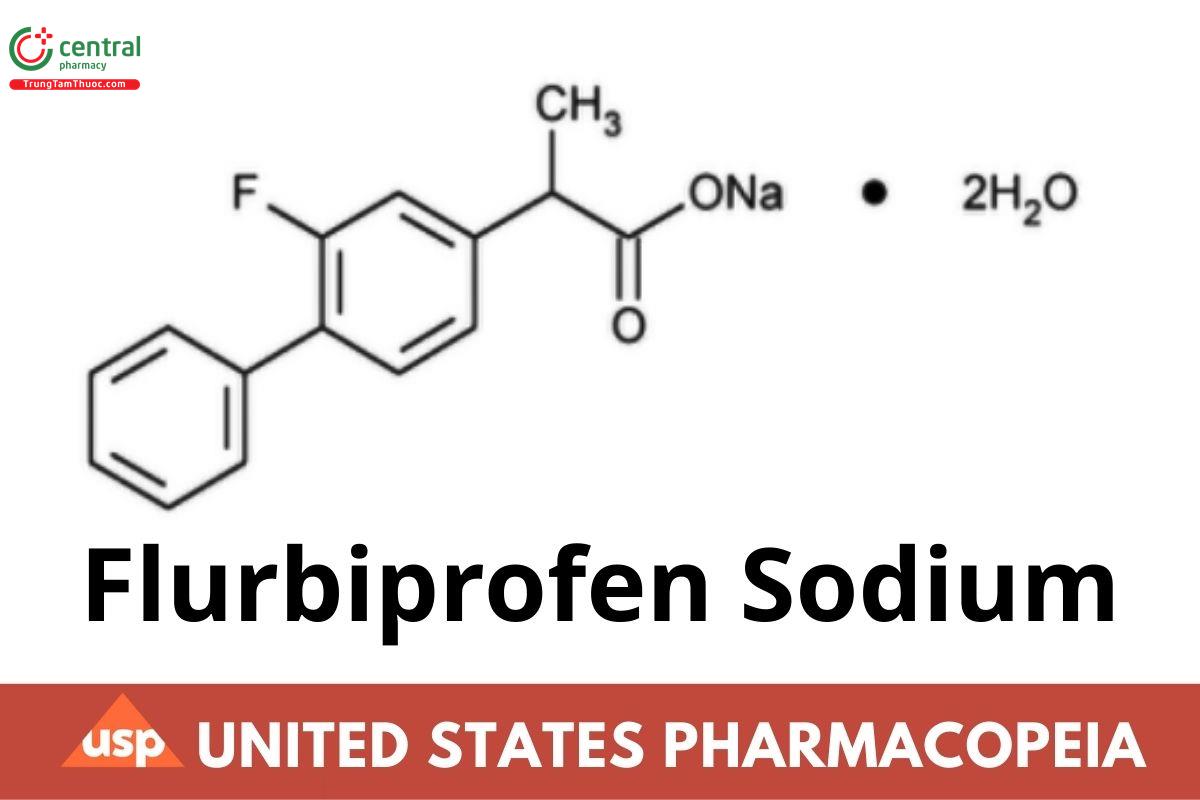

This article is compiled based on the United States Pharmacopeia (USP) – 2025 Edition
Issued and maintained by the United States Pharmacopeial Convention (USP)
C15H12FNaO2 · 2H2O 302.27
[1,1′-Biphenyl]-4-acetic acid, 2-uoro-α-methyl, sodium salt dihydrate, (±)-.
Sodium (±)-2-(2-uoro-4-biphenylyl)propionate dihydrate.
Anhydrous 266.25
Flurbiprofen Sodium contains not less than 97.0 percent and not more than 103.0 percent of C15H12FNaO2 · 2H2O
Packaging and storage—Preserve in well-closed containers.
USP Reference standards 〈11〉—
USP Flurbiprofen RS
USP Flurbiprofen Sodium RS
USP Flurbiprofen Related Compound A RS
2-(4-Biphenylyl)propionic acid.
C15H14O2 226.28
Identification—
Change to read:
A: Spectroscopic Identication Tests 〈197〉, Infrared Spectroscopy: 197M (CN 1-May-2020) —
Test specimen: previously dried.
Change to read:
B: Spectroscopic Identication Tests 〈197〉, Ultraviolet-Visible Spectroscopy: 197U (CN 1-May-2020)
Solution: 10 µg per mL.
Medium: pH 6.0 buffer consisting of 2.42 g of monobasic sodium phosphate and 0.66 g of dibasic sodium phosphate dissolved in water to make 1000 mL.
Absorptivities at 246 nm, calculated on the dried basis, do not differ by more than 3.0%.
C: The residue obtained by igniting it meets the requirements of the tests for Sodium 〈191〉.
Specific rotation 〈781S〉: between −0.45° and +0.45°.
Test solution: 50 mg per mL, in methanol.
Loss on drying 〈731〉—Dry about 0.3 g of it in vacuum at a pressure not exceeding 1 mm of mercury over phosphorus pentoxide in a suitable drying tube at 60° for 18 hours: it loses not less than 11.3% and not more than 12.5% of its weight.
Limit of flurbiprofen related compound A—
Diluent, Mobile phase, and System suitability preparation—Proceed as directed in the Assay.
Standard solution—Use Standard flurbiprofen related compound A preparation, prepared as directed in the Assay.
Test solution—Use the Assay preparation.
Chromatographic system—Proceed as directed in the Assay, except to chromatograph the Standard solution instead of the Standard preparation.
Procedure—Separately inject equal volumes (about 20 µL) of the Standard solution and the Test solution into the chromatograph, record the chromatograms, and measure the areas for the major peaks. Calculate the percentage of flurbiprofen related compound A in the portion of Flurbiprofen Sodium taken by the formula:
200(C/W)(rU /rS )
in which C is the concentration, in µg per mL, of USP Flurbiprofen Related Compound A RS in the Standard solution; W is the weight, in mg, of the portion of Flurbiprofen Sodium taken to prepare the Test solution; and rU and rS are the peak areas for flurbiprofen related compound A obtained from the Test solution and the Standard solution, respectively: not more than 1.5% is found.
Assay—
Diluent—Mix 500 mL of methanol and 250 mL of water.
Mobile phase—Prepare a filtered and degassed mixture of acetonitrile, water, and glacial acetic acid (50:49:1). Make adjustments if necessary (see System Suitability under Chromatography 〈621〉).
Standard urbiprofen related compound A preparation—Dissolve an accurately weighed quantity of USP Flurbiprofen Related Compound A RS in methanol to obtain a stock solution having a known concentration of about 150 µg per mL. Transfer 1.0 mL of this solution to a 200-mL volumetric ask, dilute with Diluent to volume, and mix.
Standard preparation—Dissolve an accurately weighed quantity of USP Flurbiprofen RS in methanol to obtain a stock solution having a known concentration of about 1 mg per mL. Transfer 5.0 mL of this solution to a 100-mL volumetric ask, dilute with Diluent to volume, and mix.
System suitability preparation—Transfer 5 mL of the stock solution used to prepare the Standard preparation and 2 mL of the stock solution used to prepare the Standard urbiprofen related compound A preparation to a 100-mL volumetric ask, dilute with Diluent to volume, and mix. Assay preparation—Transfer about 100 mg of Flurbiprofen Sodium, accurately weighed, to a 100-mL volumetric ask, dissolve in and dilute with methanol to volume, and mix. Transfer 5.0 mL of this solution to a second 100-mL volumetric ask, dilute with Diluent to volume, and mix.
Chromatographic system (see Chromatography 〈621〉)—The liquid chromatograph is equipped with a 254-nm detector and a 4.0-mm × 25-cm column that contains 10-µm packing L7. The ow rate is about 2 mL per minute. Chromatograph the System suitability preparation, and record the peak responses as directed for Procedure: the resolution, R, between urbiprofen related compound A and urbiprofen is not less than 1.0. Chromatograph the Standard preparation, and record the peak responses as directed for Procedure: the tailing factor is not more than 2.5; and the relative standard deviation for replicate injections is not more than 1.0%.
Procedure—Separately inject equal volumes (about 20 µL) of the Standard preparation and the Assay preparation into the chromatograph, record the chromatograms, and measure the areas for the major peaks. Calculate the percentage of C15H12FNaO2 · 2H2O in the portion of Flurbiprofen Sodium taken by the formula:
200(302.27/244.27)(C/W)(rU /rS)
in which 302.27 and 244.27 are the molecular weights of flurbiprofen sodium dihydrate and anhydrous urbiprofen, respectively; C is the concentration, in µg per mL, of USP Flurbiprofen RS in the Standard preparation; W is the weight, in mg, of the portion of Flurbiprofen Sodium taken to prepare the Assay preparation; and rU and rS are the flurbiprofen peak responses obtained from the Assay preparation and the Standard preparation, respectively.

