
Flurazepam Hydrochloride
If you find any inaccurate information, please let us know by providing your feedback here
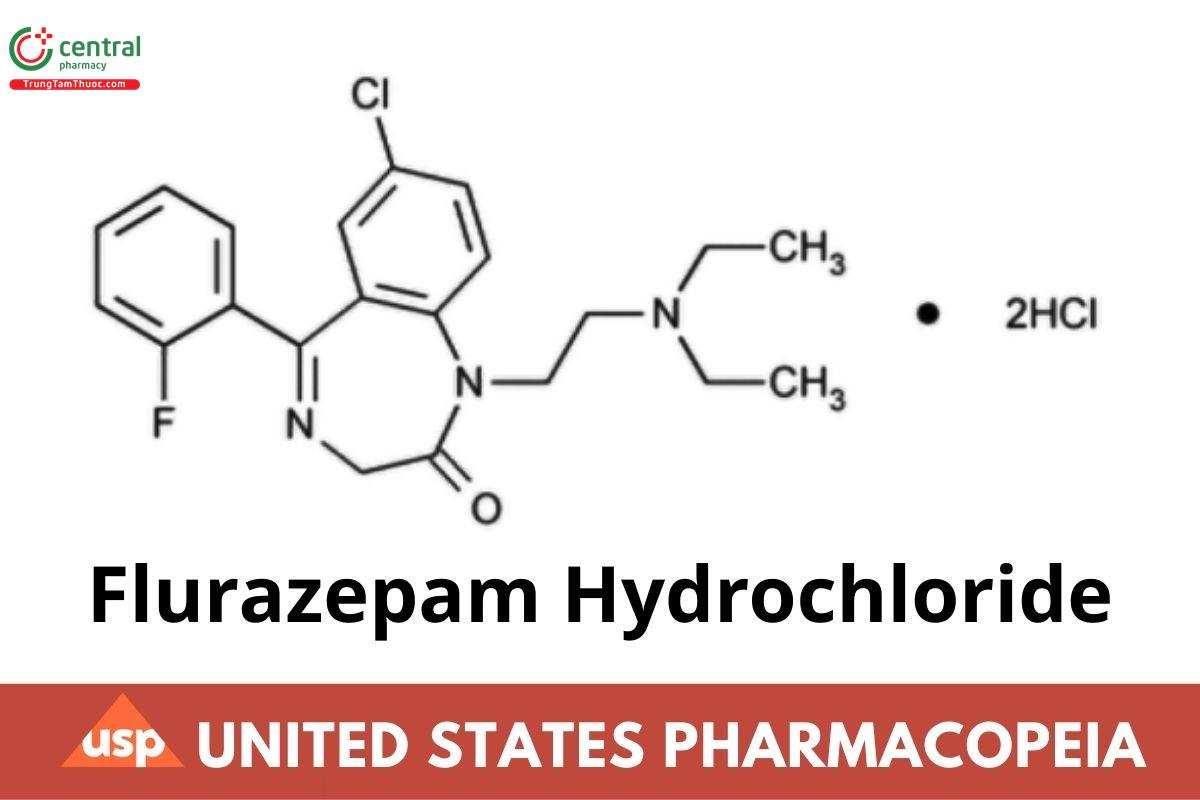

This article is compiled based on the United States Pharmacopeia (USP) – 2025 Edition
Issued and maintained by the United States Pharmacopeial Convention (USP)
C21H23ClFN3O · 2HCl 460.80
2H-1,4-Benzodiazepin-2-one, 7-chloro-1-[2-(diethylamino)ethyl]-5-(2-uorophenyl)-1,3-dihydro-, dihydrochloride.
7-Chloro-1-[2-(diethylamino)ethyl]-5-(o-uorophenyl)-1,3-dihydro-2H-1,4-benzodiazepin-2-one dihydrochloride CAS RN®: 1172-18-5; UNII: 756RDM536M.
Flurazepam Hydrochloride contains not less than 99.0 percent and not more than 101.0 percent of C21H23ClFN3O · 2HCl, calculated on the anhydrous basis.
Packaging and storage—Preserve in tight, light-resistant containers.
Change to read:
USP Reference standards 〈11〉—
USP Flurazepam Hydrochloride RS
USP Flurazepam Related Compound C RS
5-Chloro-2-(2-diethylaminoethylamino)-2′-uorobenzophenone hydrochloride. (ERR 1-Mar-2024)
C19H22ClFN2O · HCl 385.31
USP Flurazepam Related Compound F RS
7-Chloro-5-(2-uorophenyl)-1,3-dihydro-2H-1,4-benzodiazepin-2-one.
C15H10ClFN2O 288.71
Identification—
A: Spectroscopic Identication Tests 〈197〉, Infrared Spectroscopy: 197K. [Note—Do not grind excessively, as decomposition may occur.]
B: Spectroscopic Identication Tests 〈197〉, Ultraviolet-Visible Spectroscopy: 197U
Solution: 10 µg per mL.
Medium: sulfuric acid in methanol (1 in 36).
Absorptivities at 239 nm, calculated on the anhydrous basis, do not differ by more than 3.0%.
C: Prepare a solution of it in methanol containing 3 mg per mL. Apply 10 µL of this solution and 10 µL of a methanol solution of USP Flurazepam Hydrochloride RS containing 3 mg per mL to a suitable thin-layer chromatographic plate (see Chromatography 〈621〉) coated with a 0.25-mm layer of chromatographic silica gel mixture. Allow the spots to dry, and develop the chromatogram in a solvent system consisting of a mixture of ethyl acetate and ammonium hydroxide (200:1) until the solvent front has moved about three-fourths of the length of the plate. Remove the plate from the developing chamber, mark the solvent front, and allow the solvent to evaporate. Locate the spots on the plate by viewing under short-wavelength UV light: the RF value of the principal spot in the chromatogram of the test solution corresponds to that obtained from the solution of the Reference Standard.
D: To 2 mL of a solution (1 in 20) add 1 mL of 2 N nitric acid: the solution responds to the tests for Chloride 〈191〉, 5 drops of silver nitrate TS being used.
Water Determination, Method Ia 〈921〉 : not more than 0.5%.
Residue on ignition 〈281〉: not more than 0.1%.
Limit of fluoride ion—[Note—Use plasticware throughout the procedure.]
pH 5.25 Buffer—Dissolve 110 g of sodium chloride and 1 g of sodium citrate in 700 mL of water in a 2000-mL volumetric ask. Cautiously add 150 g of sodium hydroxide, and dissolve with shaking. Cool to room temperature, and, while stirring, cautiously add 450 mL of glacial acetic acid to the cooled solution. Cool, add 600 mL of isopropyl alcohol, dilute with water to volume, and mix: the pH of this solution is between 5.0 and 5.5.
Standard stock solution—Transfer 221 mg of sodium fluoride to a 100-mL volumetric ask, add about 20 mL of water, and mix to dissolve. Add 1.0 mL of sodium hydroxide solution (1 in 2500), dilute with water to volume, and mix. Each mL of this solution contains 1 mg of fluoride ions. Store in a tightly closed, plastic container.
Standard preparations—Dilute portions of the Standard stock solution quantitatively and stepwise with pH 5.25 Buffer to obtain 100-mL solutions having concentrations of 1, 3, 5, and 10 µg per mL.
Test preparation—Transfer 1.0 g of Flurazepam Hydrochloride, accurately weighed, to a 100-mL volumetric ask, dissolve in and dilute with pH 5.25 Buffer to volume, and mix.
Procedure—Concomitantly measure the potential (see Titrimetry 〈541〉), in mV, of the Standard preparations and of the Test preparation, with a pH meter capable of a minimum reproducibility of ±0.2 mV, equipped with a glass-sleeved calomel-fluoride specific electrode system. [Note—When taking measurements, immerse the electrodes in the solution, which has been transferred to a 150-mL beaker containing a polytetrafluoroethylene-coated stirring bar. Allow to stir on a magnetic stirrer having an insulated top until equilibrium is attained (1 to 2 minutes), and record the potential. Rinse and dry the electrodes between measurements, being careful to avoid damaging the crystal of the specific-ion electrode.] Plot the logarithm of the uoride-ion concentrations, in µg per mL, of the Standard preparations versus the potential in mV. From the measured potential of the Test preparation and the standard curve determine the concentration, in µg per mL, of fluoride ion in the Test preparation: not more than 0.05% is found.
Related compounds—
Mobile phase—Prepare a filtered and degassed mixture of methanol and 1% ammonium acetate (80:20). Make adjustments if necessary (see System Suitability under Chromatography 〈621〉).
Standard solution—Dissolve accurately weighed quantities of USP Flurazepam Related Compound C RS and USP Flurazepam Related Compound F RS in methanol, and dilute quantitatively, and stepwise if necessary, with methanol to obtain a solution having a known concentration of about 2 µg per mL for each component.
[Note—Prepare fresh daily.]
Test solution—Transfer about 50 mg of Flurazepam Hydrochloride, accurately weighed, to a 25-mL volumetric ask, add methanol to volume, and mix. [Note—Prepare this solution just prior to use.]
System suitability solution—Dissolve accurately weighed quantities of USP Flurazepam Hydrochloride RS and 2-amino-5-chlorobenzophenone in methanol, and dilute quantitatively, and stepwise if necessary, with methanol to obtain a solution having a known concentration in each mL of about 150 µg of USP Flurazepam Hydrochloride RS and about 60 µg of 2-amino-5-chlorobenzophenone.
Chromatographic system (see Chromatography 〈621〉)—The liquid chromatograph is equipped with a 239-nm detector and a 4.6-mm × 25-cm column that contains packing L1. The ow rate is about 1.5 mL per minute. Chromatograph the System suitability solution, and record the peak responses as directed for Procedure: the resolution, R, between 2-amino-5-chlorobenzophenone and flurazepam is not less than 2. Chromatograph replicate injections of the Standard solution, and record the peak responses as directed for Procedure: the relative standard deviation for replicate injections is not more than 2.0%.
Procedure—Separately inject equal volumes (about 20 µL) of the Standard solution and the Test solution into the chromatograph, record the chromatograms, and measure the responses for the major peaks. Calculate the quantity, in percentage, of flurazepam related compound C and flurazepam related compound F in the portion of Flurazepam Hydrochloride taken by the formula:
2.5(C/W)(rU /rS )
in which C is the concentration, in µg per mL, of USP Flurazepam Related Compound C RS or USP Flurazepam Related Compound F RS in the Standard solution; W is the weight, in mg, of Flurazepam Hydrochloride taken; and rU and rS are the peak responses for the related compounds obtained from the Test solution and the Standard solution, respectively. The limit is not more than 0.1% of flurazepam related compound C and not more than 0.1% of flurazepam related compound F.
Assay—Transfer about 600 mg of Flurazepam Hydrochloride, accurately weighed, to a 250-mL beaker, dissolve in 80 mL of glacial acetic acid, and add 20 mL of mercuric acetate TS. Titrate with 0.1 N perchloric acid VS, determining the endpoint potentiometrically, using a calomel-glass electrode system. Perform a blank determination, and make any necessary correction. Each mL of 0.1 N perchloric acid is equivalent to 23.04 mg of C21H23ClFN3O · 2HCl.

