
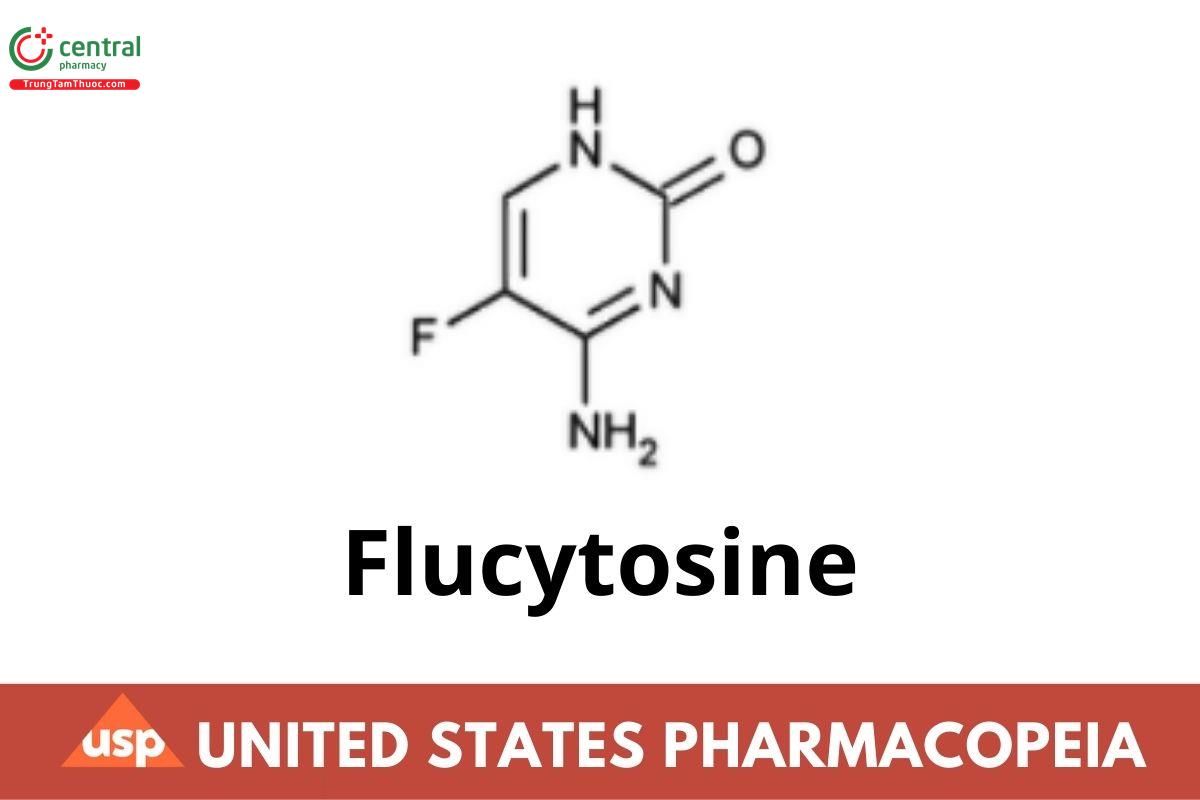
Flucytosine
If you find any inaccurate information, please let us know by providing your feedback here

Tóm tắt nội dung
This article is compiled based on the United States Pharmacopeia (USP) – 2025 Edition
Issued and maintained by the United States Pharmacopeial Convention (USP)
C4H4FN3O 129.09
Cytosine, 5-fluoro-;
5-Fluorocytosine CAS RN®: 2022-85-7; UNII: D83282DT06.
Change to read:
DEFINITION
Flucytosine contains NLT 98.0% and NMT 102.0% (USP 1-May-2022) of flucytosine (C4H4FN3O), calculated on the dried basis.
1 IDENTIFICATION
A. Spectroscopic Identification Tests 〈197〉, Ultraviolet-Visible Spectroscopy: 197U
Analytical wavelength: 285 nm
Medium: Dilute hydrochloric acid in water (1 in 100).
Sample solution: 8 µg/mL of flucytosine in Medium
Acceptance criteria: Absorptivities, calculated on the dried basis, do not differ by NMT 2.0%.
Change to read:
B. The retention time of the major peak of the Sample solution corresponds to that of the Standard solution, as obtained in the Assay. (USP 1-May-2022)
2 ASSAY
Change to read:
Procedure
Buffer: 13.6 g/L of monobasic potassium phosphate in water. Adjust with phosphoric acid to a pH of 2.0.
Solution A: Buffer and methanol (98:2)
Solution B: Buffer and methanol (85:15)
Mobile phase: See Table 1.
Table 1
Time (min) | Solution A (%) | Solution B (%) |
0 | 100 | 0 |
5 | 100 | 0 |
10 | 0 | 100 |
35 | 0 | 100 |
35.1 | 100 | 0 |
45 | 100 | 0 |
Diluent: Dissolve 13.6 g of monobasic potassium phosphate in 980 mL of water. Add 20 mL of methanol and mix. Standard solution: 0.05 mg/mL of USP Flucytosine RS in Diluent
Sample solution: 0.05 mg/mL of Flucytosine in Diluent
2.1 Chromatographic system
(See Chromatography 〈621〉, System Suitability.)
Mode: LC
Detector: UV 284 nm
Column: 4.6-mm × 25-cm; 5-µm packing L1
Flow rate: 1.1 mL/min
Injection volume: 20 µL
2.2 System suitability
Sample: Standard solution
Suitability requirements
Tailing factor: NMT 2.0
Relative standard deviation: NMT 0.73%
2.3 Analysis
Samples: Standard solution and Sample solution
Calculate the percentage of flucytosine (C4H4FN3O) in the portion of Flucytosine taken:
Result = (rU /rS ) × (CS /CU) × 100
rU = peak response of flucytosine from the Sample solution
rS = peak response of flucytosine from the Standard solution
CS = concentration of USP Flucytosine RS in the Standard solution (mg/mL)
CU = concentration of Flucytosine in the Sample solution (mg/mL)
Acceptance criteria: 98.0%–102.0% on the dried basis (USP 1-May-2022)
3 OTHER COMPONENTS
Delete the following:
Fluorouracil
Diluent: Glacial acetic acid and water (4:1)
Standard solution: 0.025 mg/mL solution of USP Fluorouracil RS in Diluent
Sample solution: 25 mg/mL flucytosine in Diluent
Application volume: 20 µL
3.1 Chromatographic system
(See Chromatography 〈621〉, Thin-Layer Chromatography.)
Mode: TLC
Adsorbent: 0.5-mm layer of chromatographic silica gel mixture
Developing solvent system: Chloroform and glacial acetic acid (13:7)
3.2 Analysis
Samples: Standard solution and Sample solution
Locate the spots on the plate by observing under short-wavelength UV radiation.
Acceptance criteria: Any spot from the Sample solution is not greater in size and intensity than the spot at the respective R produced by the Standard solution, corresponding to NMT 0.1% of uorouracil. (USP 1-May-2022)
4 IMPURITIES
Add the following:
4.1 Organic Impurities
Buffer, Solution A, Solution B, Mobile phase, and Diluent: Prepare as directed in the Assay.
Sensitivity solution: 0.1 µg/mL of USP Flucytosine RS in Diluent
Standard solution: 0.00030 mg/mL of USP Fluorouracil RS, 0.00045 mg/mL of USP Fluorouracil Related Compound F RS, and 0.00015 mg/mL of USP Flucytosine RS in Diluent
Sample solution: 0.3 mg/mL of Flucytosine in Diluent
4.1.1 Chromatographic system
(See Chromatography 〈621〉, System Suitability.)
Mode: LC
Detector: UV 260 nm
Column: 4.6-mm × 25-cm; 5-µm packing L1
Flow rate: 1.1 mL/min
Injection volume: 20 µL
4.1.2 System suitability
Samples: Sensitivity solution and Standard solution
Suitability requirements
Relative standard deviation: NMT 5% each for flucytosine,fluorouracil, and fluorouracil related compound F, Standard solution Signal-to-noise ratio: NLT 10, Sensitivity solution
4.1.3 Analysis
Samples: Standard solution and Sample solution
Calculate the percentage of fluorouracil in the portion of Flucytosine taken:
Result = (rU /rS ) × (CS /CU ) × 100
rU = peak response of fluorouracil from the Sample solution
rS = peak response of fluorouracil from the Standard solution
CS = concentration of USP Fluorouracil RS in the Standard solution (mg/mL)
CU = concentration of Flucytosine in the Sample solution (mg/mL)
Calculate the percentage of fluorouracil related compound F in the portion of Flucytosine taken:
Result = (rU /rS ) × (CS /CU) × 100
rU = peak response of fluorouracil related compound F from the Sample solution
rS = peak response of fluorouracil related compound F from the Standard solution
CS = concentration of USP Fluorouracil Related Compound F RS in the Standard solution (mg/mL)
CU = concentration of Flucytosine in the Sample solution (mg/mL)
Calculate the percentage of any individual impurity in the portion of Flucytosine taken:
Result = (rU /rS ) × (CS /CU) × 100
rU = peak response of any individual impurity from the Sample solution
rS = peak response of flucytosine from the Standard solution
CS = concentration of USP Flucytosine RS in the Standard solution (mg/mL)
CU = concentration of Flucytosine in the Sample solution (mg/mL)
Acceptance criteria: See Table 2. The reporting threshold is 0.03%.
Table 2
Name | Relative Retention Time | Acceptance Criteria, NMT (%) |
Flucytosine | 1.0 | — |
Fluorouracil | 2.0 | 0.1 |
Fluorouracil related compound F | 7.9 | 0.15 |
Any individual unspecified impurity | — | 0.05 |
Total impurities | — | 0.3 (USP 1-May-2022) |
Residue on Ignition 〈281〉: NMT 0.1%
Change to read:
4.2 Limit of Fluoride Ion
(USP 1-May-2022)
[Note—All glassware and/or plasticware used in this test should be scrupulously clean and even free from trace amounts fluoride. The use of plasticware to contain the solutions while the potential is measured is recommended.]
Buffer: Transfer 110 g of sodium chloride into a 2-L volumetric ask, add 1 g of sodium citrate and 700 mL of water, and dissolve with shaking. Carefully add 150 g of sodium hydroxide, and dissolve with shaking. Cool to room temperature, and while stirring, cautiously add 450 mL of glacial acetic acid. Cool to room temperature, add 600 mL of isopropyl alcohol, dilute with water to volume, and mix. The pH of this solution is between 5.0 and 5.5.
Standard stock solution: 1 mg/mL of fluoride ion solution in water, prepared as follows. Transfer 2.211 g of sodium fluoride, previously dried at 150° for 4 h, into a 1-L volumetric ask, and dissolve in 200 mL of water. Add 1.0 mL of sodium hydroxide solution in water (1 in 250), dilute with water to volume, and mix. Store the solution in a closed plastic container.
Standard solutions: 1, 3, 5, and 10 µg/mL of fluoride from Standard stock solution in Buffer
Sample solution: 10 mg/mL of Flucytosine in Buffer
Analysis
Samples: Standard solutions and Sample solution
Concomitantly measure the potential (see Titrimetry 〈541〉), in mV, of the Standard solutions and the Sample solution, with a suitable pH meter equipped with a fluoride-specific ion electrode and a glass-sleeved calomel reference electrode that has been modified in the following manner. Mix 70 mL of freshly prepared saturated potassium chloride solution with 30 mL of isopropyl alcohol, ll the electrode with the clear supernatant, and allow the electrode to remain in the mixture for NLT 2 h before use, or preferably overnight. When taking the measurements, transfer the solution to a 150-mL beaker, and immerse the electrodes. Insert a polytef-coated stirring bar into the beaker, place the beaker on a magnetic stirrer having an insulated top, and allow to stir until equilibrium is attained (1–2 min). Rinse and dry the electrodes between measurements, taking care not to scratch the crystal in the specific ion electrode. Measure the potential of each Standard solution, and plot the fluoride concentration, in mg/100 mL, versus the potential, in mV, on semilogarithmic paper. Measure the potential of the Sample solution, and determine from the standard curve the fluoride concentration, in mg/100 mL.
Calculate the percentage of fluoride in the portion of Flucytosine taken:
Result = C/10
C = concentration of fluoride from the standard curve (mg/100 mL)
Acceptance criteria: NMT 0.05% of fluoride
5 SPECIFIC TESTS
Loss on Drying 〈731〉
Analysis: Dry at 105° for 4 h.
Acceptance criteria: NMT 1.5%
6 ADDITIONAL REQUIREMENTS
Packaging and Storage: Preserve in tight, light-resistant containers.
Change to read:
USP Reference Standards 〈11〉
USP Flucytosine RS
USP Fluorouracil RS
USP Fluorouracil Related Compound F RS
2-Ethoxy-5-uoropyrimidin-4(1H)-one.
C6H7FN2O2 158.13 (USP 1-May-2022)

