
Filgrastim
If you find any inaccurate information, please let us know by providing your feedback here

Tóm tắt nội dung
This article is compiled based on the United States Pharmacopeia (USP) – 2025 Edition
Issued and maintained by the United States Pharmacopeial Convention (USP)
C845H1339N223O243S9 18,799 daltons CAS RN®: 121181-53-1; UNII: PVI5M0M1GW.
1 DEFINITION
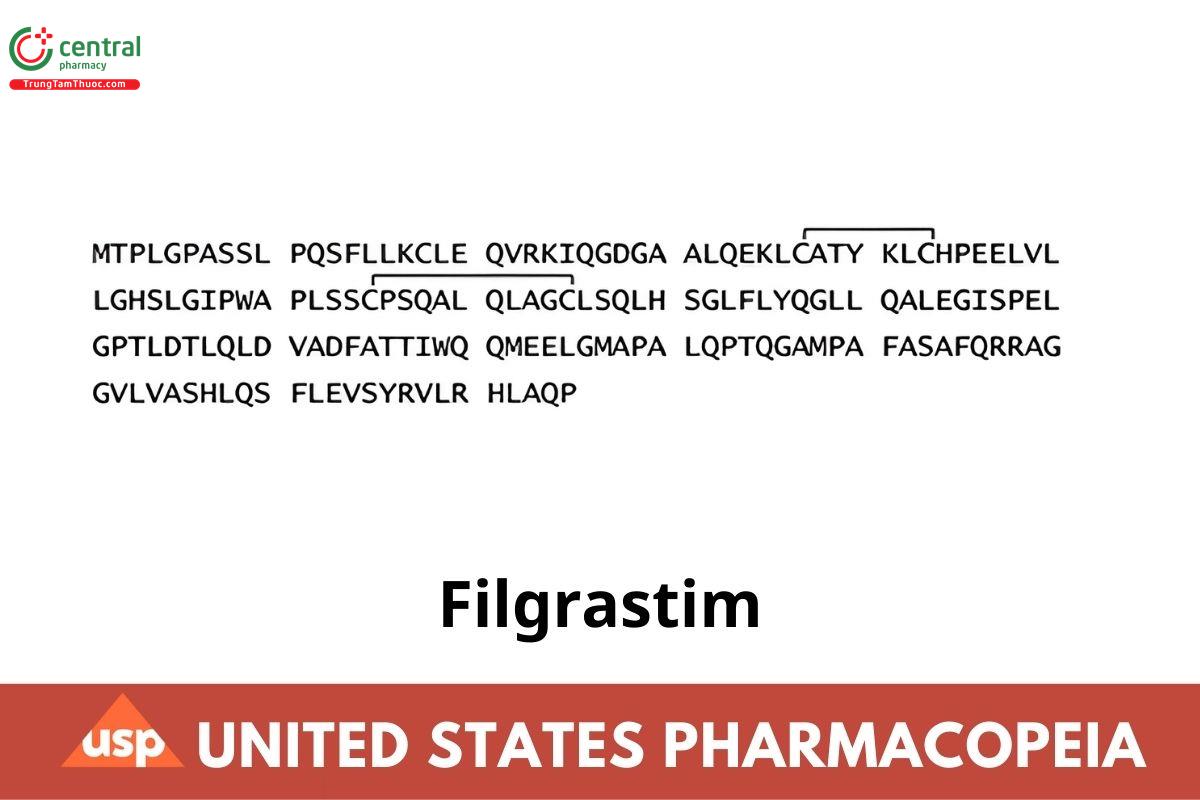
Filgrastim is a recombinant form of human granulocyte colony-stimulating factor (r-metHuG-CSF). It is a single chain, 175 Amino acid nonglycosylated polypeptide produced by Escherichia coli bacteria transfected with a gene encoding a methionyl human granulocyte colony- stimulating factor. When prepared as a drug substance, it contains NLT 0.9 mg/mL of Filgrastim. Formulation contains one or more suitable buffering and/or stabilizing agents. The presence of host cell DNA and protein in Filgrastim is process-specific. The capability of the process to clear host-derived DNA and protein requires validation and is determined by validated methods. It has a biological potency of NLT 80% and NMT 125% relative to standard on a mass-to-mass basis.
2 IDENTIFICATION
A. It meets the requirements in the Assay.
B. The retention time of the major peak of the Sample solution corresponds to that of the Standard solution, as obtained in the test for Organic Impurities, Related Compounds.
Change to read:
C. Peptide Mapping
(See Biotechnology-Derived Articles—Peptide Mapping 〈1055〉.)
Solution A: Water and tri fluoroacetic acid (1000:1)
Solution B: Transfer 100 mL of water to a 1000-mL volumetric flask, add 1 mL of trifluoroacetic acid, and dilute with acetonitrile to volume.
Mobile phase: See Table 1.
Table 1
| Time (min) | Solution A (%) | Solution B (%) |
|---|---|---|
| 0 | 98 | 2 |
| 2 | 98 | 2 |
| 30 | 70 | 30 |
| 75 | 40 | 60 |
| 90 | 2 | 98 |
| 100 | 2 | 98 |
| 101 | 98 | 2 |
| 120 | 98 | 2 |
Tris buffer: Prepare a 0.5 M tris(hydroxymethyl) aminomethane solution, and adjust with hydrochloric acid to a pH of 8.1.
Methylamine solution: Dissolve 0.27 g of methylamine hydrochloride in 10 mL of water.
DTT solution: 30.9 mg/mL of dithiothreitol in water, freshly prepared
Digestion solution: Dissolve 0.30 g of Urea in 200 μL of Tris buffer, 100 μL of Methylamine solution, 50 μL of DTT solution, and 420 μL of water.
Overlay with nitrogen, and use immediately.
Endoproteinase Glu-C solution: 0.2 μg/μL of endoproteinase Glu-C in water. Use immediately.
TFA solution: Water and trifluoroacetic acid (100:5)
Standard solution: Prepare a solution containing 80 μg of USP Filgrastim System Suitability RS (IRA 1-Jan-2021) and 200 μL of Digestion solution in a suitable tube. Add water to a final volume of 390 μL. Add 10 μL of Endoproteinase Glu-C solution. Cap the tube, mix well, and incubate at approximately 25° for 18 h. Add 18 μL of TFA solution.
Sample solution: Prepare a solution containing 80 μg of filgrastim and 200 μL of Digestion solution in a suitable tube. Add water to a final volume of 390 μL. Add 10 μL of Endoproteinase Glu-C solution. Cap the tube, mix well, and incubate at approximately 25° for 18 h. Add 18 μL of TFA solution. (IRA 1-Jan-2021)
Chromatographic system
(See Chromatography 〈621〉, System Suitability.)
Mode: LC
Detector: UV 214 nm
Column: 2.1-mm × 25-cm; packing L26
Column temperature: 40°
Flow rate: 0.2 mL/min
Injection volume: 70 μL
System suitability requirements: Eight major peaks should be present in each chromatogram as illustrated in the reference chromatogram provided with USP Filgrastim System Suitability RS. (IRA 1-Jan-2021) The absolute difference in retention time of each of the eight major peaks between the two Standard solution chromatograms must be ≤0.5 min. The difference in retention time of each of the eight major peaks between the Sample solution chromatogram and the average of the Standard solution chromatograms must be ≤0.5 min. The relative difference in peak height of each of the eight major peaks between the two Standard solution chromatograms must be ≤15%.
Analysis
Samples: Standard solution and Sample solution
[Note-Condition the Chromatographic system by running at least two blank gradient programs before injecting the digests. Separately inject the Standard solution, Sample solution, and Standard solution again, and record the responses of each peak.]
Acceptance criteria: The chromatographic proflle of the Sample solution is similar to that of the Standard solution. The relative difference in peak height between the normalized sample peak height (normalized by total peak height versus the average total peak height of the Standard solution chromatograms) and the average standard peak height of each of the eight major peaks must be ≤15%.
3 ASSAY
Change to read:
Potency
Medium A1: RPMI 1640 modified to contain 2 mM L-Glutamine, 2 g/L of sodium bicarbonate, 4.5 g/L of Glucose, 10 mM N-(2-Hydroxyethyl)piperazine-N’-(ethanesulfonic acid) (IRA 1-Jan-2021) [HEPES], 1 mM sodium pyruvate, 0.05 mM 2-mercaptoethanol, and 5% heat-inactivated fetal bovine serum (FBS). The 2-mercaptoethanol is prepared fresh and added immediately before use.
Medium B: RPMI 1640 modified to contain 2 mM l-glutamine, 2 g/L of sodium bicarbonate, 4.5 g/L of glucose, 10 mM HEPES, 1 mM sodium pyruvate, 0.05 mM 2-mercaptoethanol, and 1% heat-inactivated FBS. The 2-mercaptoethanol is prepared fresh and added immediately before use.
Medium C: Prepare a mixture of Medium A with 20 ng/mL of Interleukin 3 (IL-3).
Medium D: Prepare a mixture of Medium A with 1 ng/mL of granulocyte colony-stimulating factor (G-CSF).
Substrate solution: Reconstitute the luminescence substrate2 with the supplied buffer. Aliquot the solution and store below −65° for up to 2 months.
Standard solution: 0.5 ng/mL of USP Filgrastim for Bioassay RS (IRA 1-Jan-2021) in Medium B. [Note—Do not use single step dilutions of more than 1:100 and smaller transfer volumes than 40 μL while performing serial dilutions. Mix gently and thoroughly (do not vortex).]
Positive control solution: 10 ng/mL of USP Filgrastim for Bioassay RS (IRA 1-Jan-2021) in Medium B
Sample solution: 0.5 ng/mL of Filgrastim in Medium B. [Note—Do not use single step dilutions of more than 1:100 and smaller transfer volumes than 40 μL while performing serial dilutions. Mix gently and thoroughly (do not vortex).]
Cell culture preparation: Adapt M-NFS-60 cells3 to growth in G-CSF. Culture the cells at 5% carbon dioxide (CO ) and 37°. Cells should be passaged two times per week and reseeded at a density of 3 × 10⁴ cells/mL for 3 days or 1 × 10⁴ cells/mL for 4 days. Passage the cultures in Medium C until passage two. Transfer the cells into Medium D, and passage the cultures until passage 11. After passage 11, the cells are defined as G-CSF adapted and can be used in the Assay or can be banked. Bank the cells at a density of approximately 1.5 × 10⁶ cells/mL in banking medium [90% FBS, 10% Dimethyl sulfoxide (DMSO)]. Upon thawing the banked cells, culture the cells for 2–3 passages in Medium D before using in the Assay.
Cell suspension: Wash the cells twice with phosphate buffered saline (PBS), and adjust the cell concentration to 1 × 10⁵cells/mL in Medium B.
Preparation of cells for analysis: Use a 96-well at-bottomed black microtiter plate (optically clear well bottoms) with wells arranged in eight rows (labeled A through H) with 12 wells (numbered 1 to 12) in each row. Place 50 μL of Cell suspension into all wells of the 96-well microtiter plate except the wells of column 1 (A1–H1, blank). Column 1 is filled with 50 μL of Medium B. Incubate the plate at 37° in the incubator until the Standard solution and the Sample solution are ready, for a maximum of 1 h.
Preparation of diluted Standard solution and Sample solution: Use a 96-well round-bottom microtiter plate with wells arranged in eight rows (labeled A through H) with 12 wells (numbered 1 to 12) in each row. Dispense 100 μL of Medium B into each well of the plate except column 12 (wells A12–H12, positive control) and A2–A10. Pipet 200 μL of Standard solution into wells A3, A6, and A9; and 200 μL of Sample solution into wells A2, A5, and A8. Two samples can be prepared on one plate. The second sample can be added to wells A4, A7, and A10.
Pipet 100 μL of Positive control solution into all wells of the last column (A12–H12). Using a multi-channel pipet (12 channels), perform two- fold dilutions on the plate. Aspirate 100 μL from the first row (A2–A10), transfer to the second row, and mix three times. Then aspirate 100 μL from the second row, transfer to the third row, and mix three times. Repeat this procedure across the entire plate until row H. Discard the 100 μL aspirated from the last row.
System suitability requirements: The signal-to-noise ratio between the mean chemiluminescence signal of the positive control and the mean chemiluminescence signal of the negative control (A11–H11) should be ≥3. The number of technical outliers may not exceed four per curve.
Analysis: Using a multi-channel pipet, transfer 50 μL from each well of the round-bottom microtiter plate (containing the Standard solution and Sample solution serial dilutions, blanks, and positive and negative controls) into the same well of the black microtiter plate containing the cell suspension starting with the lowest concentration. Mix three times. Incubate the black microtiter plate in a humidi fied CO2 incubator for 31 ± 2 h at 37° with 5% CO2. Add 100 μL of reconstituted Substrate solution to all wells. Incubate the plate for 15 min at room temperature while gently agitating the plate on a plate shaker. Incubate the plate for an additional 15 min at room temperature without shaking. Read the plate in a microtiter plate luminescence reader.
Calculations: For each sample, first calculate the relative potency of Filgrastim (in percent) using statistical methods for parallel-line assays, then calculate potency in IU/mL. The statistical tests for linearity, slope, and parallelism for each sample compared to the standard have to be passed at the 95% level. The con dence limit must be within 75% and 133% of the estimated potency.
Acceptance criteria: The mean estimated potency is NLT 80% and NMT 125% of the stated potency.
4 IMPURITIES
Change to read:
4.1 Organic Impurities, Related Compounds
Solution A: Water and trifluoroacetic acid (1000:1)
Solution B: Transfer 100 mL of water to a 1000-mL volumetric flask, add 1 mL of tri fluoroacetic acid, and dilute with acetonitrile to volume.
Mobile phase: See Table 2.
Table 2
| Time (min) | Solution A (%) | Solution B (%) |
|---|---|---|
| 0 | 60 | 40 |
| 30 | 20 | 80 |
| 35 | 20 | 80 |
| 45 | 60 | 40 |
| 55 | 60 | 40 |
Standard solution: 0.75 mg/mL of USP Filgrastim System Suitability RS (IRA 1-Jan-2021) in water
Sample solution: 0.75 mg/mL of Filgrastim in water
4.1.1 Chromatographic system
(See Chromatography 〈621〉, System Suitability.)
Mode: LC
Detector: UV 215 nm
Column: 4.6-mm × 15-cm; packing L26
Column temperature: 60°
Flow rate: 0.8 mL/min
Injection volume: 33 μL
4.1.2 System suitability
Sample: Standard solution
4.2 Suitability requirements
Relative retention times: About 0.91 for oxidized Filgrastim 1, about 0.98 for oxidized Filgrastim 2, and about 1.04 for reduced Filgrastim relative to the major peak
Relative standard deviation: The relative standard deviation of the total area (main peak and minor product related peaks, excluding the void peak) and the relative standard deviation of the retention time of the major Filgrastim peak for replicate injections is NMT 5%.
4.2.1 Analysis
Samples: Standard solution and Sample solution
Calculate the percentage of oxidized Filgrastim 1, oxidized Filgrastim 2, Filgrastim, and reduced Filgrastim in the portion of Filgrastim taken:
Result = (rU/rT) × 100
rU = peak response for each impurity
rT = sum of the responses of all the peaks
4.2.2 Acceptance criteria
Individual impurities: NMT 1.0% of reduced Filgrastim
Total impurities: NMT 2.0%
Change to read:
4.3 Impurities with Charges Different from Filgrastim
(See Biotechnology-Derived Articles—Isoelectric Focusing 〈1054〉.)
1 M phosphoric acid solution: Dilute 6.8 mL of 85% phosphoric acid with water to a final volume of 100 mL.
1 M sodium hydroxide solution: Dilute 10 mL of 10 M sodium hydroxide with water to a final volume of 100 mL.
Anolyte solution: Add 10 mL of 1 M phosphoric acid solution to 90 mL of water to obtain a 0.1 M phosphoric acid solution.
Catholyte solution: Add 10 mL of 1 M sodium hydroxide solution to 90 mL of water to obtain a 0.1 M sodium hydroxide solution.
Initiator: Measure 0.072 g of potassium persulfate to 10 mL of water to obtain a 0.72% potassium persulfate solution.
Fixing solution: Mix 35 g of sulfosalicylic acid and 100 g of trichloroacetic acid in 1000 mL of water.
Gel wash: Prepare a solution containing, in each liter, 400 mL of absolute methanol, 100 mL of glacial acetic acid, and water.
Coomassie staining solution: Measure 1.25 g of Coomassie Brilliant Blue R-250 into 1 L of Gel wash.
Coomassie destaining solution: Prepare a solution containing, in each liter, 75 mL of absolute methanol, 100 mL of glacial acetic acid, and water.
Reference solution A: 1 mg/mL of USP Filgrastim System Suitability RS (IRA 1-Jan-2021) in water
Reference solution B: Dilute Reference solution A with water to obtain a concentration of 20 μg/mL of USP Filgrastim System Suitability RS. (IRA 1-Jan-2021)
Reference solution C: 3 mg/mL of USP Filgrastim System Suitability RS (IRA 1-Jan-2021) in water
Reference solution D: Use an isoelectric point (pI) calibration solution, in the pI range of 2.5–6.5, prepared according to the manufacturer's instructions.
Sample solution: 1 mg/mL of Filgrastim in water
Gel: Prepare a 6% T (total acrylamide), 0.16% C (bisacrylamide) gel containing 0.3 g/mL of urea, 1.5% pH 3–10 ampholytes, 3.7% pH 5–7 ampholytes, and 0.05% Initiator.
System suitability requirements: The isoelectric point markers are distributed along the entire length of the gel; no artifacts obscure visualization of the bands; and Reference solution B must be visible.
Analysis: Gel electrophoresis is carried out on a horizontal gel apparatus at 10° and a constant power setting of 10 W (voltage and current are allowed to vary). Pre-focus the gel for 20–40 min. Apply 10 μL of Sample solution (10 μg), Reference solution A (10 μg), Reference solution B (0.2 μg), and Reference solution C (30 μg) to separate lanes on the gel. Apply about 10 μL of Reference solution D to each side of the gel.
Focus the gel for about 2.5 h at 10° at a constant power setting of 10 W (voltage and current are allowed to vary). Remove the gel from the apparatus, place in a sufficient volume of Fixing solution to submerge the gel, and rock gently for NLT 15 min. Decant, and repeat wash in Fixing solution for an additional 15 min. Remove the Fixing solution, and submerge the gel in Gel Wash with gentle mixing for NLT 30 min.
Decant the Gel Wash solution, and immerse the gel in Coomassie staining solution with gentle mixing for 15–60 min. Remove the Coomassie staining solution, rinse the gel with Coomassie destaining solution, and submerge the gel in fresh Coomassie destaining solution.
Continue rocking the gel in Coomassie destaining solution until the background is clear and Reference solution B is still visible. Visually examine the gel.
Acceptance criteria: The major band in the Sample solution focuses at the same position as the major band in Reference solution A. Minor bands present in the Sample solution are also observed in Reference solution C and, based on visual estimates, are less intense or equal to Reference solution B. There are no bands observed in the Sample solution that are not present in Reference solution C.
Change to read:
4.4 Impurities with Molecular Weight Different from That of Filgrastim
(See Biotechnology-Derived Articles—Polyacrylamide Gel Electrophoresis 〈1056〉.)
4X SDS sample buffer (nonreducing conditions): Prepare a solution containing, in each milliliter, 80 mg of sodium dodecyl sulfate and 30 mg of tris(hydroxymethyl)aminomethane. Adjust with hydrochloric acid to a pH of 6.8. Add 0.80 mg/mL of bromophenol blue and 0.4 mL/mL of Glycerol.
4X SDS sample buffer (reducing conditions): Prepare a solution containing, in each milliliter, 80 mg of sodium dodecyl sulfate, 30 mg of tris(hydroxymethyl)aminomethane, and 38.5 mg of dithiothreitol. Adjust with hydrochloric acid to a pH of 6.8. Add 0.80 mg/mL of bromophenol blue and 0.4 mL/mL of glycerol.
1X SDS sample buffer (nonreducing conditions): Dilute 1 volume of the 4X SDS sample buffer (nonreducing conditions) with 3 volumes of water.
1X SDS sample buffer (reducing conditions): Dilute 1 volume of the 4X SDS sample buffer (reducing conditions) with 3 volumes of water.
Gel wash I: Prepare a solution containing, in each liter, 400 mL of absolute methanol, 100 mL of glacial acetic acid, and water.
Gel wash II: Prepare a solution containing, in each liter, 100 mL of 95% Ethanol, 50 mL of glacial acetic acid, and water.
Reducer solution: Prepare a solution containing 2 mg of dithiothreitol in 400 mL of water. [Note-Prepare this solution immediately before use, and protect it from light. This amount of solution is sufficient for two slab gels.]
Silver nitrate solution: Measure 0.68 g of silver nitrate in 400 mL of water, and mix well. [Note—Prepare this solution immediately before use, and protect it from light. This amount of solution is sufficient for two slab gels.]
Developer: To 500 mL of water add 18.6 g of sodium carbonate monohydrate and 0.5 mL of formaldehyde. [Note—Prepare this solution fresh at the time of use. This amount of solution is sufficient for two slab gels.]
Acetic acid solution: Prepare a solution containing, in each liter, 50 mL of glacial acetic acid and water.
Running buffer: Prepare a buffer solution containing 1 g of sodium dodecyl sulfate, 3.03 g of tris(hydroxymethyl)aminomethane, and 14.4 g of glycine per liter.
Resolving gel: Use a 1.5-mm thick, 10%–20% polyacrylamide gradient gel [10%–20% T, 2.6% C (bisacrylamide)].
Stacking gel: 4% T (total acrylamide), 2.6% C (bisacrylamide)
Reference solution A: Dilute 25 μg of USP Filgrastim System Suitability RS(IRA 1-Jan-2021) with 25 μL of the appropriate 4X SDS sample buffer and sufficient water to obtain 100 μL of a solution containing 250 μg/mL of USP Filgrastim System Suitability RS (IRA 1-Jan-2021) in 1X SDS sample buffer. Prepare both a reduced and a nonreduced Reference solution A using the appropriate 4X SDS sample buffer. Heat reduced sample at approximately 65° for 5–10 min. Do not heat the nonreduced sample.
Reference solution B: Prepare both a reduced and a nonreduced Reference solution B by diluting Reference solution A (1:100) with the appropriate 1X SDS sample buffer to obtain a 2.5-μg/mL preparation of USP Filgrastim System Suitability RS (IRA 1-Jan-2021) . Heat reduced sample at approximately 65° for 5–10 min. Do not heat the nonreduced sample.
Reference solution C: Dilute 75 μg of USP Filgrastim System Suitability RS (IRA 1-Jan-2021) with 25 μL of the appropriate 4X SDS sample buffer and suffcient water to obtain 100 μL of a solution containing 750 μg/mL of USP Filgrastim System Suitability RS (IRA 1-Jan-2021) in 1X SDS sample buffer. Prepare both a reduced and a nonreduced Reference solution C using the appropriate 4X SDS sample buffer. Heat reduced sample at approximately 65° for 5–10 min. Do not heat the nonreduced sample.
Reference solution D: Use a solution of molecular weight markers suitable for calibrating SDS-polyacrylamide gels in the range of 14.4–94kDa.
Sample solution: Dilute 25 μg of the sample to be tested with 25 μL of the appropriate 4X SDS sample buffer and sufficient water to obtain 100 μL of a solution containing a 250-μg/mL preparation of the test article in 1X SDS sample buffer. Prepare both a reduced and anonreduced Sample solution using the appropriate 4X SDS sample buffer. Heat reduced sample at approximately 65° for 5–10 min. Do not heat the nonreduced sample.
Analysis: Separately apply 20 μL of the Sample solution, Reference solution A, Reference solution B, and Reference solution C into separate lanes of the gel. Apply about 20 μL of Reference solution D to each side of the gel. [Note-Reduced and nonreduced samples should either be run on separate gels or on the same gel if separated by at least three lanes containing 1X SDS sample buffer (nonreducing).] Perform the electrophoresis using a constant voltage of 125 V. [Note-Current and power are allowed to vary throughout the run.] Remove the gel from the apparatus after the tracking dye begins to approach the anode end of the gel, place the gel in a sufficient volume of Gel Wash I to submerge the gel, and mix gently for NLT 1 h. Decant the Gel Wash I, and immerse the gel in a similar volume of Gel Wash II. After 15 min of gentle mixing, decant, and wash the gel for an additional 15 min in Gel Wash II. Wash the gel twice for 15 min each with the Reducer solution followed by two washes of 15 min each in the Silver nitrate solution. Rinse twice with water, and decant. Transfer the gel to a clear container containing a sufficient volume of the Developer to immerse the gel, and rock the container changing the Developer frequently (10–15 s) until the molecular weight markers and Reference standard B become visible. When the gel is visibly stained, wash immediately with the Acetic acid solution. Rinse the gel repeatedly with Acetic acid solution to remove the Developer, then rock gently for approximately 30 min. Visually examine the gel.
System suitability requirements: No artifacts obscure visualization of the bands, and Reference solution B must be visible.
Acceptance criteria: The main band in the Sample solution migrates to the same position as the main band in Reference solution A. Minor bands present in the Sample solution are also observed in Reference solution C and, based on visual estimates, are less intense or equal to Reference solution B. There are no bands observed in the Sample solution that are not present in Reference solution C.
Change to read:
4.5 Limit of High Molecular Weight Proteins
Mobile phase: Add 11.5 g of concentrated phosphoric acid to 800 mL of water. Adjust with 10 N sodium hydroxide to a pH of 2.5, and dilute with water to 1000 mL. Filter, and degas.
Column conditioning solution: Dissolve 18 mg of bovine serum Albumin (BSA) in 9 mL of water.
Resolution solution: 0.3 mg/mL of USP High Molecular Weight Filgrastim RS (IRA 1-Jan-2021)
Standard solution: 0.3 mg/mL of USP Filgrastim System Suitability RS (IRA 1-Jan-2021) in water
Sample solution: Dilute Filgrastim with water to 0.3 mg/mL.
4.5.1 Chromatographic system
(See Chromatography 〈621〉, System Suitability.)
Mode: LC
Detector: UV 214 nm
Column: 7.8-mm × 30-cm; packing L59
Column temperature: Ambient
Flow rate: 1 mL/min
Injection volume: 40 μL
4.5.2 System suitability
Samples: Column conditioning solution, Resolution solution, and Standard solution
4.5.3 Suitability requirements
Column solution peak response: Chromatograph the Column conditioning solution 3–10 times. The peak response of the final consecutive injections should be constant.
Relative retention times: Chromatograph the Resolution solution two times, and record the peak responses. The relative retention times are about 0.5 for Filgrastim aggregate, 0.9 for Filgrastim dimer, and 1.0 for Filgrastim monomer.
Relative standard deviation: The relative standard deviation of the total area (main peak and minor product related peaks, excluding the void peak) for replicate injections of the Standard solution is NMT 3%. The relative standard deviation of the retention time of the major
Filgrastim peak for replicate injections of the Standard solution is NMT 3%.
4.5.4 Analysis
Samples: Standard solution and Sample solution
Measure the areas of the main peak and of the peaks eluting prior to the main peak, excluding the solvent peaks. Calculate the percentage of aggregates (peaks eluting before dimer), dimer, and monomer in the portion of Filgrastim taken:
Result = (rU /rT ) × 100
rU = individual peak response of aggregates, dimer, and monomer
rT = sum of the responses of all the peaks
4.5.5 Acceptance criteria
Individual impurities: NMT 0.5% of aggregate
Total high molecular weight impurities: NMT 2.0%
5 SPECIFIC TESTS
Change to read:
Protein Concentration
(See Biotechnology–Derived Articles—Total Protein Assay 〈1057〉.)
5% Sorbitol solution, pH 3.25: Prepare a 5% solution of sorbitol in water, and adjust with hydrochloric acid to a pH of 3.25.
Sample solution: Dilute the Filgrastim in 5% Sorbitol solution, pH 3.25 to obtain a solution with a concentration between 0.2 and 1.7 mg/mL.
Blank: 5% Sorbitol solution, pH 3.25
Instrumental conditions
Mode: UV-Vis
Analytical wavelengths: 280, 320, and 350 nm
Cell: Quartz spectrophotometric cell of path length 1 cm
Analysis
Sample: Sample solution
Calculate the sample absorbance at 320 nm as a percentage of the absorbance at 280 nm:
Result = (A280 /A320 ) × 100
A280 = absorbance value of the Sample solution at 320 nm
A320 = absorbance value of the Sample solution at 280 nm
If the absorbance at 320 nm is less than 5.0% of the absorbance at 280 nm, calculate the protein concentration of the Filgrastim sample:
Result = A280 × D
A280 = absorbance value of the Sample solution at 280 nm
D = dilution factor of the Sample solution
If the absorbance at 320 nm is more than 5.0% of the absorbance at 280 nm, calculate the protein concentration of the Filgrastim sample:
Result = {A280 − [(3.3435 × A320 ) − (2.3435 × A350 )]} × D
A280 = absorbance value of the Sample solution at 280 nm
A320 = absorbance value of the Sample solution at 320 nm
A350 = absorbance value of the Sample solution at 350 nm
D = dilution factor of the Sample solution
Microbial Enumeration Tests 〈61〉 and Tests for Specified Microorganisms 〈62〉: The total aerobic count does not exceed 0 cfu/10 mL of the substance solution.
Bacterial Endotoxins Test 〈85〉: It contains NMT 2 USP Endotoxin Units/mg of drug substance.
6 ADDITIONAL REQUIREMENTS
Packaging and Storage: Preserve in tight containers. Store between 2° and 8°. Protect from light during long-term storage.
Labeling: Label to indicate the content of the drug substance in grams per container. The labeling states that the material is of recombinant DNA origin.
Change to read:
USP Reference Standards 〈11〉
USP Filgrastim for Bioassay RS
USP Filgrastim System Suitability RS
USP High Molecular Weight Filgrastim RS
1 A suitable RPMI 1640 medium is available from ATCC (catalog no.: 30-2001), or use an equivalent formulation.
2 A suitable substrate is available from Promega (Cell Titer Glo-Luminescence Kit, catalog no.: G7572) or equivalent.
3 M-NFS-60 cells can be obtained from ATCC (catalog no.: CRL-1838) or suitable equivalent.

