
Ethambutol Hydrochloride
If you find any inaccurate information, please let us know by providing your feedback here
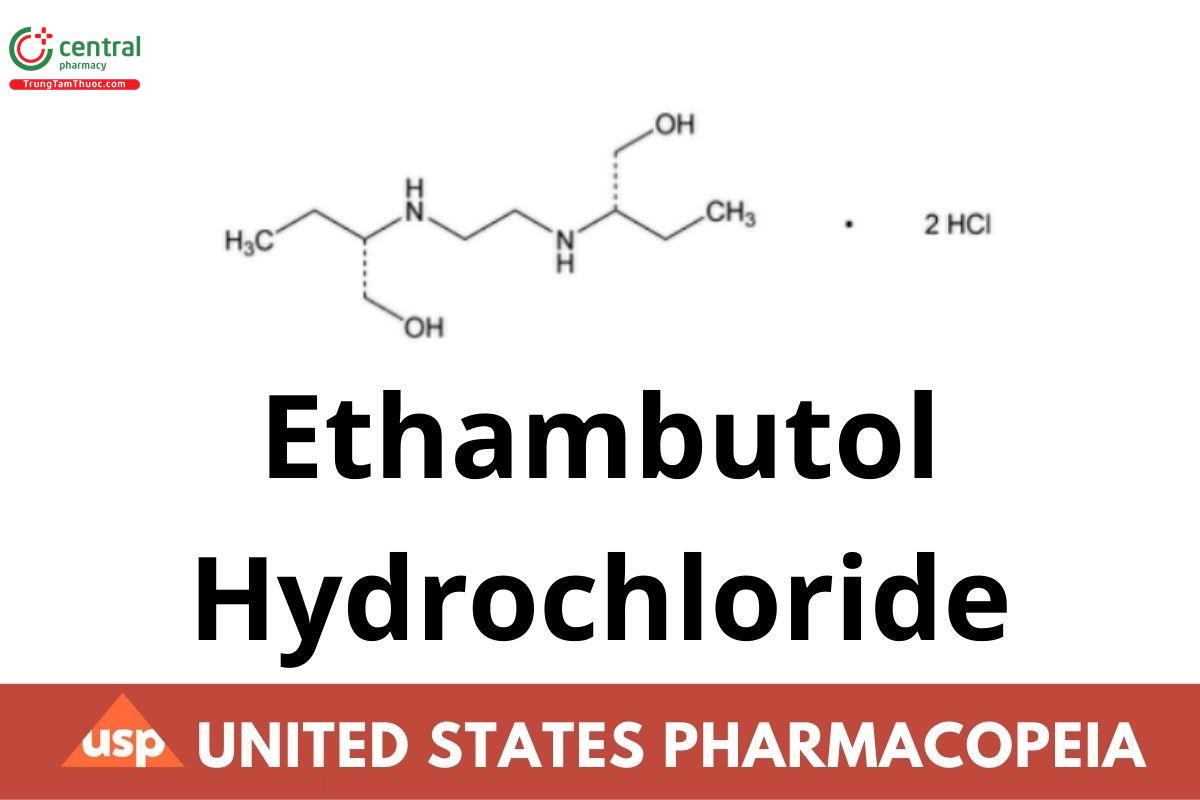

This article is compiled based on the United States Pharmacopeia (USP) – 2025 Edition
Issued and maintained by the United States Pharmacopeial Convention (USP)
DOWNLOAD PDF HERE
1 DEFINITION
Ethambutol Hydrochloride contains NLT 98.0% and NMT 100.5% of ethambutol hydrochloride (C10H24N2O2 · 2HCl), calculated on the dried basis.
2 IDENTIFICATION
A. Spectroscopic Identification Tests 〈197〉, Infrared Spectroscopy: 197A or 197K
B. Identification Tests—General 〈191〉, Chemical Identification Tests, Chloride
Sample solution: 100 mg/mL in water
Acceptance criteria: Meets the requirements
3 ASSAY
Procedure
Sample solution: 200 mg of Ethambutol Hydrochloride in a mixture of 100 mL of glacial acetic acid and 5 mL of mercuric acetate TS. Add crystal violet TS.
Analysis: Titrate with 0.1 N perchloric acid VS (the color change at the endpoint is from blue to blue-green). Perform a blank determination, and make any necessary corrections (see Titrimetry 〈541〉). Each milliliter of 0.1 N perchloric acid is equivalent to 13.86 mg of ethambutol hydrochloride (C10H24N2O2 · 2HCl).
Acceptance criteria: 98.0%–100.5% on the dried basis
4 IMPURITIES
Organic Impurities
Protect all solutions containing ethambutol from light.
Solution A: Methanol and water (50:50)
Solution B: Methanol
Mobile phase: See Table 1.
Table 1
Time (min) | Solution A (%) | Solution B (%) |
| 0 | 82 | 18 |
| 30 | 82 | 18 |
| 35 | 0 | 100 |
| 37 | 0 | 100 |
| 38 | 82 | 18 |
| 50 | 82 | 18 |
Impurity stock solution A: To 4 mg of USP Ethambutol Related Compound A RS, add 4 mL of acetonitrile and 0.1 mL of triethylamine. Sonicate for 5 min and add 15 μL of (R)-(+)-alpha-methylbenzyl isocyanate. Heat the mixture at 70° for 20 min.
Impurity stock solution B: To 4 mg of USP Ethambutol Related Compound B RS, add 4 mL of acetonitrile and 0.1 mL of triethylamine. Sonicate for 5 min and add 15 μL of (R)-(+)-alpha-methylbenzyl isocyanate. Heat the mixture at 70° for 20 min.
System suitability solution: To 4 mg of USP Ethambutol Hydrochloride RS, add 4 mL of acetonitrile and 0.1 mL of triethylamine. Sonicate for 5 min and add 15 μL of (R)-(+)-alpha-methylbenzyl isocyanate. Heat the mixture at 70° for 20 min. Add 40 μL each of Impurity stock solution A and Impurity stock solution B.
Standard stock solution: To 4 mg of USP Ethambutol Hydrochloride RS, add 4 mL of acetonitrile and 0.1 mL of triethylamine. Sonicate for 5 min and add 15 μL of (R)-(+)-alpha-methylbenzyl isocyanate. Heat the mixture at 70° for 20 min.
Standard solution: Dilute 0.5 mL of Standard stock solution with acetonitrile to 100.0 mL.
Sample solution: To 4 mg of Ethambutol Hydrochloride, add 4 mL of acetonitrile and 0.1 mL of triethylamine. Sonicate for 5 min and add 15μL of (R)-(+)-alpha-methylbenzyl isocyanate. Heat the mixture at 70° for 20 min.
Chromatographic system
(See Chromatography 〈621〉, System Suitability.)
Mode: LC
Detector: UV 215 nm
Column: 4.6-mm × 10-cm; 3-μm packing L1
Temperatures
Autosampler: 10°
Column: 40°
Flow rate: 1 mL/min
Injection volume: 10 μL
System suitability
Samples: System suitability solution and Standard solution
[Note—The relative retention times for ethambutol related compound B, ethambutol, and ethambutol related compound A are 0.91, 1.0, and 1.3, respectively.]
Suitability requirements
Resolution: NLT 1.2 between ethambutol related compound B and ethambutol; NLT 3.0 between ethambutol and ethambutol related compound A, System suitability solution
Relative standard deviation: NMT 5.0%, Standard solution
Analysis
Samples: Standard solution and Sample solution
Calculate the percentage of any individual impurity in the portion of Ethambutol Hydrochloride taken:
Result = (rU/rS) × (CS/CU) × 100
rU = peak response of any individual impurity from the Sample solution
rS = peak response of ethambutol from the Standard solution
CS = concentration of USP Ethambutol Hydrochloride RS in the Standard solution (mg/mL)
CU = concentration of Ethambutol Hydrochloride in the Sample solution (mg/mL)
Acceptance criteria: See Table 2. The reporting threshold is 0.05%.
Table 2
| Name | Relative Retention Time | Acceptance Criteria, NMT (%) |
| Ethambutol | 1.0 | - |
| Ethambutol related compound A | 1.3 | 1.0 |
| Any individual impuritya | - | 0.10 |
| Total impuritiesa | - | 1.0 |
a Calculate any individual impurity and total impurities from the relative retention times of 0.75 to 1.5 with reference to ethambutol.
Change to read:
Limit of Aminobutanol
Solution A: 12.4 mg/mL of boric acid in water. Adjust with 5 N sodium hydroxide to a pH of 9.0 prior to final dilution.
Fluorescamine solution: 0.1 mg/mL of fluorescamine in acetone
Standard solution: 5 μg/mL of USP Aminobutanol RS
Sample solution: 0.5 mg/mL of Ethambutol Hydrochloride
Instrumental conditions
(See Fluorescence Spectroscopy 〈853〉.)
Mode: Fluorometry
Analytical wavelength: 485 nm, with the excitation wavelength at about 385 nm
Cell: 1 cm
Analysis
Samples: Standard solution and Sample solution
Pipet a 10-mL portion of the Sample solution into a glass-stoppered, 100-mL conical flask, and add 10 mL of water and 20 mL of Solution A. To another 100-mL flask, add 10.0 mL of the Sample solution, 10.0 mL of the Standard solution, and 20 mL of Solution A. Place the flasks on a magnetic stirrer, and while the contents are being stirred rapidly, add 10 mL of Fluorescamine solution rapidly. Insert the stoppers in the flasks, invert, and shake briefly. After 1 min, accurately timed, determine the relative fluorescence intensities of both solutions in a suitable fluorometer.
Acceptance criteria: The fluorescence intensity of the solution from the Sample solution is NMT (ERR 1-Aug-2020) the difference between the intensities of the two solutions (NMT 1.0%). (ERR 1-Aug-2020)
5 SPECIFIC TESTS
Optical Rotation 〈781S〉, Procedures, Specific Rotation
Sample solution: 100 mg/mL in water
Acceptance criteria: +6.0° to +6.7°
Loss on Drying 〈731〉
Analysis: Dry at 105° for 2 h.
Acceptance criteria: NMT 0.5%
6 ADDITIONAL REQUIREMENTS
Packaging and Storage: Preserve in well-closed containers.
USP Reference Standards 〈11〉
USP Aminobutanol RS C H NO 89.14
USP Ethambutol Hydrochloride RS
USP Ethambutol Related Compound A RS
((2R,2′S)-2,2′-[Ethane-1,2-diylbis(azanediyl)]dibutan-1-ol)dihydrochloride.
C10H24N2O2 · 2HCl 277.23
USP Ethambutol Related Compound B RS
((2R,2′R)-2,2′-[Ethane-1,2-diylbis(azanediyl)]dibutan-1-ol)dihydrochloride.
C10H24N2O2 · 2HCl 277.23

