
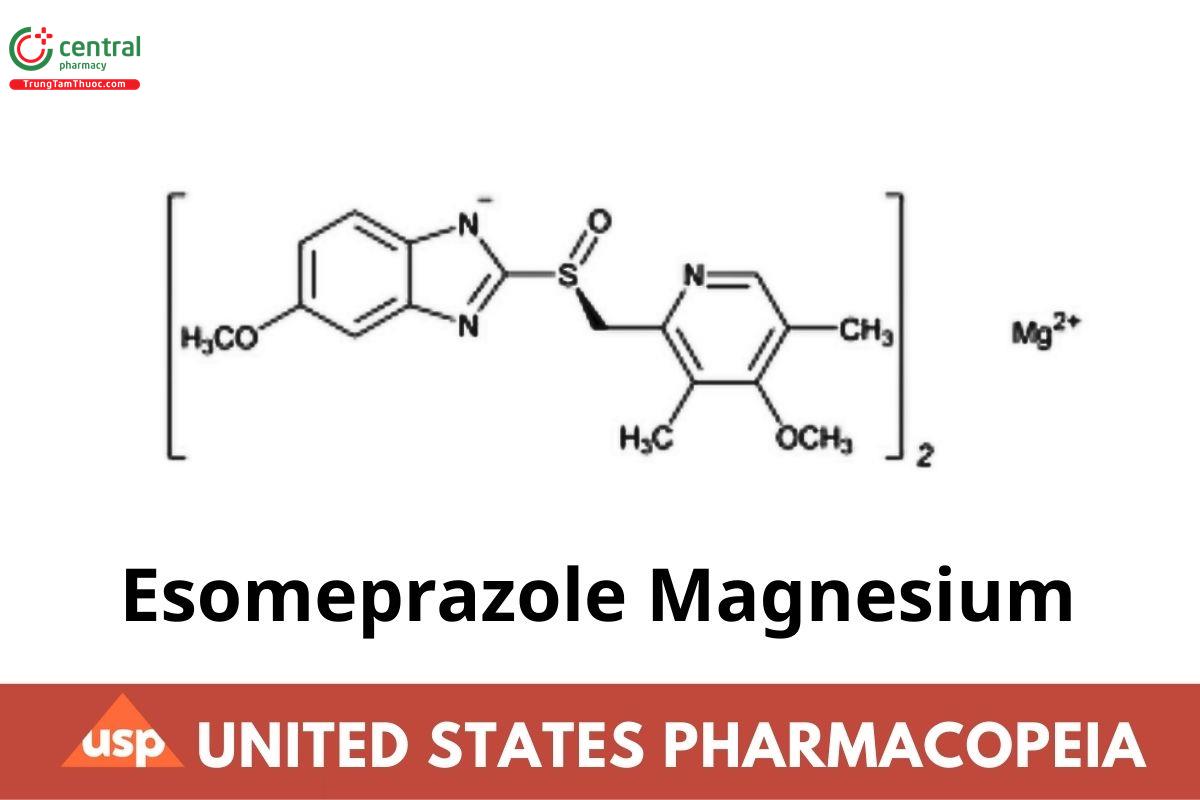
Esomeprazole Magnesium
If you find any inaccurate information, please let us know by providing your feedback here

Tóm tắt nội dung
This article is compiled based on the United States Pharmacopeia (USP) – 2025 Edition
Issued and maintained by the United States Pharmacopeial Convention (USP)
1H-Benzimidazole,5-methoxy-2-[(S)-[(4-methoxy-3,5-dimethyl-2-pyridinyl)methyl]sulnyl]-, magnesium salt (2:1)
5-Methoxy-2-[(S)-[(4-methoxy-3,5-dimethyl-2-pyridyl)methyl]sulnyl]benzimidazole, magnesium salt (2:1)
Trihydrate: CAS RN®: 217087-09-7; UNII: R6DXU4WAY9.
Dihydrate: CAS RN®: 217087-10-0; UNII: 36H71644EQ.
1 DEFINITION
Esomeprazole Magnesium contains NLT 98.0% and NMT 102.0% of esomeprazole magnesium (C34H26MgN6O6S2), calculated on the anhydrous basis.
2 IDENTIFICATION
A. SPECTROSCOPIC IDENTIFICATION TESTS (197), Infrared Spectroscopy: 197K. [Norm-If a difference appears in the IR spectra of the analyte and the Standard, separately dissolve equal portions of the sample specimen and USP Esomeprazole Magnesium RS in equal volumes of methanol, evaporate the solution to dryness in similar containers under identical conditions, and repeat the test on the residues.]
B. The Sample solution, prepared and tested as directed in the test for Content of Magnesium, exhibits a significant absorption at 285.2 nm.
C. The retention time of the major peak of the Sample solution corresponds to that of the Standard solution, as obtained in the Assay.
3 ASSAY
PROCEDURE
Solution A: 0.181 g/L of sodium phosphate monobasic and 1.118 g/L of sodium phosphate dibasic anhydrous in water if necessary, adjust with phosphoric acid to a pH of 7.6
Solution B: Mix 11 mL of 0.25 M sodium phosphate tribasic with 22 mL of 0.5 M sodium phosphate dibasic, and dilute with water to 100 ml.
Mobile phase: Acetonitrile and Solution A (35:65)
Standard solution: 0.05 mg/ml, of USP Omeprazole RS prepared as follows. Transfer 10 mg of USP Omeprazole RS to a 200-ml volumetric flask, and dissolve in about 10 mL of methanol. Add 10 mL of Solution B, and dilute with water to volume
Sample solution: 0.05 mg/mL of Esomeprazole Magnesium prepared as follows. Transfer 10 mg of Esomeprazole Magnesium to a 200ml. volumetric flask, and dissolve in about 10 ml, of methanol. Add 10 mL of Solution B, and dilute with water to volume.
Chromatographic system
(See Chromatography (621) System Suitability)
Mode: LC
Detector: UV 280 nm
Column: 4.0-mm × 12.5-cm or 4.6-mm × 15-cm; 5-μm packing L7. [Note—Alternatively, a 3.9-mm × 15-cm column; 4-μm packing L1 may be used.]
Flow rate: 1.0 mL/min
Injection volume: 20 μL
System suitability
Sample: Standard solution
Suitability requirements
Tailing factor: NMT 1.5
Relative standard deviation: NMT 1.0%
Analysis
Samples: Standard solution and Sample solution
Calculate the percentage of esomeprazole magnesium (C34H26MgN6O6S2) in the portion of Esomeprazole Magnesium taken:
Result = (rU/(rS) × (CS /CU) x [Mr1 /(2 × Mr2 )] × 100
rU = peak response of esomeprazole from the Sample solution
rS = peak response of omeprazole from the Standard solution
CS = concentration of USP Omeprazole RS in the Standard solution (mg/mL)
CU = concentration of Esomeprazole Magnesium in the Sample solution (mg/mL)
Mr1 = molecular weight of esomeprazole magnesium, 776.44
Mr2 = molecular weight of omeprazole 345.42
Acceptance criteria: 98.0%–102.0% on the anhydrous basis
4 OTHER COMPONENTS
Change to read:
Content of Magnesium
Lanthanum solution: Transfer 58.7 g of lanthanum oxide to a 1000-mL volumetric ask, wet the substance with some water, and dissolve by cautious addition of 250 mL of hydrochloric acid in 20- to 30-mL portions, cooling between the additions. Add water while stirring, cool to room temperature, and dilute with water to volume. [Note—Store the solution in a plastic bottle.]
Standard stock solution: 1000 μg/mL of magnesium in water, from a commercially prepared atomic absorption standard solution. [Note—Store the solution in a plastic bottle.]
Standard solution A: Transfer 10.0 mL of Standard stock solution to a 500-mL volumetric ask, add 50 mL of 1 N hydrochloric acid, and dilute with water to volume. Transfer 20.0 mL of this solution to a 200-mL volumetric ask, and dilute with water to volume. [Note—This solution contains 2 μg/mL of magnesium.]
Standard solution B: Combine 5.0 mL of Standard solution A and 4.0 mL of Lanthanum solution, and dilute with water to 100.0 mL (0.1 μg/mL).
Standard solution C: Combine 10.0 mL of Standard solution A and 4.0 mL of Lanthanum solution, and dilute with water to 100.0 mL (0.2 μg/mL).
Standard solution D: Combine 15.0 mL of Standard solution A and 4.0 mL of Lanthanum solution, and dilute with water to 100.0 mL (0.3 μg/mL).
Standard solution E: Combine 20.0 mL of Standard solution A and 4.0 mL of Lanthanum solution, and dilute with water to 100.0 mL (0.4 μg/mL).
Standard solution F: Combine 25.0 mL of Standard solution A and 4.0 mL of Lanthanum solution, and dilute with water to 100.0 mL (0.5 μg/mL). [Note—Concentrations of the Standard solutions and the Sample solution may be modied tot the linear or working range of the instrument. When using instruments with a linear calibration graph, the number of Standard solutions can be reduced.]
Sample solution: Transfer 250 mg of Esomeprazole Magnesium to a 100-mL volumetric ask, add 20 mL of 1 N hydrochloric acid, swirl until dissolved, and dilute with water to volume. Allow to stand for 30 min. Transfer 10.0 mL of this solution to a 200-mL volumetric ask, and dilute with water to volume. Transfer 10.0 mL of the solution to another 100-mL volumetric ask, add 4.0 mL of Lanthanum solution, and dilute with water to volume.
Blank: Transfer 4.0 mL of Lanthanum solution to a 100-mL volumetric flask, and dilute with water to volume.
Instrumental conditions
(See Atomic Absorption Spectroscopy (852).)
Mode: Atomic absorption spectrophotometry
Flame: Air–acetylene
Analytical wavelength: 285.2 nm
Analysis
Samples: Standard solution B, Standard solution C, Standard solution D, Standard solution E, Standard solution F, Sample solution, and Blank
Determine the concentration, C , in μg/mL, of magnesium in the Sample solution using the calibration graph.
Calculate the percentage of magnesium in the portion of Esomeprazole Magnesium taken:
Result = (Cs /Cu ) × [100/(100 − F)] × 100
Cs = concentration of magnesium in the Sample solution as calculated above (μg/mL)
Cu = concentration of Esomeprazole Magnesium in the Sample solution (μg/mL)
F = content of water in Esomeprazole Magnesium, as determined in Specific Tests, Water Determination (%)
Acceptance criteria: on the anhydrous basis
5 IMPURITIES
Organic Impurities
Solution A: Prepare as directed in the Assay.
Mobile phase: Acetonitrile and Solution A (11:29). [Note—To improve the resolution, the composition may be changed to 1:3, if necessary.]
System suitability solution: 0.04 mg/mL each of USP Omeprazole RS and USP Omeprazole Related Compound A RS in Mobile phase.
Sample solution: 0.16 mg/mL of Esomeprazole Magnesium in Mobile phase. [Note—Prepare this solution fresh.]
Chromatographic system
(See Chromatography (621), System Suitability.)
Mode: LC
Detector: UV 280 nm
Column: 4.0-mm × 12.5-cm or 4.6-mm × 15-cm; 5-μm packing L7. [Note—Alternatively, a 3.9-mm × 15-cm column; 4-μm packing L1 may be used.]
Flow rate: 0.8–1.0 mL/min
Injection volume: 50 μL
Run time: NLT 4.5 times the retention time of omeprazole
System suitability
Sample: System suitability solution
Suitability requirements
Resolution: NLT 3 between omeprazole related compound A and omeprazole
Analysis
Sample: Sample solution
Calculate the percentage of any individual impurity in the portion of Esomeprazole Magnesium taken:
Result = (ru /rt ) × 100
ru = peak response of any individual impurity from the Sample solution
rt = sum of all the peak responses from the Sample solution
Acceptance criteria: See Table 1.
| Name | Relative Retention Time | Acceptance Criteria, NMT (%) |
| Omeprazole N-oxidea | 0.45 | 0.1 |
| Omeprazole related compound A | 0.8 | 0.2 |
| Esomeprazole | 1.0 | — |
| Any other individual impurity | — | 0.1 |
| Total impurities | — | 0.5 |
a 4-Methoxy-2-[[(RS)-(5-methoxy-1H-benzimidazol-2-yl)sulnyl]methyl]-3,5-dimethylpyridine 1-oxide.
EHANTIOMERIC PURITY
Solution A: Mix 70 mL of 1 M sodium phosphate monobasic with 20 mL of 0.5 M sodium phosphate dibasic, and dilute with water to 1000 mL. Dilute 250 ml. of this solution with water to 1000 mL
Mobile phase: Acetonitrile and Solution A (15:85)
Diluent: Mix 11 ml of 0.25 M sodium phosphate tribasic with 22 mL of 0.5 M sodium phosphate dibasic, and dilute with water to 1000 mL
System suitability solution: 0.004 mg/ml. of USP Omeprazole RS in Diluent
Sample solution: 0.03 mg/mL of Esomeprazole Magnesium prepared as follows. Dissolve 40 mg of Esomeprazole Magnesium in 5 mL of methanol, and dilute with Diluent to 25 ml. Dilute 1 ml of this solution with Diluent to 50 mL
Chromatographic system
(See Chromatography (621), System Suitability)
Mode: LC
Detector: UV 302 nm
Column: 4.0-mm × 10-cm; 5-μm packing L41
Flow rate: 0.6 mL/min
Injection volume: 20 μL
System suitability
Sample: System suitability solution
Suitability requirements
Resolution: NLT 3 between the enantiomer peaks. Nors-The elution order is the Renantiomer, followed by the esomeprazole peak, which is the S-enantiomer.]
Analysis
Sample: Sample solution
Calculate the percentage of the R-enantiomer in the portion of Esomeprazole Magnesium taken:
Result = (ru /rt ) × 100
ru = peak response of the R-enantiomer from the Sample solution
rt = sum of the peak responses for esomeprazole and R-enantiomer from the Sample solution
Acceptance criteria: NMT 0.2% of the R-enantiomer
6 SPECIFIC TESTS
WATER DETERMINATION (921), Method I
If labeled as trihydrate: 6.0%-8.0%
If labeled as dihydrate: 4.5%-7.0%
If labeled as amorphous: 7.0%-10.0%
CRYSTALLINITY (695) (if it is labeled as amorphous): Most of the particles do not exhibit birefringence and extinction positions.
COLOR OF SOLUTION
Sample solution: 20 mg/mL of Esomeprazole Magnesium in methanol, filtered
Analysis: Determine the absorbance of this solution at 440 nm, in 1-cm cells, using methanol as the blank
Acceptance criteria: NMT 0.2
7 ADDITIONAL REQUIREMENTS
PACKAGING AND STORAGE: Preserve in tight containers, protected from light. Store at room temperature. If it is labeled as amorphous, store at 2-8" under nitrogen atmosphere.
LABELING: Where it is a dihydrate form, the label so indicates. Where it is an amorphous form, the label so indicates.

