
Erythritol
If you find any inaccurate information, please let us know by providing your feedback here
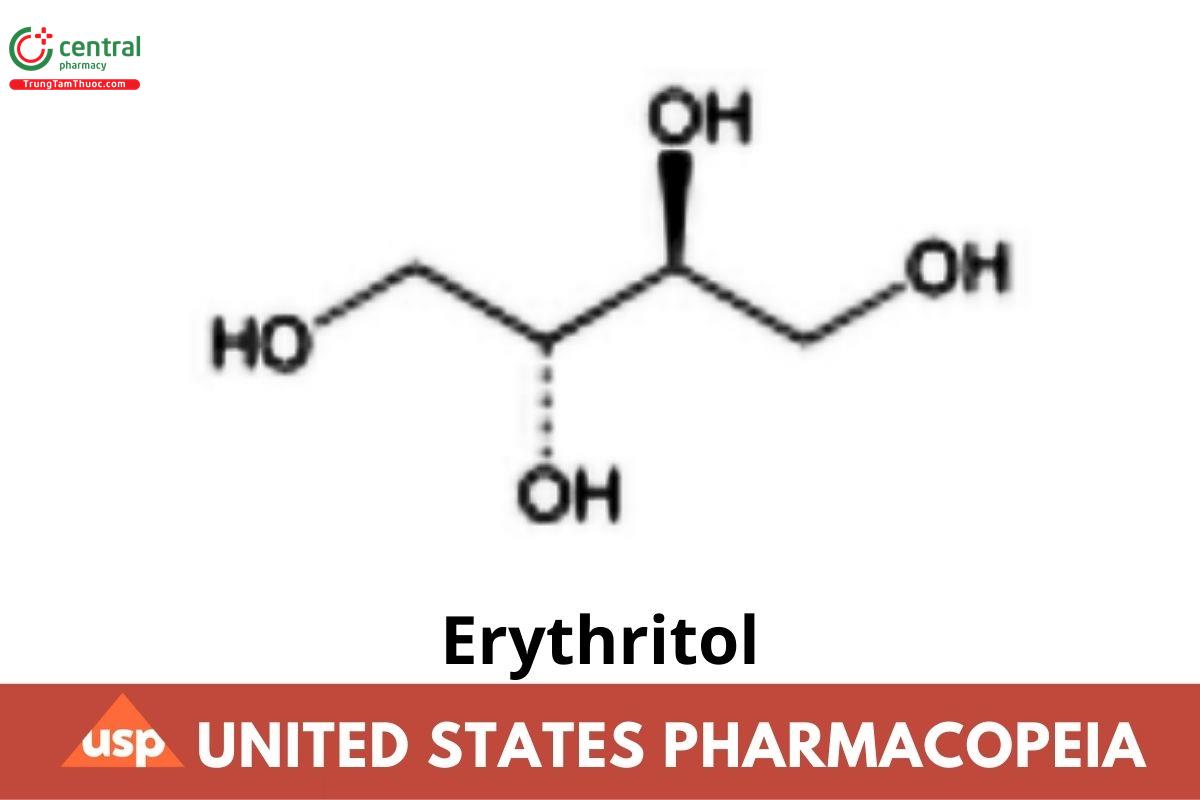

This article is compiled based on the United States Pharmacopeia (USP) – 2025 Edition
Issued and maintained by the United States Pharmacopeial Convention (USP)
C4H10O4 122.12
1,2,3,4-Butanetetrol;
Butane 1,2,3,4-tetrol (meso-erythritol) CAS RN®: 149-32-6.
1 DEFINITION
Erythritol is obtained by fermentation of starch enzyme hydrolysate (from starches such as wheat and corn). It is obtained from the fermentation broth of suitable osmophilic yeasts such as Moniliella pollinis or Trichosporonoides megachiliensis. It contains NLT 96.0% and NMT 102.0% of erythritol (C4H10O4 ), calculated on the anhydrous basis.
2 IDENTIFICATION
Change to read:
A. Spectroscopic Identification Tests 〈197〉, Infrared Spectroscopy: 197K (CN 1-May-2020)
B. Melting Range or Temperature 〈741〉: 119°–123°
3 ASSAY
Procedure
Mobile phase: 0.01% Sulfuric acid
System suitability solution: 0.05 mg/mL each of USP Erythritol RS and glycerol
Standard solution: 50 mg/mL of USP Erythritol RS
Sample solution: 50 mg/mL of Erythritol
Chromatographic system
(See Chromatography 〈621〉, System Suitability.)
Mode: LC
Detector: Refractive index
Column: 7.8-mm × 30-cm; packing L17
Column temperature: 70°
Flow rate: 0.8 mL/min
Injection volume: 10 µL
System suitability
Samples: System suitability solution and Standard solution
[Note—The relative retention times for erythritol and Glycerol are about 1.0 and 1.1, respectively.]
Suitability requirements
Resolution: NLT 2.0 between erythritol and glycerol, System suitability solution
Relative standard deviation: NMT 2.0%, Standard solution
Analysis
Samples: Standard solution and Sample solution
[Note—Record chromatograms for over a period of 3 times the retention time of erythritol.]
Calculate the percentage of erythritol (C4H10O4 ) in the portion of Erythritol taken:
Result = (rU/rS) × (CS/CU) × 100
rU = peak response from the Sample solution
rS = peak response from the Standard solution
CS = concentration of USP Erythritol RS in the Standard solution (mg/mL)
CU = concentration of Erythritol in the Sample solution (mg/mL)
Acceptance criteria: 96.0%–102.0% on the anhydrous basis
4 IMPURITIES
Residue on Ignition 〈281〉: NMT 0.1%
Limit of Lead
Sample solution: Dissolve 20.0 g of Erythritol in diluted acetic acid, and dilute with the same medium to 100 mL. Add 2.0 mL of a saturated ammonium pyrrolidinedithiocarbamate solution (10 mg/mL of ammonium pyrrolidinedithiocarbamate) and 10.0 mL of methyl isobutyl ketone, and shake for 30 s. Protect from bright light. Allow the two layers to separate, and use the methyl isobutyl ketone layer.
Standard solutions: Prepare as directed for the Sample solution, except prepare three solutions by adding 0.5, 1.0, and 1.5 mL of standard lead solution TS in addition to the 20.0 g of Erythritol.
Blank solution: Prepare as directed for the Sample solution, omitting Erythritol.
Instrumental conditions
(See Atomic Absorption Spectroscopy 〈852〉.)
Mode: Atomic absorption spectrophotometry, using methyl isobutyl ketone previously treated as described in the Sample solution, but without the sample added
Analytical wavelength: 283.3 nm
Lamp: Lead hollow-cathode
Flame: Air–acetylene
Analysis
Samples: Sample solution and Standard solutions
Introduce the Sample solution and each of the three Standard solutions into the instrument. Record the steady absorbance reading. Plot the absorbance readings against the known concentrations of added lead (in µg), and draw a straight line. Extrapolate the line until it meets the concentration axis, which is equal to the concentration, in ppm, of lead in the sample.
Acceptance criteria: NMT 0.5 µg/g
Change to read:
Related Compounds
Mobile phase, System suitability solution, Standard solution, and Sample solution: Proceed as directed in the Assay. Standard solution A: Transfer 2.0 mL of the Standard solution from the Assay to a 100-mL volumetric ask, and dilute with water (1 mg/mL of erythritol).
Chromatographic system: Proceed as directed in the Assay, except use an Injection volume of 20 µL.
Analysis
Samples: Standard solution A (ERR 1-Jun-2018) and Sample solution
Calculate the percentage of each impurity found:
Result = (rU/rS) × (CS/CU) × 100
rU = peak response from the Sample solution
rS = peak response of erythritol from the Standard solution
CS = concentration of USP Erythritol RS in the Standard solution A (mg/mL)
CU = concentration of Erythritol in the Sample solution (mg/mL)
Acceptance criteria
Individual impurities: NMT 2.0%
Total impurities: NMT 2.0%
5 SPECIFIC TESTS
Microbial Enumeration Tests 〈61〉andTests for Specified Microorganisms 〈62〉: The total aerobic microbial count using the Plate-Count Methods is NMT 103 cfu/g, and the total combined molds and yeasts count is NMT 102 cfu/g. It meets the requirements of the tests for absence of Salmonella species and Escherichia coli.
Loss on Drying 〈731〉
Sample: 8 g
Analysis: Dry the Sample at 105° for 4 h.
Acceptance criteria: NMT 0.2%
Water Determination, Method I〈921〉: NMT 0.5%
Conductivity
Sample solution: 200 mg/mL in water
Analysis: Using an appropriate conductivity meter, choose a conductivity cell that is appropriate for the properties and conductivity of the solution to be examined. Use a certified reference material,1 for example, a solution of potassium chloride, that is appropriate for the measurement. The conductivity value of the certified reference material should be near the expected conductivity value of the solution to be examined. After calibrating the apparatus with a certified reference material solution, rinse the conductivity cell several times with water and at least twice with the aqueous solution to be examined. Measure the conductivity of the solution at a temperature of 20° while stirring gently with a magnetic stirrer.
Acceptance criteria: NMT 20 µS/cm
6 ADDITIONAL REQUIREMENTS
Packaging and Storage: Preserve in well-closed containers. Store at room temperature.
USP Reference Standards 〈11〉
USP Erythritol RS
meso-Erythritol, 1,2,3,4-butanetetrol.
C4H10O4 122.12
1 Commercially available conductivity calibration solutions for conductivity meter standardization, standardized by methods traceable to the National Institute of Standards and Technology (NIST), may be used. Solutions prepared according to instructions given in the American Society for Testing and Materials (ASTM) Standard D1125 may be used, provided that the conductivity of the resultant solution is the same as that of the solution prepared from the NIST-certified material.

