
Edetate Calcium Disodium
If you find any inaccurate information, please let us know by providing your feedback here
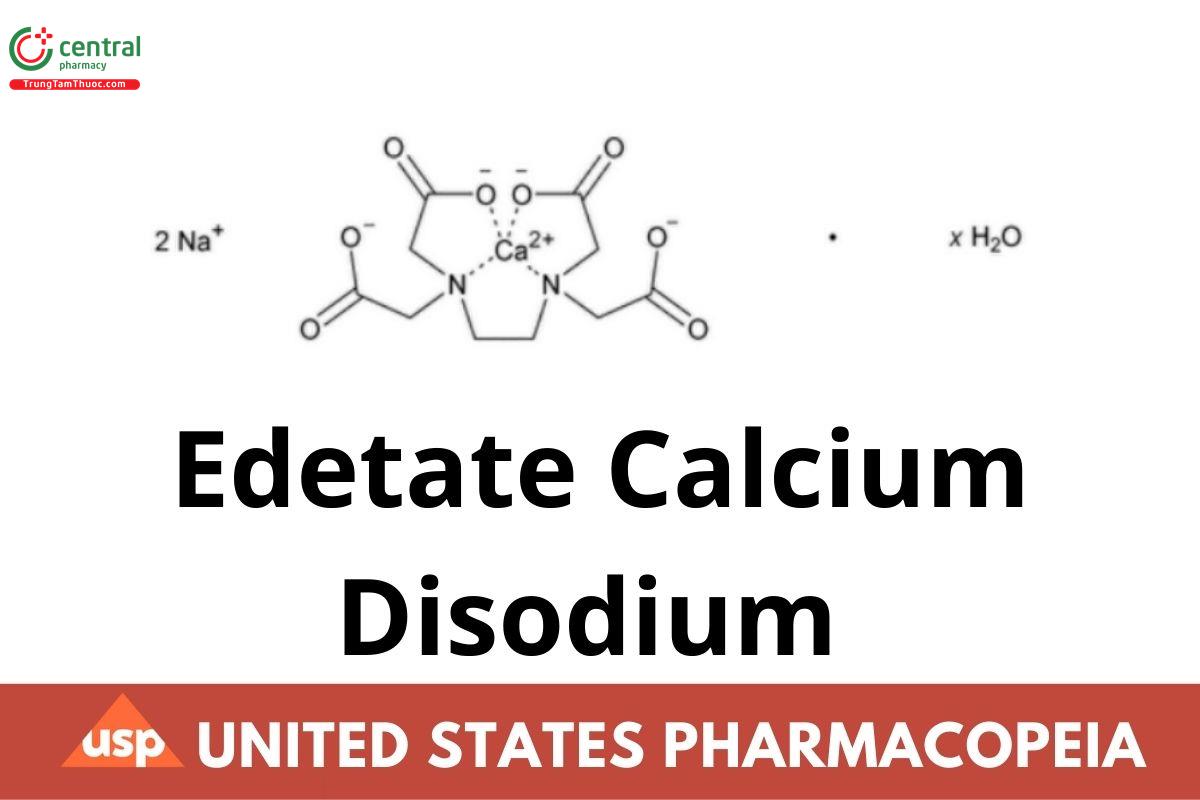

This article is compiled based on the United States Pharmacopeia (USP) – 2025 Edition
Issued and maintained by the United States Pharmacopeial Convention (USP)
DOWNLOAD PDF HERE
1 DEFINITION
Edetate Calcium Disodium contains NLT 98.0% and NMT 102.0% of edetate calcium disodium (C10H12CaN2Na2O8), calculated on the anhydrous basis.
2 IDENTIFICATION
Change to read:
A. Spectroscopic Identification Tests 〈197〉, Infrared Spectroscopy: 197M (CN 1-May-2020)
B. Procedure
Sample: 2 g
Analysis: Dissolve the Sample in 10 mL of water, add 6 mL of lead (II) nitrate solution (33 in 1000), shake, and add 3 mL of potassium iodide TS: no yellow precipitate is formed. Make this solution alkaline by the addition of diluted ammonia solution (7 in 50), and add 3 mL of ammonium oxalate TS.
Acceptance criteria: A white precipitate is formed.
C. Procedure
Sample: 0.5 g
Analysis: Dissolve 0.5 g in 10 mL of water, and add 10 mL of potassium pyroantimonate TS.
Acceptance criteria: A white, crystalline precipitate is formed. The formation of the precipitate is accelerated by rubbing the inside wall of the test tube with a glass rod.
3 ASSAY
Procedure
Sample: 500 mg of Edetate Calcium Disodium
Analysis: Transfer the Sample into a 200-mL volumetric flask. Dissolve in and dilute with water to volume, and mix. Pipet 20 mL of this solution to 80 mL of water, and adjust with diluted nitric acid to a pH of 2–3. Add two drops of xylenol orange TS, and titrate with 0.01 M Bismuth nitrate VS until the color of the solution changes from yellow to red. Each mL of 0.01 M bismuth nitrate VS is equivalent to 3.743 mg of edetate calcium disodium (C10H12CaN2Na2O8).
Acceptance criteria: 98.0%–102.0% on the anhydrous basis
4 IMPURITIES
Chloride and Sulfate, Chloride〈221〉
Sample solution: To 0.70 g of Edetate Calcium Disodium add 20 mL of water and 30 mL of diluted nitric acid. Allow to stand for 30 min, and filter. To 10 mL of the filtrate add water to make 50 mL.
Control solution: Prepare with 0.40 mL of 0.01 M hydrochloric acid VS.
Analysis: Proceed as directed in the chapter.
Acceptance criteria: NMT 0.10%
Organic Impurities
Procedure 1: Disodium Edetate
Sample: 1.00 g of Edetate Calcium Disodium
Analysis: Dissolve the Sample in 50 mL of water. Add 5 mL of ammonia–ammonium chloride buffer TS, and 40 mg of eriochrome black T–sodium chloride indicator. Titrate with 0.01 M magnesium chloride VS until the color of the solution changes from blue to red-violet.
Acceptance criteria: NMT 3.0 mL of 0.01 M magnesium chloride VS is consumed (NMT 1.0%).
Procedure 2: Limit of Nitrilotriacetic Acid
Mobile phase: Add 10 mL of 1.0 M tetrabutylammonium hydroxide in methanol to 200 mL of water, and adjust with 1 M phosphoric acid to a pH of 7.5 ± 0.1. Transfer the solution to a 1000-mL volumetric flask, add 90 mL of methanol, dilute with water to volume, pass through a filter of 0.5-μm or finer pore size, and degas.
Cupric nitrate solution: 10 mg/mL of cupric nitrate [Cu(NO ) ] in water
Standard stock solution: Transfer 100 mg of nitrilotriacetic acid to a 10-mL volumetric flask, add 0.5 mL of ammonium hydroxide, and mix.
Dilute with water to volume, and mix.
Standard solution: Transfer 1.0 g of Edetate Calcium Disodium to a 100-mL volumetric flask, add 100 μL of Standard stock solution, dilute with Cupric nitrate solution to volume, and mix. Sonicate, if necessary, to achieve complete solution.
System suitability solution: Transfer 10 mg of Edetate Calcium Disodium to a 100-mL volumetric flask, add 100 μL of Standard stock solution, dilute with Cupric nitrate solution to volume, and mix. Sonicate, if necessary, to dissolve.
Sample solution: 10 mg/mL of Edetate Calcium Disodium in Cupric nitrate solution. Sonicate, if necessary, to achieve complete solution.
Chromatographic system
(See Chromatography 〈621〉, System Suitability.)
Mode: LC
Detector: UV 254 nm
Column: 4.6-mm × 15-cm; packing L7
Flow rate: 2 mL/min
Injection volume: 50 μL
System suitability
Samples: System suitability solution and Standard solution
[Note—The relative retention times for nitrilotriacetic acid, copper, and edetate are about 0.35, 0.65, and 1.0, respectively.]
Suitability requirements
Resolution: NLT 3 between nitrilotriacetic acid and copper, System suitability solution
Relative standard deviation: NMT 2.0%, Standard solution
Analysis
Samples: Standard solution and Sample solution
Measure the responses for the major peaks.
Acceptance criteria: The peak response of nitrilotriacetic acid from the Sample solution does not exceed the difference between the
nitrilotriacetic acid peak responses obtained from the Standard solution and the Sample solution (0.1%).
5 SPECIFIC TESTS
pH 〈791〉
Sample solution: A solution (1 in 5)
Acceptance criteria: 6.5–8.0
Water Determination, Method I〈921〉
Sample: 0.2 g
Acceptance criteria: 5.0%–13.0%
6 ADDITIONAL REQUIREMENTS
Packaging and Storage: Preserve in tight containers. No storage requirements specified.
USP Reference Standards 〈11〉
USP Edetate Calcium Disodium RS

