
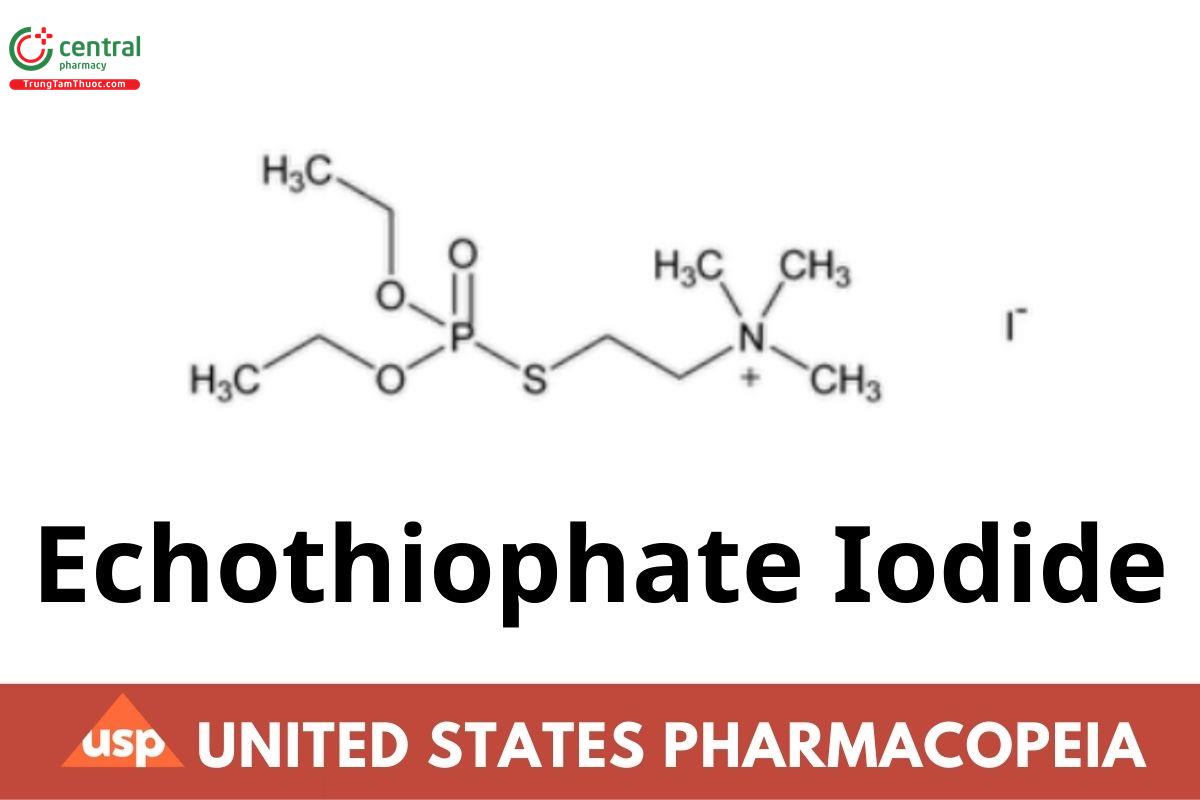
Echothiophate Iodide
If you find any inaccurate information, please let us know by providing your feedback here

Tóm tắt nội dung
This article is compiled based on the United States Pharmacopeia (USP) – 2025 Edition
Issued and maintained by the United States Pharmacopeial Convention (USP)
DOWNLOAD PDF HERE
1 DEFINITION
Echothiophate Iodide contains NLT 95.0% and NMT 100.5% of echothiophate iodide (C9H23INO3PS), calculated on the dried basis.
2 IDENTIFICATION
A.
Sample solution: 50 mg/mL
Analysis: To 2 mL of the Sample solution in a test tube add 1 mL of nitric acid. Transfer 1 drop of this mixture to another test tube, add 1 mL of solvent hexane, and shake.
Acceptance criteria: (1) A brown precipitate of iodine is formed after addition of nitric acid. (2) The solvent hexane acquires a pink color.
B. Identification Tests—General, Phosphate〈191〉
Analysis: Heat the remainder of the brown reaction mixture from Identification test A over a flame until a colorless solution remains (about 3 min). Cool, and dilute with water to 10 mL.
Acceptance criteria: A 2-mL portion of this solution meets the requirements.
C. Identification Tests—General, Sulfate〈191〉: A 2-mL portion of the solution obtained in Identification test B meets the requirements.
3 ASSAY
Procedure
In the preparation of all reagents, and throughout this procedure, wherever water is specified, use only water that has been distilled, boiled for 10 min, and cooled while protected from the atmosphere.
Solution A: Transfer 5.44 g of anhydrous dibasic sodium phosphate to a 100-mL volumetric flask, and add a volume of 1 N sodium hydroxide VS that contains 36.5 mEq of sodium hydroxide. Add 40 mL of water, shake to dissolve the sodium phosphate, and dilute with water to volume.
Solution B: Dilute 0.1 N iodine with water to 0.004 N, and standardize the solution on the day of use as follows. Weigh 150 mg of arsenic trioxide, and dissolve in 20 mL of 1 N sodium hydroxide, by warming if necessary, in a 500-mL volumetric flask. Dilute with 40 mL of water, add 2 drops of methyl orange TS, then add 3 N hydrochloric acid until the yellow color is changed to pink. Add 2 g of sodium bicarbonate, then add water to volume. Transfer 5.0 mL of this solution to a titration vessel, and add 50 mL of Solution A (see Reagents, Indicators, and Solutions—Solutions). Titrate with 0.004 N iodine, determining the endpoint potentiometrically, using platinum and silver–silver chloride electrodes. Calculate the normality. Each 197.8 μg of arsenic trioxide is equivalent to 1 mL of 0.004 N iodine.
Sample solution: 1.25 mg/mL of Echothiophate Iodide in water
Analysis: Transfer 10.0 mL of the Sample solution to a titration vessel containing 30 mL of water. Add 10.0 mL of Solution A, cover, and allow to stand for 20 min at 25 ± 3°. Add 2 mL of glacial acetic acid rapidly and with mixing. Titrate with Solution B, determining the endpoint potentiometrically, using platinum and silver–silver chloride electrodes. Correct for the amount of free thiol sulfur by repeating the
procedure but adding the glacial acetic acid first, then Solution A, and titrating immediately. Subtract the volume of Solution B used in the second titration from that used in the first. Each mL of 0.004 N iodine is equivalent to 1.533 mg of echothiophate iodide (C9H23INO3PS).
Acceptance criteria: 95.0%–100.5% on the dried basis
4 SPECIFIC TESTS
Loss on Drying 〈731〉
Analysis: Dry under vacuum over phosphorus pentoxide at 50° for 3 h.
Acceptance criteria: NMT 1.0%
5 ADDITIONAL REQUIREMENTS
Packaging and Storage: Preserve in tight, light-resistant containers, preferably at a temperature below 0°.

