
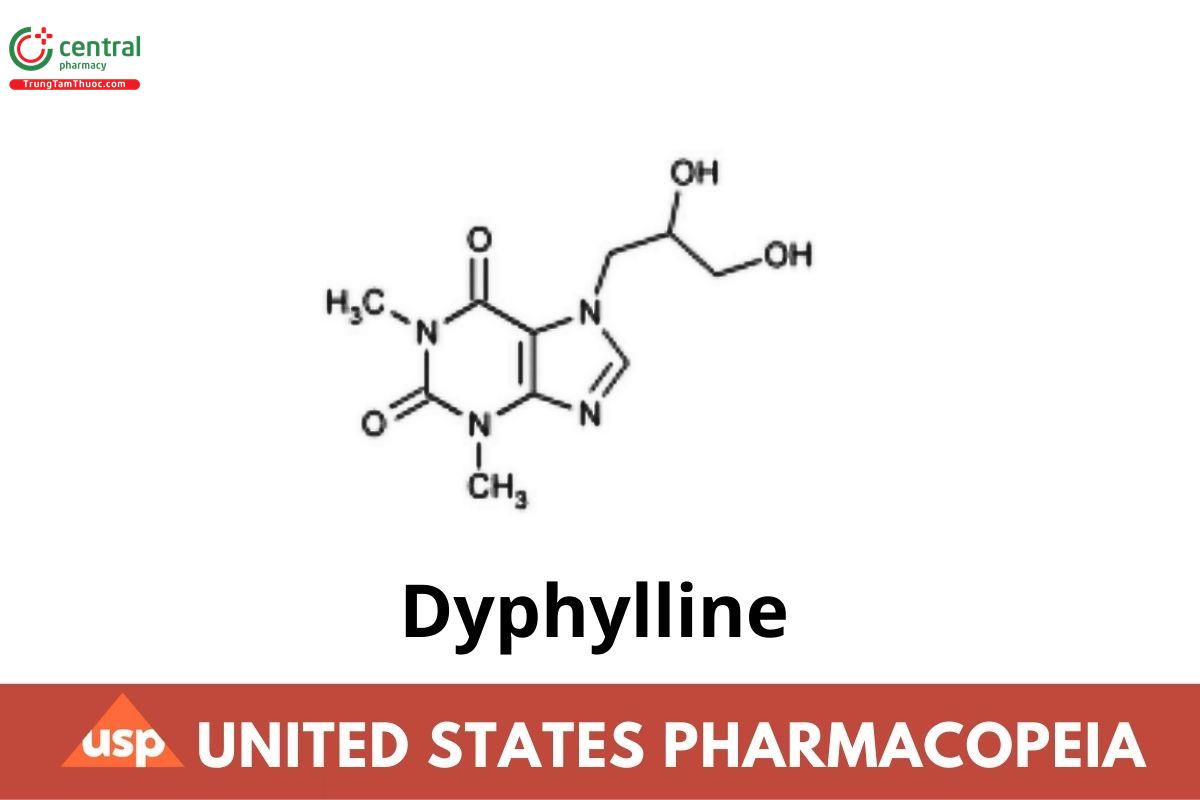
Dyphylline
If you find any inaccurate information, please let us know by providing your feedback here
This article is compiled based on the United States Pharmacopeia (USP) – 2025 Edition
Issued and maintained by the United States Pharmacopeial Convention (USP)
1H-Purine-2,6-dione, 7-(2,3-dihydroxypropyl)-3,7-dihydro-1,3-dimethyl-, (±)-.
(±)-7-(2,3-Dihydroxypropyl)theophylline CAS RN®: 479-18-5; UNII: 263T0E9RR9.
» Dyphylline contains not less than 98.0 percent and not more than 102.0 percent of C10H14N4O4, calculated on the dried basis.
Packaging and storage—Preserve in tight containers.
Identication—
Change to read:
A:Spectroscopic Identification Tests (197), Infrared Spectroscopy: 1975 (CN 1-May-2020)
Change to read:
B: SPECTROSCOINC IDENTIFICATION TESTS (197) Ultraviolet-Visible Spectroscopy: 1970 (CN 1-May-2020)
Solution: 10 µg per mL..
Medium: water.
MELTING RANGE (741): between 160° and 164"
PH (791): between 5.0 and 7.5, in a solution (1 in 100)..
LOSS ON DRYING (731)-Dry about 1 g, accurately weighed, at 105" for 3 hours: it loses not more than 0.5% of its weight.
RESIDUE ON IGNITION (281): not more than 0.15%.
CHLONE (221): A 1.0-g portion shows no more chloride than corresponds to 0.50 mL of 0.020 N hydrochloric acid (0.035%).
SULFATE (221): A 1.0-g portion shows no more sulfate than corresponds to 0.10 mL of 0.020 N sulfuric acid (0.010%).
Limit of theophylline—Dissolve 2.0 g in 10 mL of hot water. Cool, add 10 drops of bromothymol blue TS and 5.0 mL of silver nitrate TS, and mix.
Not more than 0.50 mL of 0.10 N sodium hydroxide is required to change the color of the solution to blue (0.5%).
Related compounds—Dissolve about 200 mg in a mixture of 30 volumes of methanol and 20 volumes of water in a 10-ml volumetric flask, dilute with the same mixture to volume, and mix (Test solution). Dilute 1 mL of the Test solution with methanol to 100 ml. (Diluted test solution).
Separately apply 10 µl of each solution to a suitable thin-layer chromatographic plate (see Chromatography (621)) coated with a 0.25-mm layer of binder-free chromatographic silica gel mixture. Develop the plate in a suitable chamber containing a mixture of chloroform, dehydrated alcohol, and ammonium hydroxide (90:10:1) until the solvent front has moved about 15 cm. Remove the plate, air-dry at room temperature, and examine under short-wavelength UV light: no spot in the chromatogram of the Test solution other than the principal spot is larger or more intense than the principal spot from the Diluted test solution (1.0%).
Assay—Dissolve about 200 mg of Dyphylline, accurately weighed, in 2 mL of formic acid, and carefully add, with stirring, 50 mL of acetic anhydride. Add 0.2 ml of Sudan IV TS, and titrate with 0.1 N perchloric acid VS to a deep violet endpoint. Perform a blank determination, and make any necessary correction. Each mL of 0.1 N perchloric acid is equivalent to 25.42 mg of C10H14N4O4

