
Dyclonine Hydrochloride
If you find any inaccurate information, please let us know by providing your feedback here
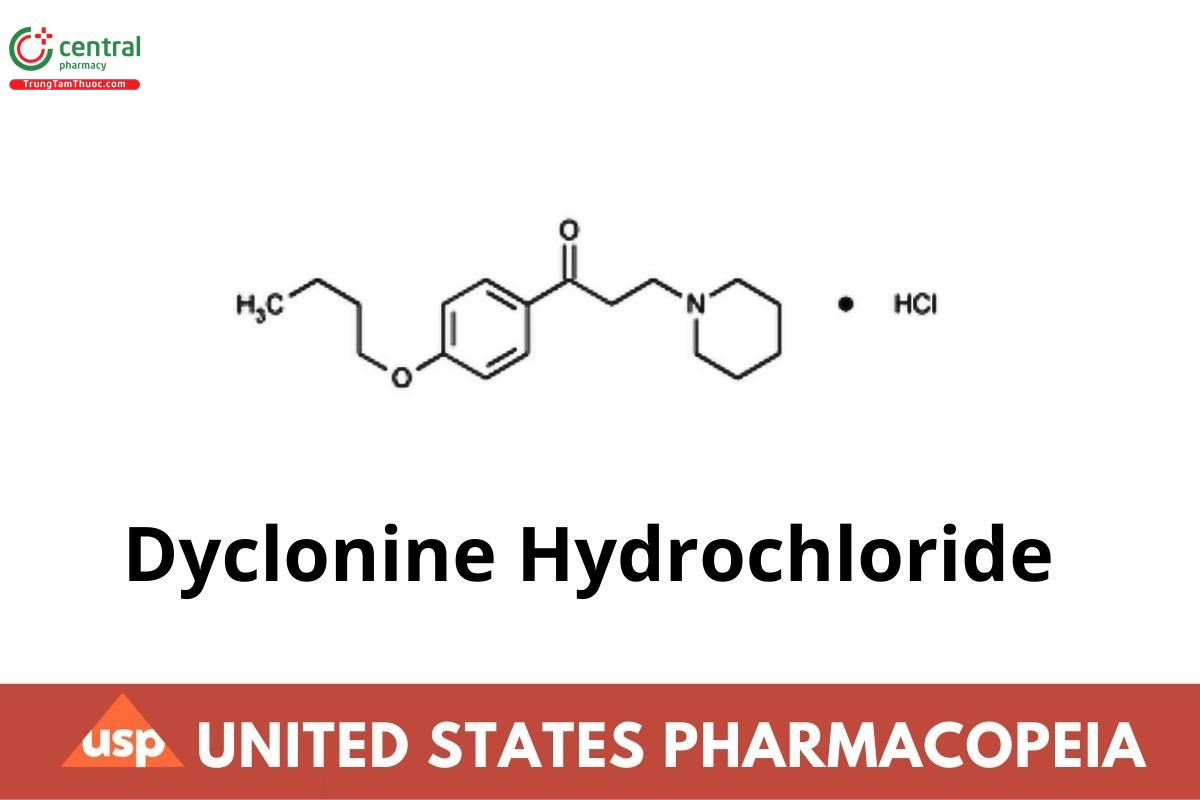

This article is compiled based on the United States Pharmacopeia (USP) – 2025 Edition
Issued and maintained by the United States Pharmacopeial Convention (USP)
1-Propanone, 1-(4-butoxyphenyl)-3-(1-piperidinyl)-hydro chloride.
4′-Butoxy-3-piperidinopropiophenone hydrochloride CAS RN®: 536-43-6; UNII: ZEC193879Q.
Dyclonine Hydrochloride contains not less than 98.0 percent and not more than 102.0 percent of C18H27NO2 · HCl calculated on the dried basis.
Packaging and storage— Preserve in tight, light-resistant containers.
USP REFERENCE STANDARDS (11)
USP Dicionine thotroctionide RS
Identification—
Change to read:
A:Spectroscopic Identification Tests (197). Infrared Spectroscopy: 197M (CN 1-May-2020)
B: The retention time of the major peak in the chromatogram of the Assay preparation corresponds to that in the chromatogram of the Standard preparation, as obtained in the Assay.
C: Add 2 mL of silver nitrate TS to 10 ml of Dycionine Hydrochloride solution (1 in 100): a white precipitate is formed. Add 2 ml of nitric acid, centrifuge, and discard the supernatant. Wash the precipitate twice by adding 10 mL of 2N nitric acid, centrifuging, and discarding the supematant: the precipitate so obtained is soluble in 6 N ammonium hydroxide.
MELTING RANGE (741); between 173° and 178°.
PH (791); between 4.0 and 7.0, in a solution (1 in 100).
LOSS ON DRYING (731) Dry it at 105°for 1 hour: it loses not more than 1.0% of its weight.
RESIDUE ON IGNITION (281): not more than 0.2%
Assay—
Mobile phase, Standard preparation, and Chromatographic system-Proceed as directed in the Assay under Dyclonine Hydrochloride Gel.
Assay preparation-Transfer about 50 mg of Dyclonine Hydrochloride, accurately weighed, to a 500-mL volumetric flask, dissolve in 0.001 N phosphoric acid, dilute with 0.001 N phosphoric acid to volume, and mix,
Procedure-Separately inject equal volumes (about 20 µL) of the Standard preparation and the Assay preparation into the chromatograph, record the chromatograms, and measure the responses for the major peaks. Calculate the quantity, in mg, of C18H27NO2 · HCl in the portion of
Dyclonine Hydrochloride taken by the formula:
500C(rU/(rS)
in which C is the concentration, in mg per ml, of LISP Dyclonine Hydrochloride RS in the Standard preparation; and rU and rS are the peak responses obtained from the Assay preparation and the Standard preparation, respectively.

